English
 Español
 Français
 عربى
عربى italiano
On a busy arterial road, a driver veers off the lane and hits a light pole. In a fixed-base installation, the pole stops the vehicle abruptly, creating severe occupant impact. With a breakaway base, the pole separates near ground level and pivots away, giving the vehicle a much slower deceleration. Breakaway bases exist to turn a rigid roadside object into a predictable energy-absorbing system. This article explains how these bases work, what standards govern them, how to choose and install them, and why they are a key part of modern roadway lighting.
Content
- 1 What Is a Breakaway Base for a Light Pole?
- 2 Standards and Specifications Governing Breakaway Bases
- 3 How a Breakaway Base Works: Design and Components
- 4 Key Factors in Choosing a Breakaway Base for Your Light Pole
- 5 Installation, Inspection, and Replacement Best Practices
- 6 Conclusion: Build Safety into the Complete System
What Is a Breakaway Base for a Light Pole?
A breakaway base is a frangible or hinged device mounted between the pole shaft and its foundation. It is designed to break, bend, or shear when struck by a vehicle, so that the pole does not remain a rigid barrier. Common materials include cast aluminum, ductile iron, and steel with weakened sections. The base typically has one or more shear plates or bolt patterns that control where and how it gives way. Because the base is the weakest link by design, the rest of the pole can remain relatively strong for wind and ice loads. This is why breakaway bases are widely used on highway and street lighting systems.
Average Peak Occupant Impact Force by Base Type
Illustrative values based on typical comparative crash test trends.
The chart above shows why breakaway bases are specified for high-speed roads. A fixed base transfers almost the entire kinetic energy of the vehicle into the passengers in a very short time. A breakaway base reduces the peak occupant impact force by roughly two-thirds in this example. The difference in magnitude is significant enough to change the outcome of a crash from fatal to survivable. Engineers use these comparative values when evaluating roadside hardware in crash tests. That is why many highway departments exclude fixed bases from unshielded clear zones.
Standards and Specifications Governing Breakaway Bases
Roadside safety hardware is not designed by guesswork. In the United States, the Federal Highway Administration (FHWA) requires that breakaway supports meet nationally accepted crash test criteria. The lineage of these standards runs from the 1985 AASHTO specifications through NCHRP Report 350 to the current Manual for Assessing Safety Hardware (MASH). Each update tightened the test conditions and occupant risk criteria. The table below summarizes the most commonly referenced documents.
| Standard | Test Context | Key Focus |
|---|---|---|
| AASHTO 1985 | 35 mph (56 km/h) | Maximum velocity change of about 15 ft/s |
| NCHRP 350 | Multiple test levels up to 100 km/h | Occupant impact velocity and ridedown acceleration |
| MASH 2016 | Multiple test levels up to 100 km/h | Stricter vehicle trajectory and compatibility requirements |
Breakaway Support Test Speeds by AASHTO Test Level
Speeds are in kilometers per hour.
The column chart displays the typical test speeds associated with three AASHTO test levels. Test Level 1 represents low-speed roads, while Test Level 3 covers highways and freeways. A breakaway base that passes Test Level 3 has proven its ability to protect occupants at 100 km/h. Because public roads contain many different speed limits, agencies choose the test level that matches the site. In practice, most breakaway light pole bases are specified to meet Test Level 3 for major roads. This is why the 100 km/h value appears repeatedly in modern procurement documents.
How a Breakaway Base Works: Design and Components
Inside a typical breakaway base, the key elements are the shear plane, the hinge, and the anchor bolts. When a vehicle hits the pole, the shear plane fractures first, and the pole rotates about a hinge or a hinge-like deformable zone. The energy is dissipated as the metal bends and the pole tip scrapes along the ground. This controlled motion creates a longer stopping distance for the vehicle and a lower angular velocity for the pole. The design must balance two requirements: it must release reliably during a collision, yet remain stiff enough to carry the pole and luminaire in normal wind and icing conditions.
Vehicle Speed During a Pole Impact Event
Schematic speed profile for a frontal impact into a light pole support.
The graph shows two different deceleration profiles. The fixed base causes an almost immediate stop, while the breakaway version extends the event over roughly 200 milliseconds. As a result, the occupant ride-down acceleration stays within a more survivable range. This is why many agencies require breakaway bases on unshielded poles within clear zones. It also explains why the base cannot be replaced with a solid transformer base or a concrete collar, because those would defeat the frangible feature. In more detail, the AASHTO standard considers both the occupant impact velocity and the ridedown acceleration, not just the total time.
Key Factors in Choosing a Breakaway Base for Your Light Pole
Selecting a breakaway base requires matching the base to the pole shaft, the foundation, and the intended site conditions. You need to check the pole diameter, wall thickness, and base plate pattern to ensure the shear bolts align. You also need to know the wind load rating for the installation, because the breakaway feature must not compromise structural performance under normal loads. For coastal or corrosive environments, specify a base with a durable coating or aluminum construction that will not seize over time. Site speed limits, clear zone distances, and agency policies will tell you which test level your base must meet. It is also wise to verify that the base manufacturer provides replacement shear bolts and spare parts for maintenance.
 BERMUDA Conical Aluminum Roadway Light Pole with Breakaway Base CompatibilityThis aluminum 6063-T6 pole offers a satin brushed or anodized finish, with a bottom diameter of 152-178mm. Its conical design suits roadway installations where a matching breakaway base is required for safety.View Product →
Comparison of Base Types by Key Criteria
Ratings are qualitative and intended for comparative understanding.
The radar chart compares three base types across five performance criteria. Breakaway bases score highest on safety because they are purpose-built for crash energy management. They also offer reasonable cost and maintenance characteristics without the very high structural stiffness of a fixed base. Slip bases perform similarly on safety but can be more sensitive to vertical misalignment during installation. Fixed bases excel in structural strength and low cost, but their safety rating is poor. That is why the choice often comes down to a tradeoff between crash safety and stiffness. A well-designed breakaway base gives you most of the structural performance you need while eliminating the biggest safety risk.
Installation, Inspection, and Replacement Best Practices
Even the best breakaway base will not perform unless it is installed and maintained correctly. One common mistake is to set the anchor bolts in a large concrete haunch around the base, which stiffens the connection and eliminates the breakaway action. Another is to use galvanized bolts where stainless steel is specified, leading to corrosion and seizing. Torque values must be confirmed with the manufacturer and checked periodically. Agencies should also keep records of the base model and torque specifications for every pole location.
- Verify anchor bolt protrusion and leveling before grouting.
- Do not encase the base in concrete above grade.
- Use only factory-approved shear bolts and washers.
- Inspect after any vehicle impact and at least annually.
- Replace deformed plates and torque-lost bolts immediately.
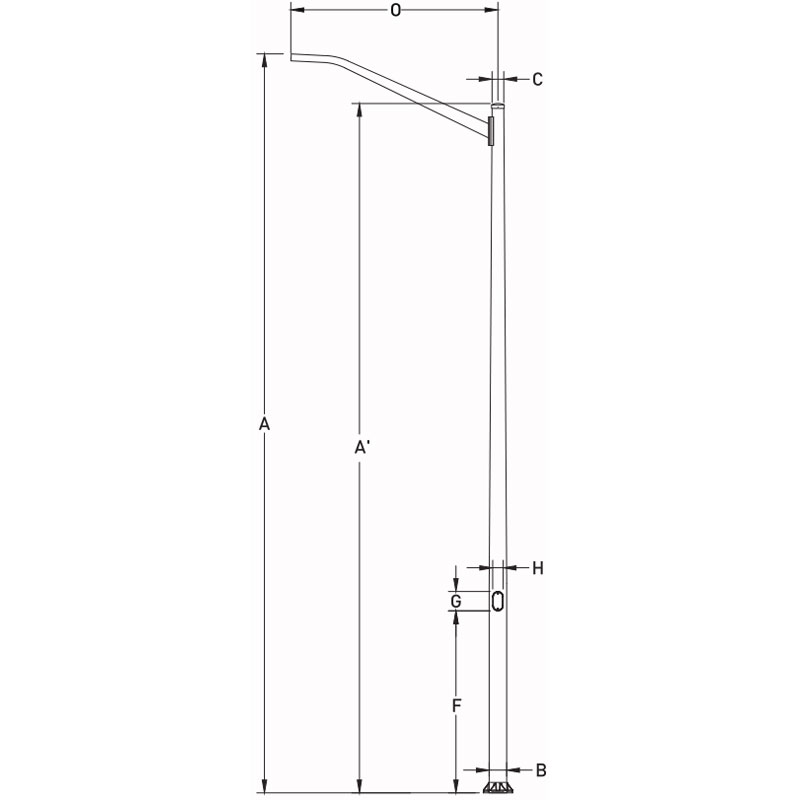 20ft-40ft Aluminum Conical Light Pole with Cast Base FlangeExtruded AL6063 shaft with full-length T6 heat treatment, cast A356-T6 base flange, and reinforced hand hole. Ideal for applications needing a reliable mounting base with proper torque and corrosion resistance.View Product →
Some agencies replace bases every few years as preventive maintenance, but damage, cracking, or corrosion should trigger instant replacement. If a pole has been hit, even if it looks straight, the base may have fatigued. Reuse of the base without replacing the shear pin design is not recommended. The safest policy is to carry spare bases and bolts in every maintenance depot. Regular inspection schedules help catch loose bolts before they become a safety problem. Remember that a breakaway base is a sacrificial component by design; it is meant to be deformed only during a crash and then replaced.
Conclusion: Build Safety into the Complete System
Breakaway bases are not an optional accessory on high-speed roadways; they are a critical safety component that protects lives. Whether you are a municipal engineer, installer, or contractor, you should treat the base as part of an engineered system that includes the pole, foundation, anchor bolts, and luminaire. When you need a pole that works seamlessly with breakaway hardware, a manufacturer with a broad range of tested products makes the job easier. Morelux has manufactured lighting poles and structural components for more than 20 years, exporting to over 30 countries. You can see the full range of lighting poles or contact our engineering team for a specific recommendation on poles and bases.