English
 Español
 Français
 عربى
عربى italiano
A common outdoor court problem looks like this. Eight 500 W LED floodlights are mounted on 12 foot poles at the sidelines, and after dark the half court line disappears under shadow and every inbound pass creates a distracting glare. The fixtures are not the main issue. The design was never matched to the playing surface, the players' sight lines, or the ball flight zone.
The fastest way to design basketball court lighting correctly is to start from the intended use level, then work backwards to fixture brightness, aiming angle, uniformity, and pole height. A competitive municipal court and a small park court need completely different systems, even when they cover the same floor area. This guide explains the numbers behind those decisions and the practical sequence that avoids costly rework.
Content
- 1 What Standards Should Drive the Lighting Design?
- 2 Uniformity, Glare, and Color Quality
- 3 Why Has LED Replaced Metal Halide on New Courts?
- 4 Matching the Light Pole to the Court Design
- 5 Lumen Depreciation, Maintenance, and Total Cost of Ownership
- 6 Layout and Aiming Sequence
- 7 Final Specification Checklist
What Standards Should Drive the Lighting Design?
Illuminance is the amount of light arriving at the court surface, expressed in lux. Sports federations and lighting standards group basketball courts into five practical levels: recreational play, training, school and regional competition, domestic league play with occasional video, and international broadcast events. The higher the level, the more horizontal light the design must deliver and the tighter the tolerances become.
| Use Level | Maintained Horizontal Illuminance (lux) | Typical Venue |
|---|---|---|
| Recreational play | 150 to 200 | Parks, residential community courts |
| Training and practice | 300 | School gyms, club practice sessions |
| School and regional matches | 500 | High school leagues, municipal tournaments |
| Domestic league with video | 750 | Professional club courts, college events |
| International and broadcast events | 1000 to 2000 | Arenas, televised championships |
The horizontal bar chart compares the maintained illuminance targets for five basketball use levels. A 150 lux recreational court is workable for free shooting, but it is too dark for quick lateral movements on the painted lanes. Training courts at 300 lux give coaches enough visual detail to correct footwork and passing angles. School matches enter a different performance window at 500 lux, where player recognition and depth perception become noticeably stronger. League clubs and broadcast venues push into the 750 to 1500 lux range because camera sensors and audiences need the same visual information as the referee. The key term here is maintained illuminance, which already includes a maintenance factor for dust, lamp ageing, and temperature drift, so the design target must never be treated as an initial lamp output.
Uniformity, Glare, and Color Quality
A high lux average does not automatically produce a usable court. Uniformity is what removes dark zones. For basketball, the accepted design ratios are a minimum to average ratio of about 0.6 and a minimum to maximum ratio of at least 0.5. When uniformity drops below these figures, players lose track of the ball against a dark background and the three point arc becomes hard to identify in transition.
Glare control is the second quality factor. The protective angle of each fixture should keep the direct lamp image at least 30 degrees above the players' sight line. On an outdoor court, this is achieved with tall poles and asymmetric reflectors that aim light toward the game area instead of the fence. Indoors, the mounting height and luminaire tilt angle must be coordinated so that the last row of the audience is not looking into the source.
Color quality also influences performance. A neutral white source of 4000K to 5000K is a comfortable match for basketball, because it preserves depth perception without the yellow tint of old floodlights. The color rendering index should be at least 70 for general play and 90 for televised games, since players rely on the contrast between jerseys, skin tones, and the ball surface to make split second decisions.
The radar diagram places LED and metal halide systems on the same six scales, which makes the practical difference visible at once. The red polygon, representing LED, reaches the outer ring on energy efficiency, instant start, dimming, lifespan, and optical control, while color rendering sits one step below maximum. The grey polygon, representing metal halide, scores reasonably on color reproduction but collapses on restart behavior, dimming, and optics. This shape difference is the reason a metal halide floodlight needs a heavy reflector and a high mounting position, while an LED fixture can be aimed and dimmed with much finer control. The instant start point also matters in real play: after a power dip at a televised match, LED restores full brightness in milliseconds. These six factors explain why most new court specifications now exclude metal halide unless the venue already carries a large legacy inventory.
Why Has LED Replaced Metal Halide on New Courts?
Metal halide served basketball courts for decades because it delivered high lumen output and acceptable color. The drawback is optical efficiency. A metal halide lamp emits light in every direction, so a large reflector is needed to push the beam downward, and a substantial part of the output is still lost beyond the court boundaries. LED fixtures use individual lenses to concentrate light into an asymmetric beam that matches the court shape, which reduces the connected load by roughly half for the same illuminance target.
The two columns show the total connected load needed to hold roughly 500 lux over a 32 by 19 m outdoor court. The LED system draws about 3.5 kW because its optical lenses put the light only where the court surface and the vertical plane above it need light. The metal halide system draws about 7 kW, not because the lamp is less bright, but because most of its 360 degree output is redirected by a reflector and lost to adjacent zones. At 1500 operating hours per season, the difference becomes 5250 kWh versus 10,500 kWh of annual energy consumption. At a commercial tariff of USD 0.15 per kWh, an LED conversion saves roughly USD 780 per year on electricity alone. The further savings from avoided lamp replacement and reduced cooling load in the electrical cabinet are separate budget wins.
Matching the Light Pole to the Court Design
For outdoor basketball, pole height matters as much as fixture output. A typical recommendation is 9 m to 14 m, with the pole base set at least 2 m behind the sideline. The taller the pole, the wider the beam can spread; the shorter the pole, the sharper the shadows. Most recreation courts use four poles, two on each side, aimed toward the painted area and not beyond the sideline.
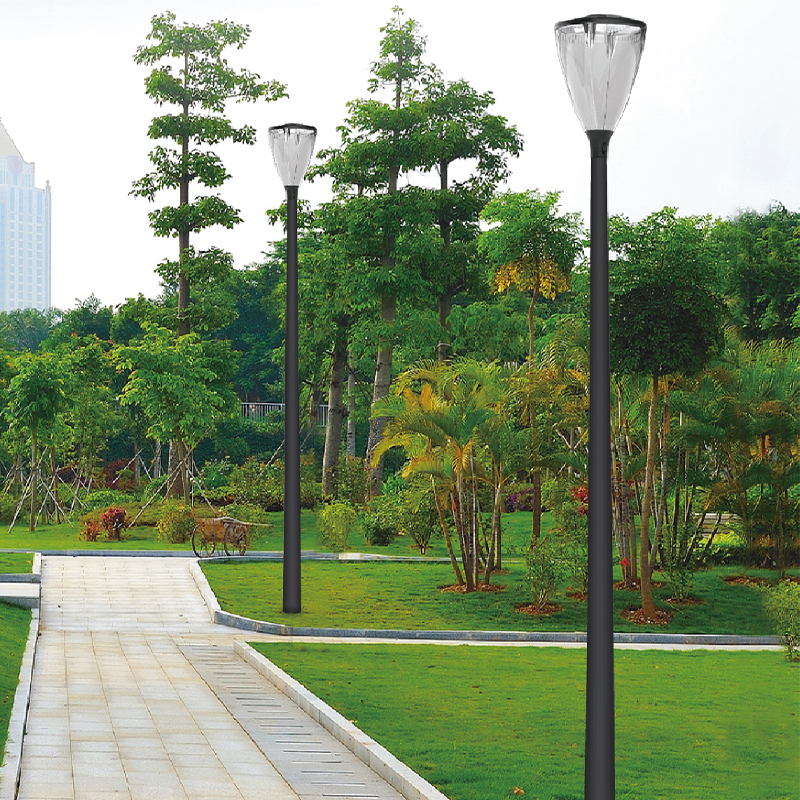
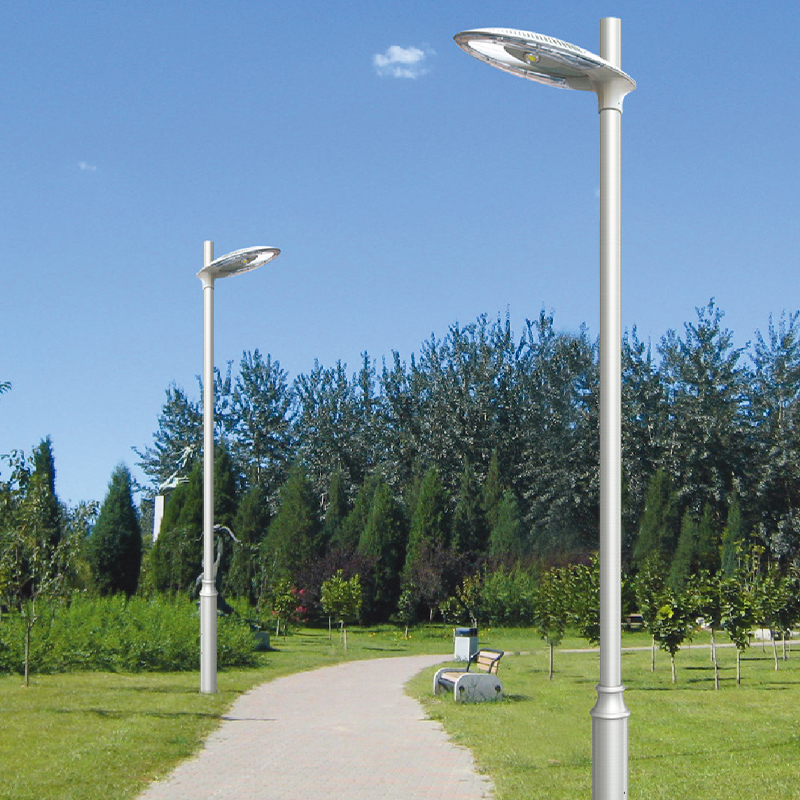
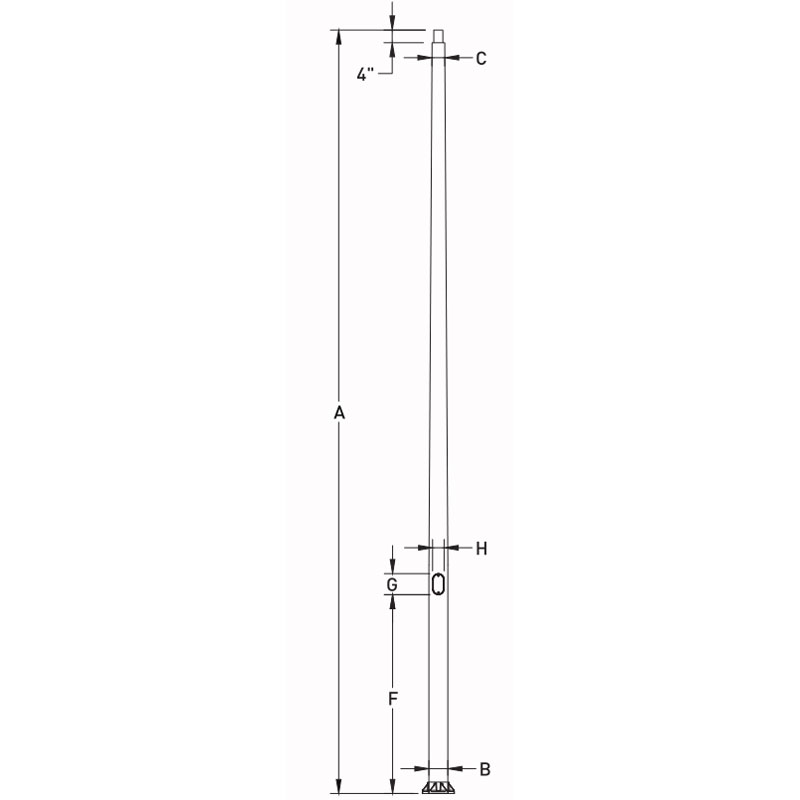 Aluminum Conical Light Pole with Flange Base, 10-40 ftThis aluminum conical pole is corrosion-resistant and lighter than steel, making it a practical choice for coastal courts and community parks. Its flange-mounted base suits pre-cast foundations where precise vertical alignment is required.View Product →
Aluminum poles are corrosion resistant and lighter to handle, which makes them a sensible choice for coastal schools and community parks. Steel poles offer higher stiffness for sites with strong wind or for poles carrying a heavier lighting bracket. If the court must meet a competition standard, the pole should be specified with the same wind load calculation used for street lighting in the local area. The complete range of light poles covers both aluminum and steel versions, so the structural choice can be made after the photometric layout is finished. A flange mounted base is preferred when the foundation is cast in advance and the pole must stand perfectly plumb, while a direct burial style reduces material cost for smaller recreational projects.
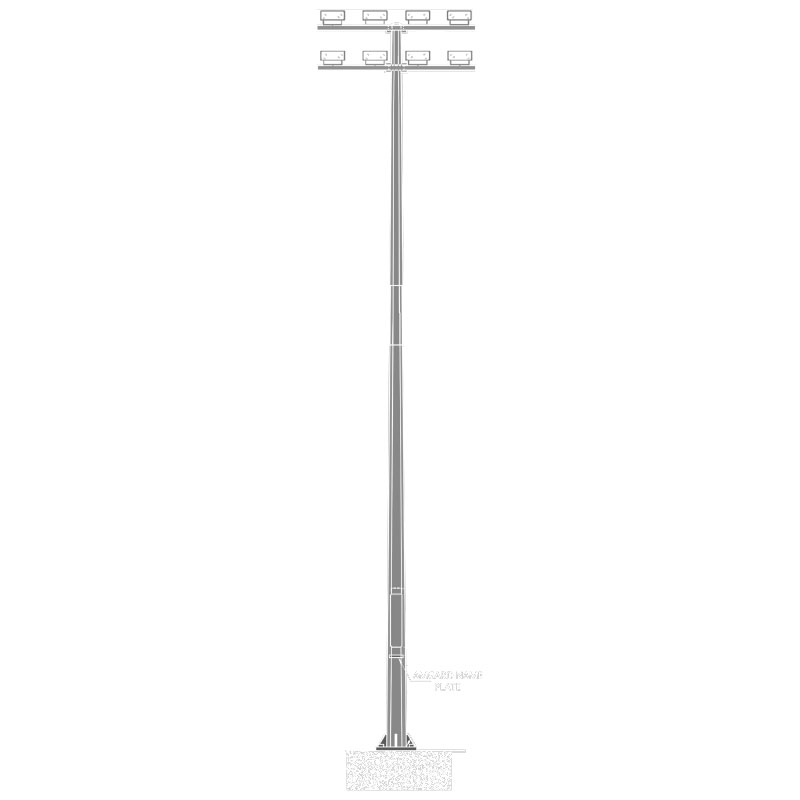 Steel Floodlight Pole for Stadium and Area LightingDesigned for mounting high-intensity floodlights on large sites, this steel pole offers higher stiffness for strong wind conditions or heavier brackets. Available in conical, cylindrical, and octagonal shapes with heights from 3 to 20 meters.View Product →
Lumen Depreciation, Maintenance, and Total Cost of Ownership
The initial lux reading on the court does not tell the full story. Every light source loses output as it ages, and the rate of loss determines when the facility will fall below the design standard. Metal halide lamps also require cooling downtime before replacement, which forces a court to close during a maintenance window. LED modules operated at a conservative current retain their useful output for many seasons, so the owner recovers the higher initial investment through lower energy bills and fewer service calls.
The lumen maintenance curves show why an identical lux reading after one year of operation does not stay identical over time. The grey dashed line represents metal halide, whose light output falls quickly to about 65 percent after only 3000 hours and below 50 percent by 5000 hours. The solid red line represents a quality LED module, which typically retains over 90 percent of its initial output after 8000 hours. For a court designed at 500 lux, this means the metal halide installation will practically operate at 325 lux around the 3000 hour mark, well below the level expected by players. The LED installation will still be near 480 lux at the same point. Replacing metal halide lamps also interrupts the season, because the operator must close the court, hire a scissor lift, and wait for the lamps to cool and restart. The maintenance advantage of LED is therefore not only a lighting benefit, it is a schedule benefit that affects facility availability.
Layout and Aiming Sequence
A practical layout for a standard full court starts with four poles positioned along the two sidelines, outside the playing boundary. The fixtures should be aimed so that the main beam hits the center of the court and the cut off line stops before the opposite sideline. A common mistake is to aim the floodlights along the baseline, which creates high vertical glare for players inbounding the ball.
The aiming angle measured from the vertical should not exceed 70 degrees. Beyond that limit, the beam skims across the court and produces long shadows under players. For broadcast matches, the design must also consider vertical illuminance on a plane about 1.5 m above the floor, because that is the height where the camera sees players and the ball. A good sequence is to set the lux target, check the uniformity ratio, choose the beam angle, place the poles, and only then select the exact fixture model. Requesting an IES photometric file from the luminaire supplier and running a simple simulation removes most of the uncertainty before installation begins.
Final Specification Checklist
- Confirm the target maintained lux level and the court dimensions before any fixture is selected.
- Check the uniformity ratio and ask for a photometric report that covers the full court.
- Select a neutral color temperature of 4000K to 5000K and a CRI of at least 70 for general use.
- Verify that the fixture approach angle keeps direct lamp image at least 30 degrees above the players' sight line.
- Choose an IP65 rated luminaire to protect against dust, rain, and insects on outdoor courts.
- Match the pole material, height, arm type, and mounting method to the wind load and planned fixture weight.
- Keep a minimum clearance between the pole base and the court sideline so the structure does not interfere with play.
- Request an IES file and a simulation report before approving the final equipment list.
A court lighting specification is only complete when it lists the lux target, the uniformity ratio, the glare protection angle, the color temperature, the IP rating, the pole mounting method, and the photometric report. Any supplier that cannot provide an IES file for the proposed fixture should be treated with caution. The same design principle applies whether the court is 20 m long or 80 m long: light the play area, not the perimeter, and keep the glare angle out of the players' sight lines. If you are planning a court upgrade and need help translating these numbers into a pole specification, describe your court size and target lux level to our technical team and we will review the layout with you. We can advise on pole height, arm type, mounting bracket, and the combination that keeps the lighting uniform and easy to maintain over the life of the installation.