English
 Español
 Français
 عربى
عربى italiano
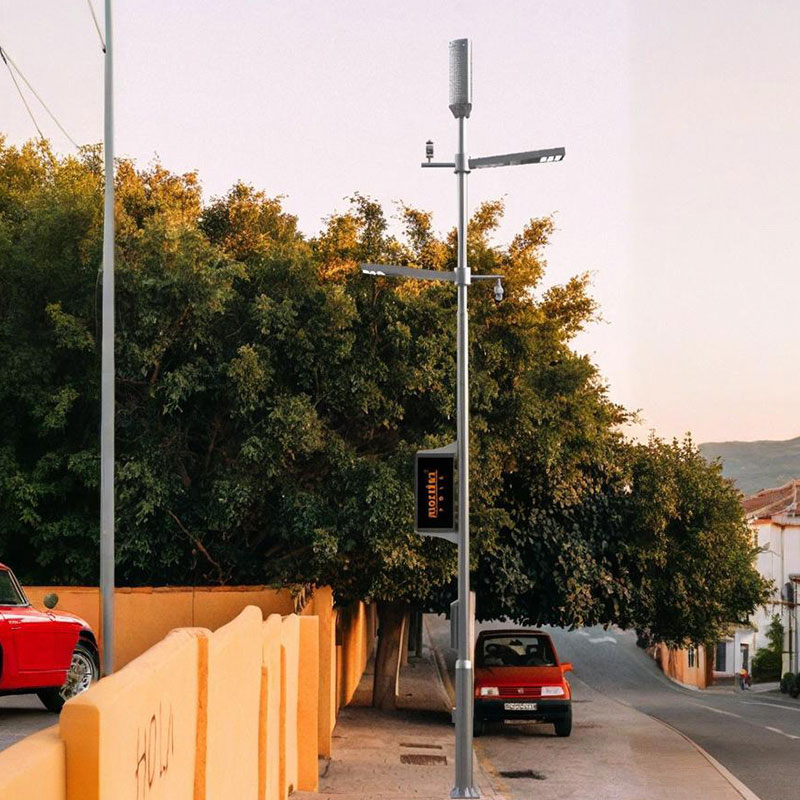
A smart light pole works by integrating multiple sensing, communication, and management technologies into a single urban infrastructure unit. Rather than simply illuminating streets, it functions as a connected node in a smart city network — collecting environmental data, broadcasting information, enabling surveillance, providing wireless connectivity, and supporting EV charging, all managed remotely through a unified software platform. At its core, a smart light pole bridges the physical and digital layers of a city, turning passive streetlights into active data endpoints.
As a leading Wholesale Smart Light Pole Manufacturer and OEM/ODM Smart Light Pole Company, Morelux has been engineering advanced aluminum lamp pole solutions for global customers since 2000. Every pole we produce combines precise mechanical design with cutting-edge smart technology — built to illuminate not just streets, but the future of urban life.
Content
- 1 The Four-Layer Architecture Behind a Smart Light Pole
- 2 Smart Lighting Control: From Manual Switches to Remote Precision Management
- 3 Integrated 5G and Wireless Connectivity
- 4 Environmental Monitoring: What Sensors Does a Smart Pole Carry?
- 5 HD Video Surveillance and Public Safety Features
- 6 Multimedia Information Display and Public Communication
- 7 EV Charging Integration and Mobility Services
- 8 Vehicle-Road Collaboration and Intelligent Traffic Systems
- 9 How All Functions Are Managed: The Smart Pole Control Platform
- 10 Smart Light Poles as the Backbone of New Urban Infrastructure
The Four-Layer Architecture Behind a Smart Light Pole
Understanding how a smart light pole works starts with its platform architecture. Morelux smart light poles are built on a four-layer system that organizes every function from physical sensing to end-user application:
| Layer | Name | Primary Role | Example Components |
|---|---|---|---|
| 1 | Device Perception Layer | Sensing and input | Environmental sensors, cameras, alarms |
| 2 | Network Communication Layer | Data transmission | 5G modules, Wi-Fi AP, fiber backhaul |
| 3 | Data Aggregation Layer | Processing and storage | Edge computing units, cloud servers |
| 4 | System Application Layer | User-facing control and services | Web dashboards, mobile apps, APIs |
These four layers work together seamlessly. Sensors and cameras at the base collect raw data (Layer 1), which is transmitted via 5G or Wi-Fi (Layer 2), aggregated and processed at edge nodes or the cloud (Layer 3), and finally made accessible to city managers and residents through software applications (Layer 4). This architecture allows a single pole to serve dozens of urban functions simultaneously without requiring separate infrastructure for each service.
Smart Lighting Control: From Manual Switches to Remote Precision Management
The most foundational function of any street light pole is illumination — and smart poles transform this completely. Traditional streetlights operate on fixed timers or basic photocells. Smart light poles, by contrast, enable granular, real-time, remote control of every individual fixture.
Through PC-based or mobile management software, operators can:
- Remotely turn individual lights on or off from any location
- Adjust dimming levels in real time to match traffic density or ambient light conditions
- Set automated timed tasks (e.g., 30% brightness at 2 AM, 100% during peak evening hours)
- Monitor energy consumption per pole and generate usage reports
- Receive fault alerts automatically when a lamp fails or a circuit drops
This refined management capability can reduce urban lighting energy consumption by 40–70% compared to conventional fixed-schedule systems, while also cutting maintenance costs by enabling proactive fault detection rather than reactive repair cycles.
Power for all smart functions is drawn through existing street light wiring — eliminating the need for costly separate cable installations. The smart controller mounted inside or at the base of the pole handles all communication between the lamp, the sensors, and the central platform.
Integrated 5G and Wireless Connectivity
One of the most strategically important capabilities of a smart light pole is its role as a wireless communication node. Because lamp poles are already evenly distributed across urban areas at heights of 6–12 meters, they are ideal mounting platforms for wireless antennas and access points.
5G Small Cell Integration
5G networks depend on dense deployments of small cells to achieve their advertised speeds and low latency. Morelux smart poles are designed to accommodate 5G radio units directly within their structure, providing the backhaul connectivity and weatherproof housing these units require. A city that deploys smart poles across its road network effectively builds a 5G infrastructure backbone at the same time.
Public Wi-Fi Hotspots
By integrating Wi-Fi AP (Access Point) hotspot devices, each smart pole broadcasts a public wireless signal accessible to pedestrians and vehicles within range. In practice, a grid of smart poles spaced 50–80 meters apart can create seamless outdoor Wi-Fi coverage across entire districts — parks, shopping streets, transit corridors, and public squares — without requiring separate hotspot infrastructure.
Both 5G and Wi-Fi connectivity also serve as the backbone through which all other pole functions — sensors, cameras, displays — transmit their data to the city management platform in real time.
Environmental Monitoring: What Sensors Does a Smart Pole Carry?
Smart light poles serve as distributed urban weather and environmental stations. Morelux poles come equipped with built-in multi-parameter meteorological sensor arrays capable of monitoring a comprehensive set of environmental indicators simultaneously:
- Air temperature and humidity — real-time thermal comfort and condensation risk data
- Wind speed and direction — critical for storm early warning systems and structural load monitoring
- Rainfall intensity — enables drainage management and flood risk alerting
- UV intensity — useful for public health advisories in parks and outdoor venues
- Noise level — noise pollution mapping for urban planning and enforcement
- Light intensity (lux) — for automatic lighting adjustment and daylight tracking
- Air quality indicators (PM2.5, PM10, CO, NO₂, O₃) — available on expanded sensor configurations
Each sensor transmits readings continuously to the data aggregation platform. Because poles are distributed densely across an urban grid, their collective sensor data provides a high-resolution environmental map of the city — far more accurate than a small number of centralized weather stations. This data can feed city dashboards, public apps, municipal environmental reports, and emergency response systems.
HD Video Surveillance and Public Safety Features
Security is a central use case for smart light poles. Each Morelux pole integrates a built-in high-definition camera with infrared night vision, enabling 24-hour continuous monitoring of road surfaces, intersections, pedestrian areas, and public spaces. Footage is accessible remotely via mobile phone or PC-based management software with no need for on-site personnel.
Camera Capabilities
- Full HD (1080p or higher) daytime video with wide-angle coverage
- Infrared night vision for clear imagery in zero-light conditions
- AI-enabled functions such as crowd density detection, license plate recognition, and perimeter intrusion alerting on advanced configurations
- Cloud storage or edge storage integration for video archiving
One-Click Emergency Alarm
A critical public safety feature is the one-click alarm button integrated into the pole structure. When a person in distress presses it, an immediate alert is transmitted to the background management center, including the pole's GPS location. Staff can respond without the caller needing to describe their position — a major advantage in disorienting emergencies. Combined with the pole's integrated camera, operators can visually assess the situation before dispatching assistance.
Two-Way Broadcast Intercom
Built-in broadcast speakers allow operators to transmit audio remotely to any pole or group of poles across the city. This supports emergency announcements, crowd management, scheduled public information broadcasts, and two-way intercom communication between field personnel and a control center. The system can be triggered manually or scheduled automatically.
Multimedia Information Display and Public Communication
Smart poles frequently incorporate LED digital display screens that serve as dynamic urban communication channels. Unlike static signage, these screens can be updated remotely in real time from a central management platform, allowing cities and property managers to publish a wide variety of content:
- Real-time meteorological information sourced directly from the pole's own sensors
- Air quality index and public health advisories
- Property and park management notices for residential or commercial districts
- Emergency alerts and evacuation instructions during incidents
- Commercial advertising content, enabling revenue generation for municipalities or operators
- Public transport schedules, event information, and wayfinding content
Content management is handled through the System Application Layer, where authorized users can schedule, preview, and push content to individual poles or groups of poles across a city zone. This eliminates the cost and delay of physical signage updates and allows cities to respond to changing conditions instantly.
EV Charging Integration and Mobility Services
As electric vehicle adoption accelerates globally, smart light poles offer a ready-made solution for expanding urban EV charging infrastructure. Because poles are already connected to the power grid through existing street lighting circuits, adding a charging module requires minimal additional electrical work.
Morelux smart poles with integrated charging management support:
- Mobile phone charging reservation — users book a charging slot via a dedicated app before arriving
- Online payment — contactless or QR-code payment for charging sessions, with digital billing
- Remote PC-side management — operators monitor charger status, session logs, and energy usage from a central dashboard
- Fault detection and alerts — automatic notifications when a charging unit goes offline or registers an error
This turns every smart pole into a potential public charging point, dramatically reducing the density and cost barrier of EV infrastructure rollout. A city that deploys thousands of smart poles along its road network could simultaneously create a city-wide EV charging grid without constructing any dedicated charging stations.
Vehicle-Road Collaboration and Intelligent Traffic Systems
An emerging and increasingly important function of smart light poles is vehicle-road collaboration (V2X) — the ability of roadside infrastructure to communicate with connected and autonomous vehicles. Smart poles act as roadside units (RSUs) in V2X networks, broadcasting real-time data such as signal phase timing, road hazards, pedestrian presence, and weather conditions to approaching vehicles.
This supports:
- Advanced traffic signal coordination for smoother vehicle flow and reduced stop-start cycling
- Safety warnings transmitted directly to vehicle dashboards before drivers can see the hazard
- Support for autonomous vehicle navigation in complex urban intersections
- Real-time traffic density data fed to city traffic management centers for dynamic signal control
As autonomous vehicle technology matures, the role of smart poles as V2X nodes will become critical urban infrastructure — comparable in importance to traffic signals today. Cities that deploy smart poles now are building the foundation for next-generation mobility ecosystems.
How All Functions Are Managed: The Smart Pole Control Platform
All of the hardware capabilities described above would have limited value without a powerful, unified software platform to orchestrate them. The Morelux smart pole ecosystem includes a cloud-based remote management platform accessible via web browser on PC or as a mobile application on any smartphone.
From a single dashboard, authorized operators can:
- View the real-time status of every pole in the network on an interactive map
- Control lighting, display content, and broadcast audio across individual poles or geographic zones
- Review live and recorded camera footage
- Monitor environmental sensor readings across the city in real time
- Manage EV charging sessions and billing records
- Respond to alarm events and emergency alerts as they arrive
- Generate analytical reports on energy use, fault frequency, sensor trends, and service utilization
The platform supports role-based access control, meaning different departments (traffic, environment, public safety, utilities) can each access only the data and controls relevant to their responsibilities. APIs allow integration with third-party city operating systems, enabling smart pole data to feed directly into broader smart city platforms.
Smart Light Poles as the Backbone of New Urban Infrastructure
In the context of smart city development, the light pole has undergone a fundamental transformation. Where traditional poles served one purpose, modern smart poles serve as multi-functional urban service hubs — each one a convergence point for lighting, connectivity, safety, environment monitoring, mobility, and public communication.
The advantages of deploying smart poles as the carrier of this infrastructure are significant:
- Pre-existing grid coverage — street lights already span every road and public space in a city, eliminating site acquisition costs
- Pre-existing power supply — electrical connections are already in place at every pole position
- Optimal mounting height — 6–12 meter pole heights provide ideal line-of-sight for cameras, sensors, and antennas
- Consolidated infrastructure cost — one deployment serves 10+ functions, versus separate deployments for each service
- Scalable modular design — functions can be added or upgraded as city needs evolve without replacing the entire pole
Since its founding in 2000, Morelux has been at the forefront of this transformation — delivering aluminum smart pole solutions that combine structural durability with the full spectrum of smart city capabilities. From precise engineering design to complete system integration, every Morelux smart pole is built to serve as a dependable, long-life node in the urban intelligence networks of today and tomorrow.
As new infrastructure investment continues to accelerate globally, the smart light pole is no longer a peripheral upgrade — it is becoming a foundational requirement of any city that aims to manage its resources intelligently, serve its citizens effectively, and build the connectivity that future mobility and services will demand.