English
 Español
 Français
 عربى
عربى italiano
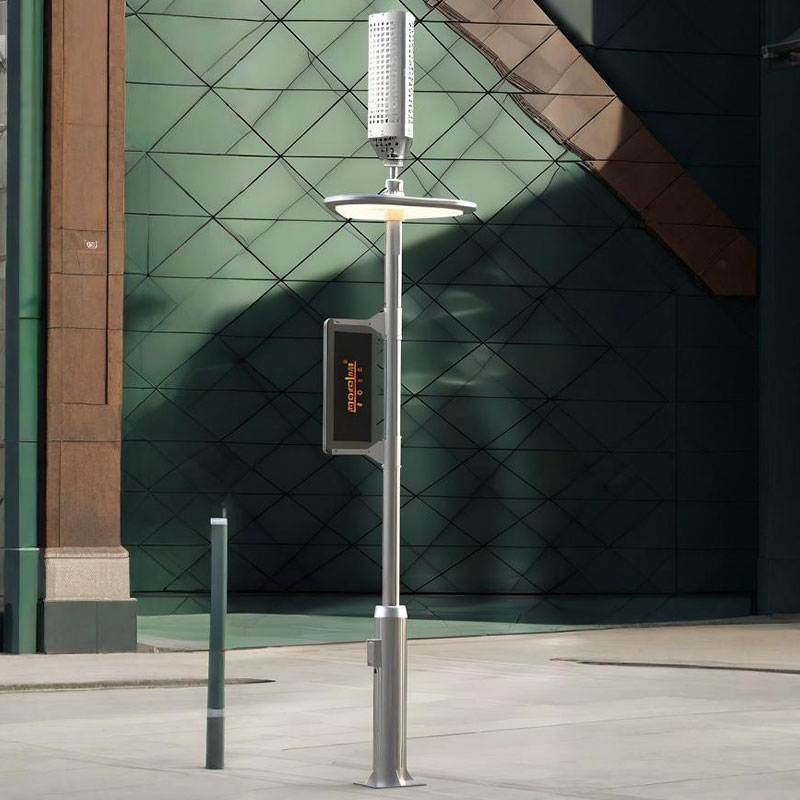
Smart street light poles offer substantial advantages over traditional street lights across every dimension that matters to modern cities: energy efficiency, operational cost, public safety, environmental monitoring, connectivity, and multi-function service delivery. While a traditional street light does one thing — illuminate a road on a fixed schedule — a smart street light pole integrates sensors, cameras, wireless communication, emergency systems, and data management into a single piece of infrastructure, turning every pole on every street into an active node in the city's intelligence network.
The gap between the two is not incremental. It is architectural. Traditional poles are passive fixtures. Smart poles are active platforms. Understanding the specific advantages in each area helps city planners, infrastructure managers, and communities make informed decisions about modernizing their street lighting systems.
Content
- 1 Side-by-Side Comparison: Smart Poles vs Traditional Street Lights
- 2 Energy Efficiency: Adaptive Lighting vs Fixed Consumption
- 3 Maintenance Cost Reduction Through Proactive Fault Detection
- 4 Public Safety Enhancement: Surveillance, Alarms, and Emergency Communication
- 5 5G and Wi-Fi Connectivity: Smart Poles as Urban Wireless Infrastructure
- 6 Environmental Monitoring at Urban Scale
- 7 Multimedia Information Display and Dynamic Public Communication
- 8 EV Charging Integration: Expanding Urban Mobility Without New Infrastructure
- 9 Vehicle-Road Collaboration and Intelligent Traffic Management
- 10 Infrastructure Consolidation: One Pole, Many Services
- 11 The Four-Layer Smart Platform Architecture That Makes It All Work
- 12 Morelux: Engineering Smart Poles for the Cities of Tomorrow
Side-by-Side Comparison: Smart Poles vs Traditional Street Lights
The following table summarizes the core differences across the most critical performance and capability areas:
| Feature / Capability | Traditional Street Light | Smart Street Light Pole |
|---|---|---|
| Lighting control | Fixed timer or basic photocell | Remote on/off/dim, timed tasks, mobile/PC control |
| Energy management | No adaptive control; full power always | Adaptive dimming; 40–70% energy savings possible |
| Fault detection | Manual inspection cycles required | Automatic real-time fault alerts to management platform |
| Video surveillance | Not available | Built-in HD camera with IR night vision, 24/7 remote access |
| Wireless connectivity | None | 5G small cell, Wi-Fi AP hotspot integration |
| Environmental sensing | None | Temperature, humidity, wind, rainfall, UV, noise, air quality |
| Emergency response | None | One-click alarm button with location-linked alerts |
| Public communication | None | LED display screens, broadcast speakers, remote intercom |
| EV charging support | None | Integrated charging pile management via existing power lines |
| Data generation | None | Continuous real-time data streams across all integrated sensors |
Energy Efficiency: Adaptive Lighting vs Fixed Consumption
Traditional street lights operate on a simple and wasteful principle: they turn on at dusk and off at dawn, running at full power regardless of whether anyone is on the road. A street that carries heavy traffic at 8 PM and is completely empty at 3 AM receives exactly the same lighting output. This inflexibility results in significant energy waste every night across millions of poles globally.
Smart street light poles solve this with adaptive, demand-responsive lighting control. Through remote management software accessible via PC or mobile phone, operators can:
- Dim lights to 30–50% output during low-traffic late-night hours
- Automatically return to full brightness when motion sensors detect a vehicle or pedestrian
- Program timed schedules tailored to the specific traffic patterns of each road segment
- Monitor per-pole energy consumption with granular data available in real time
Cities that have implemented smart adaptive lighting systems have documented energy savings of 40% to 70% compared to fixed-schedule traditional lighting. For a city with 100,000 street lights, this can translate to millions of kilowatt-hours saved annually — and a corresponding reduction in carbon emissions without any reduction in road safety or visibility.
Smart poles also pair naturally with LED light sources, which are already 50–70% more efficient than high-pressure sodium lamps commonly used in traditional poles. The combination of LED technology and smart adaptive control maximizes energy efficiency at both the hardware and operational levels simultaneously.
Maintenance Cost Reduction Through Proactive Fault Detection
One of the most significant hidden costs of traditional street lighting is maintenance. Because traditional poles have no self-reporting capability, cities rely entirely on reactive maintenance — a light fails, a resident reports it or an inspector notices it during a scheduled patrol, and then a crew is dispatched to repair it. The average failed lamp in a traditional system may remain unrepaired for days or even weeks before being identified.
Smart street light poles replace this reactive model with continuous proactive monitoring. Every pole transmits real-time status data to the central management platform. When a lamp fails, a circuit drops voltage, or a component malfunctions, an automatic alert is generated immediately — pinpointing the exact pole location on a city map. Maintenance crews receive precise dispatch instructions rather than generic patrol assignments.
The practical advantages of this approach include:
- Faster repair times — faults are identified in real time rather than discovered on manual inspection rounds that may happen weekly or monthly
- Reduced patrol labor — fewer person-hours spent physically inspecting poles across large geographic areas
- Predictive maintenance potential — historical performance data from each pole can be analyzed to identify patterns that precede failure, enabling replacement before breakdown
- Reduced liability exposure — a dark stretch of road is a safety and legal risk; immediate fault detection minimizes the window during which such conditions exist
Studies of smart lighting deployments have found that operational maintenance costs can be reduced by 30–50% when proactive monitoring replaces traditional manual inspection regimes.
Public Safety Enhancement: Surveillance, Alarms, and Emergency Communication
Traditional street lights contribute to safety only passively, through illumination. Smart poles actively support public safety through an integrated suite of hardware and communication tools that traditional infrastructure simply cannot provide.
Built-In HD Video Surveillance
Each smart pole is equipped with a built-in high-definition camera capable of monitoring road and pedestrian environments continuously, 24 hours a day. Infrared night vision ensures clear imagery even in zero ambient light conditions. Camera footage is accessible remotely via mobile phone or PC by authorized personnel — eliminating the need for dedicated camera poles or separate CCTV infrastructure. Advanced configurations support AI-enabled functions such as license plate recognition, crowd density analysis, and perimeter intrusion detection.
One-Click Emergency Alarm
Smart poles include an integrated one-click alarm button accessible to members of the public. When pressed, the system immediately transmits an alert to the central management platform along with the precise GPS-located pole address. Operators can dispatch assistance directly to the correct location without requiring the caller to navigate or describe their surroundings — a critical advantage in disorienting emergencies such as accidents, medical events, or criminal incidents. The pole's camera simultaneously provides a live visual feed of the situation to responding staff.
Two-Way Audio Broadcast and Intercom
A built-in broadcast speaker allows the management center to transmit audio remotely to any individual pole or group of poles across a city zone. This enables emergency announcements during incidents, crowd management instructions during events, routine public information broadcasts, and real-time two-way intercom communication between field personnel and a control center. No separate PA or intercom infrastructure is required — the smart pole handles all of it.
5G and Wi-Fi Connectivity: Smart Poles as Urban Wireless Infrastructure
Traditional street light poles are structurally well-positioned for wireless antenna deployment — they are evenly distributed across every road in a city, reach heights of 6–12 meters providing excellent line-of-sight coverage, and already have power connections at every location. Yet traditional poles provide none of this wireless capability. Smart poles exploit this structural advantage fully.
5G Small Cell Hosting
5G networks require dense deployments of small cell radio units to deliver their characteristic high bandwidth and low latency performance. Smart light poles are purpose-designed to accommodate 5G radio units within their structure, providing the weatherproof housing, power supply, and fiber or cable backhaul connectivity these units require. A citywide smart pole rollout simultaneously creates the 5G small cell network density needed for full urban 5G coverage — eliminating the need to negotiate separate mounting agreements and power connections for thousands of individual antenna sites.
Public Wi-Fi Coverage
By integrating Wi-Fi AP (Access Point) hotspot devices, smart poles broadcast public wireless internet access to pedestrians and vehicles within range. A grid of poles spaced 50–80 meters apart provides seamless outdoor Wi-Fi coverage across entire districts — parks, commercial streets, transit corridors, public squares, and residential neighborhoods — without any dedicated hotspot infrastructure. Residents and visitors can connect simply by joining the network, improving digital equity and urban liveability in public spaces.
Critically, the 5G and Wi-Fi infrastructure hosted by smart poles also serves as the communication backbone for all other pole functions — sensors, cameras, displays, and alarms — transmitting their data streams to the city management platform in real time.
Environmental Monitoring at Urban Scale
Traditional street lights collect no environmental data whatsoever. Smart poles, by contrast, function as distributed urban sensing stations — each one simultaneously monitoring a comprehensive set of environmental parameters and uploading data continuously to the city platform.
The built-in meteorological sensor array on smart poles typically measures:
- Air temperature and relative humidity — thermal comfort data and condensation risk monitoring
- Wind speed and direction — structural load monitoring and storm early warning
- Rainfall intensity — drainage management and flood risk alerting
- UV radiation intensity — public health advisories for outdoor spaces
- Ambient noise level — noise pollution mapping to support urban planning and enforcement
- Ambient light intensity (lux) — for automatic lighting adjustments and daylight tracking
- Air quality indicators (PM2.5, PM10, CO, NO₂, O₃) — available in expanded sensor configurations
Because smart poles are deployed across the full urban road network, their combined sensor readings create a high-resolution environmental map of the entire city — something impossible to achieve with a small number of centralized monitoring stations. This data feeds city dashboards, public environmental apps, municipal reporting systems, emergency services, and long-term urban planning analysis. Traditional street lights contribute nothing to this picture.
Multimedia Information Display and Dynamic Public Communication
Traditional street lights are silent. They provide no channel for communicating with the public, publishing information, or disseminating alerts. Smart poles address this gap with integrated LED digital display screens that function as dynamic, remotely managed urban communication points.
Content on these screens can be updated remotely in real time from the central platform, allowing authorized operators to publish:
- Real-time weather and air quality information sourced directly from the pole's own sensors
- Emergency alerts and evacuation instructions during incidents or natural disasters
- Property management notices and community announcements for residential districts
- Public transport schedules, wayfinding, and event information
- Commercial advertising, creating a revenue stream that can offset infrastructure costs for municipalities
The ability to instantly update display content across thousands of poles simultaneously means that cities can respond to evolving situations — road closures, weather events, public health alerts — in minutes rather than days required to update physical signage. This is an operational capability gap between smart and traditional infrastructure that has no parallel equivalent.
EV Charging Integration: Expanding Urban Mobility Without New Infrastructure
As electric vehicle adoption accelerates globally, cities face the challenge of expanding public charging infrastructure rapidly across dense urban environments where land is scarce and installation costs are high. Traditional street light poles offer no path toward solving this problem. Smart poles do — because they already have both the power grid connection and the management platform needed to support EV charging.
By integrating a charging module into the pole using existing street light power lines, smart poles can offer public EV charging without requiring separate cable trenching, electrical permitting for new supply points, or dedicated charging station construction. The charging management system is handled entirely through the pole's existing platform connection, supporting:
- Mobile app-based charging slot reservation before arrival
- Online and contactless payment for charging sessions
- Remote PC-side monitoring of charger status and session data
- Automatic fault detection and maintenance alerts
A city that deploys smart poles at scale effectively builds a distributed EV charging network simultaneously — every pole on every street a potential charging point. This is an infrastructure multiplication effect that traditional poles are entirely incapable of providing.
Vehicle-Road Collaboration and Intelligent Traffic Management
Traditional street lights play no role in traffic management beyond illuminating the road surface. Smart poles actively participate in traffic intelligence through vehicle-road collaboration (V2X) functionality — communicating with connected and autonomous vehicles in real time to improve safety and traffic flow.
As roadside units in V2X networks, smart poles broadcast data to approaching vehicles including signal phase timing, road hazard warnings, pedestrian detection alerts, and local weather and visibility conditions. This supports:
- Traffic signal coordination for reduced stop-start cycling and smoother vehicle flow through intersections
- Advanced hazard warnings transmitted to vehicle dashboards before the hazard is visually visible to the driver
- Autonomous vehicle navigation support in complex urban intersections where sensor data from infrastructure supplements onboard vehicle perception
- Real-time traffic density data fed to city traffic management centers for dynamic signal control and congestion response
As autonomous and connected vehicle adoption grows, the smart pole's role as a V2X infrastructure node will become as foundational to urban mobility as traffic signals are today. Cities deploying smart poles now are building the physical layer that future transportation ecosystems will depend upon.
Infrastructure Consolidation: One Pole, Many Services
Perhaps the most strategically important advantage of smart poles over traditional street lights is one that is easy to overlook: infrastructure consolidation. In a city built on traditional infrastructure, each urban service requires its own dedicated hardware deployment — separate CCTV poles, separate environmental monitoring stations, separate Wi-Fi access points, separate digital signage frames, separate EV charging units, separate emergency call boxes. Each requires its own installation, power supply, maintenance schedule, and management system.
Smart poles collapse all of these into a single structure using infrastructure that is already present on every street:
| Service | Traditional Approach | Smart Pole Approach |
|---|---|---|
| Street lighting | Dedicated light pole | Integrated in smart pole |
| CCTV surveillance | Separate camera pole + power + cable | Built-in HD camera on existing pole |
| Environmental monitoring | Standalone weather station | Integrated sensor array on each pole |
| Public Wi-Fi | Separate AP unit + mounting + power | Wi-Fi AP integrated in pole structure |
| 5G coverage | Separate small cell site negotiation | 5G radio unit hosted within pole |
| Emergency call points | Dedicated SOS call box infrastructure | One-click alarm on every pole |
| Digital signage | Separate sign frames + installation | Integrated LED display on pole |
| EV charging | Dedicated charging station build-out | Charging module on existing pole power |
This consolidation delivers compounding savings: fewer construction projects, fewer street excavations, fewer separate maintenance contracts, fewer management platforms, and fewer visual intrusions into the streetscape. A city that deploys smart poles once gains eight or more services from a single infrastructure investment.
The Four-Layer Smart Platform Architecture That Makes It All Work
The advantages of smart poles over traditional street lights are not simply the result of adding more hardware to a pole. They emerge from a carefully engineered platform architecture that organizes all functions into a coherent, scalable, and manageable system. The Morelux smart pole platform is built on four integrated layers:
- Device Perception Layer — physical sensors, cameras, alarms, and displays at each pole that collect data and deliver services
- Network Communication Layer — 5G, Wi-Fi, and wired backhaul connections that transmit data between poles and the central platform
- Data Aggregation Layer — edge computing and cloud servers that process, store, and analyze the continuous data streams from the pole network
- System Application Layer — web dashboards and mobile applications through which city managers, operators, and service providers access controls and data
This architecture allows the same pole hardware to be managed and extended through software — adding new functions, integrating with third-party city platforms, or scaling across additional poles without replacing physical infrastructure. Traditional street lights have no equivalent architecture. They are terminal-point fixtures with no ability to evolve.
Morelux: Engineering Smart Poles for the Cities of Tomorrow
At Morelux, the mission goes beyond manufacturing streetlight poles. Since 2000, Morelux has been committed to providing excellent aluminum lamp pole solutions for global customers — integrating advanced technology and precision engineering into every product. As a Wholesale Smart Light Pole Manufacturer and OEM/ODM Smart Light Pole Company, Morelux develops smart poles that serve as the best platform for various smart city management facilities, delivering precise data management across every urban domain.
The Morelux smart pole integrates 5G signal output, video surveillance, multimedia information release, public broadcast, environmental monitoring, cloud remote control, vehicle-road collaboration, and charging management into a unified, field-proven system. From precise design to complete manufacturing, every pole reflects the goal of illuminating not just streets, but the future of connected urban life — efficiently, reliably, and in an environmentally responsible way.
The transition from traditional street lights to smart poles is not simply a technology upgrade. It is a fundamental rethinking of what street infrastructure can and should do for a city. Every pole on every road is an opportunity — to save energy, to protect the public, to gather data, to connect communities, and to build the physical layer that smart cities need to function. Morelux exists to make that opportunity real.