English
 Español
 Français
 عربى
عربى italiano
The luminaires are usually chosen first. On an office landscaping project the design team picks post-top lanterns and floodlights from a catalogue, the contractor prices them, and only later does anyone ask what they will be mounted on, at what height, and on which base. Poles then become the reason a lighting package is redesigned.
The workable order is the opposite. Fix the pole standard first, then choose fixtures that fit it. Five items decide whether an office exterior landscape lighting package installs cleanly: pole height, tenon diameter, mounting method, material and finish, and the wind rating for the fixture load. Those five also decide foundation work, inspection, and how easy the campus will be to maintain in year ten.
The notes below cover entrances, courtyards, car parks and perimeter paths, written from the manufacturing side of the pole business.
Content
- 1 Why the Pole Standard Comes Before the Fixture List
- 2 Zone by Zone: What Office Grounds Actually Need
- 3 Matching Pole Types to Office Zones
- 4 Fit-Out Details That Cause Most Rework
- 5 Aluminum or Steel, and Which Finish Holds Up
- 6 Where Solar Poles Make Sense on an Office Site
- 7 A Short Procurement Checklist for Office Projects
- 8 Getting the Pole Schedule Right the First Time
Why the Pole Standard Comes Before the Fixture List
The pole is the slower item. A decorative garden pole and a nine metre roadway pole can take longer to produce and ship than the luminaires that sit on top of them, particularly when the finish is a specified colour. Ordering fixtures first shortens the part of the schedule that was never the constraint.
The pole is also the structural item. Switching from a base flange to direct burial after foundations are poured means extra excavation, and increasing height or arm length after fabrication usually means new poles. Luminaires, by contrast, can be swapped, re-aimed or upgraded later with far less disruption.
Standardising helps more than optimising. A campus that uses two or three pole families across its entrance, car park and service areas keeps maintenance simple: one tenon adapter size in the store room, one touch-up colour, one set of anchor details on the drawings. Mixed pole types look varied, but they multiply every spare part decision for the next twenty years.
Zone by Zone: What Office Grounds Actually Need
Requirements change with the zone rather than with the fixture brand. Three zones cover most office sites.
Entrances, walkways and courtyards
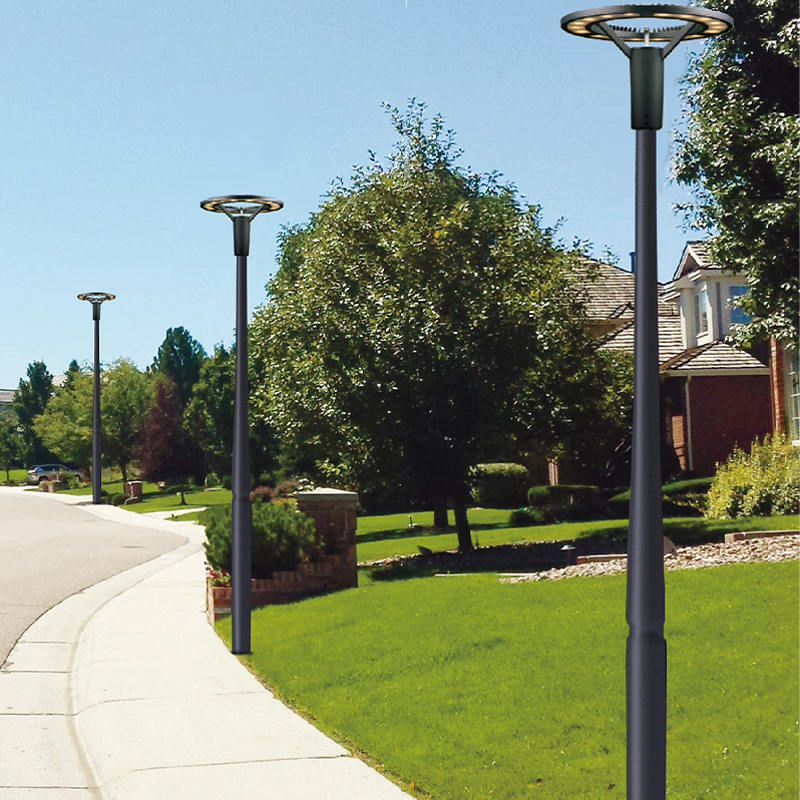
Pedestrian areas need low, evenly spaced light rather than brightness. Poles of 3 to 4 metres with post-top or short bracket luminaires are enough to guide people from a car park to a lobby door. Spacing of roughly two and a half to three times the mounting height overlaps the pools of light without leaving dark gaps. Aim for enough light to read a face and see a step edge, and check that uplight from the luminaire does not throw glare into ground floor windows or across a boundary.
Car parks and service drives
Vehicle areas need height and reach, typically 6 to 10 metres with single or double arms so light spreads across bays instead of down one line. Watch light spill at the site boundary, and avoid positions where a reversing lorry will clip the pole. Loading docks and service yards are usually better served by a floodlight or high mast arrangement on a stiffer pole than by lengthening a decorative arm.
Facades, signs and tree canopies
A wall mount bracket or a short pole does this better than a tall one. Narrow beam fixtures placed close to the surface create the shadow and depth that make an entrance read at night, while a sign needs flat, even light with no hot spot. Anything fixed to a facade should be reachable from a ladder for re-lamping, because the alternative is a lift hire every time a lamp fails.
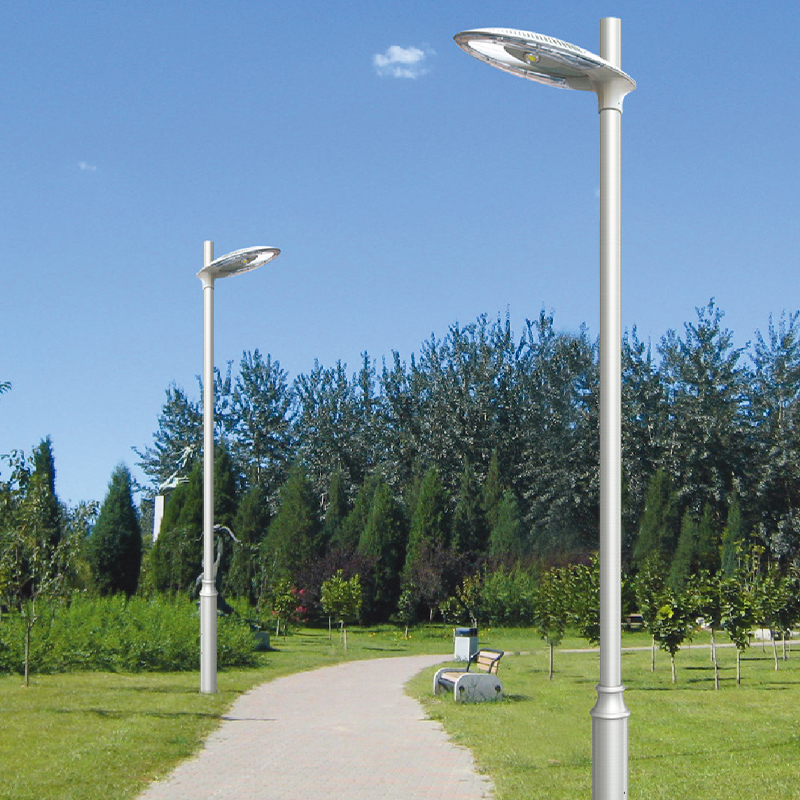
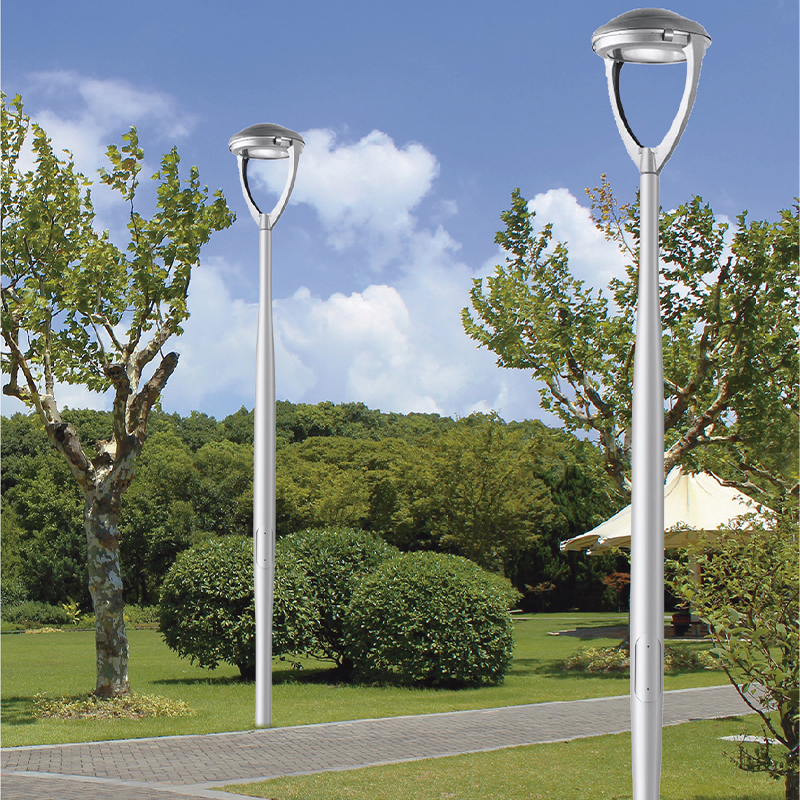 DUBLIN Aluminum Garden Light Pole with Flange MountA 2.5–4 m aluminum garden pole with flange mount, 3 mm wall, and finishes suited to layouts where service access and pole schedules matter.View Product →
Matching Pole Types to Office Zones
Once the zones are agreed, selection comes down to a small set of decisions that can be written into the pole schedule.
| Zone | Pole type | Typical height | Mounting | Points to check |
|---|---|---|---|---|
| Main entrance and plaza | Garden or landscape column | 3 to 4 m | Small flange or direct burial | Post-top lantern scale, no glare into windows |
| Pedestrian walkways | Garden pole | 3 to 5 m | Direct burial | Spacing about 2.5 to 3 times the height |
| Car park and access road | Roadway pole, single or double arm | 6 to 10 m | Base flange on concrete foundation | Arm reach, uniformity, boundary light spill |
| Service yard and loading dock | Floodlight or high mast pole | 8 to 12 m | Base flange | Stiffer pole for heavy heads, aim away from offices |
| Facade and signage | Wall bracket or short pole | 2 to 4 m | Wall mount bracket | Reachable for maintenance, even light on the sign |
| Perimeter path and remote lot | Solar pole | 4 to 6 m | Direct burial or flange | Panel output in winter, battery sizing |
| Crossing and traffic signals | Traffic signal pole | 3 to 5 m | Base flange | Local road authority requirements |
A useful check before ordering is to mark pole positions on the site plan and measure the distance from the nearest kerb, parking bay and foundation. Poles are damaged by vehicles far more often than by weather.
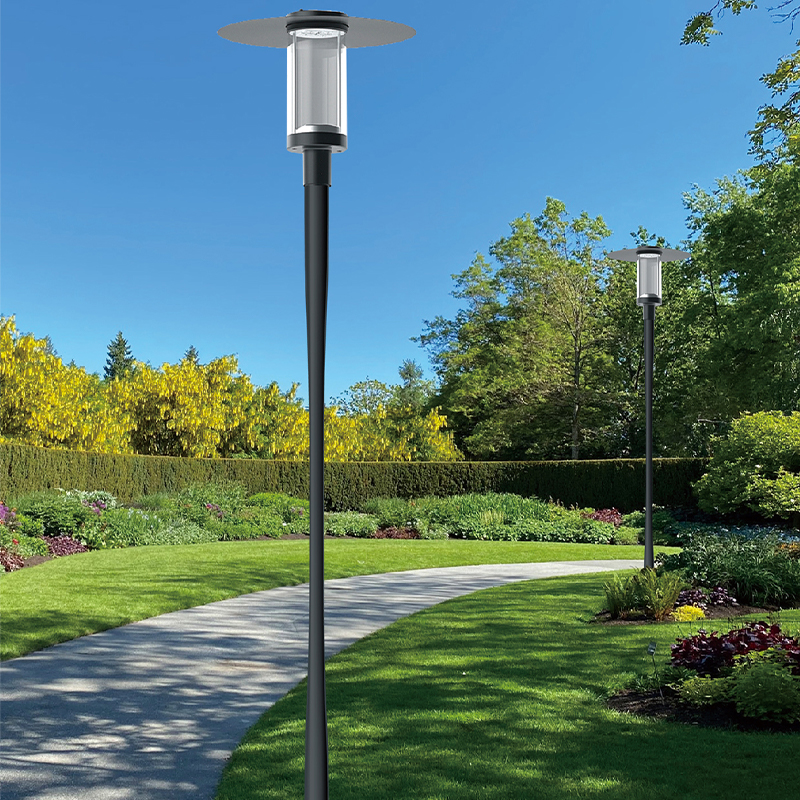
 KOLN Aluminum Conical Outdoor Roadway Light PoleConical aluminum roadway pole with 152–203 mm base and 3.2–4.0 mm wall; tenon fit and vehicle clearance should be checked before production.View Product →
Fit-Out Details That Cause Most Rework
Tenon and adapter compatibility
The tenon is the short spigot a luminaire slides onto, and it is where mismatches surface on site. Common sizes are 4 inch and 5 inch, round or square, horizontal or vertical, depending on the fixture. Adapters that convert between them are small, inexpensive and easy to forget until the fixtures are in the yard and the crane is booked. Compare the tenon drawing with the fixture socket drawing before production, not after delivery.
Base flange or direct burial
A base flange sits on a concrete foundation with cast-in anchor bolts and lets the pole be levelled and, if needed, replaced. Direct burial is faster and cheaper: the pole goes into a prepared hole and is backfilled, with no anchor cage. Direct burial suits garden and pathway poles, while flanged bases suit tall roadway poles and anything that may have to come out again. Agree cable entry, hand hole position and earthing early.
Wind load and fixture sail area
Poles are rated for a load at the top, usually expressed as projected area at a given wind speed. That allowance covers the luminaire, the arm and anything else bolted on, including banners, cameras and small speakers. Adding a camera and two banners to a pole designed for one lantern changes the structure. If the total sits close to the limit, ask for the calculation instead of assuming a standard product will cope.
Aluminum or Steel, and Which Finish Holds Up
Aluminum poles do not rust and are easy to handle, which is why they suit courtyards, coastal sites and anywhere road salt is spread in winter. Aluminum is also fully recyclable, a point that matters to clients working towards green building targets. Steel is stiffer and remains the practical choice for tall high mast poles and heavy camera or floodlight loads; it depends on galvanising or a robust coating, and any chip needs touching up.
Finish consistency deserves planning. If a campus is built in phases, order finish samples and record the colour code, because a slightly different batch of powder coat shows more on a pole than on a wall. Aluminum light poles have moved from a niche choice to a standard commercial specification for reasons worth understanding before the schedule is fixed.
Where Solar Poles Make Sense on an Office Site
Solar poles earn their place where trenching is expensive or impossible: perimeter paths, overflow car parks and sites where a mains connection would cross finished landscaping. They are a poor fit under dense tree canopy or where a building shades the panel for part of the day. Size the panel and battery for December output rather than June output, and treat the winter figure as the design case. Modular panel and battery components also allow an existing pole to be converted later, which is useful when a site is delivered in phases.
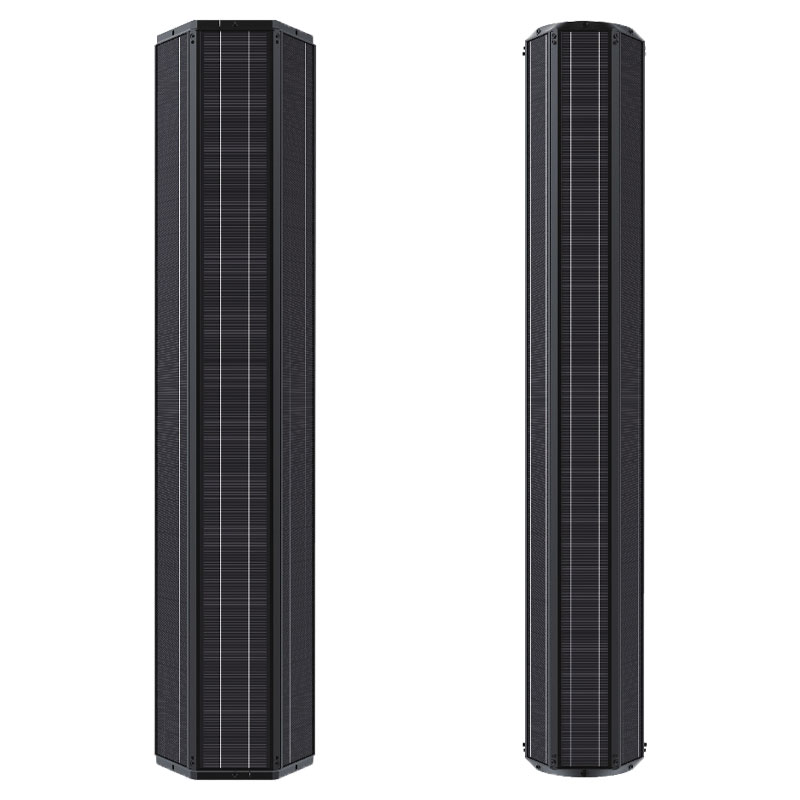
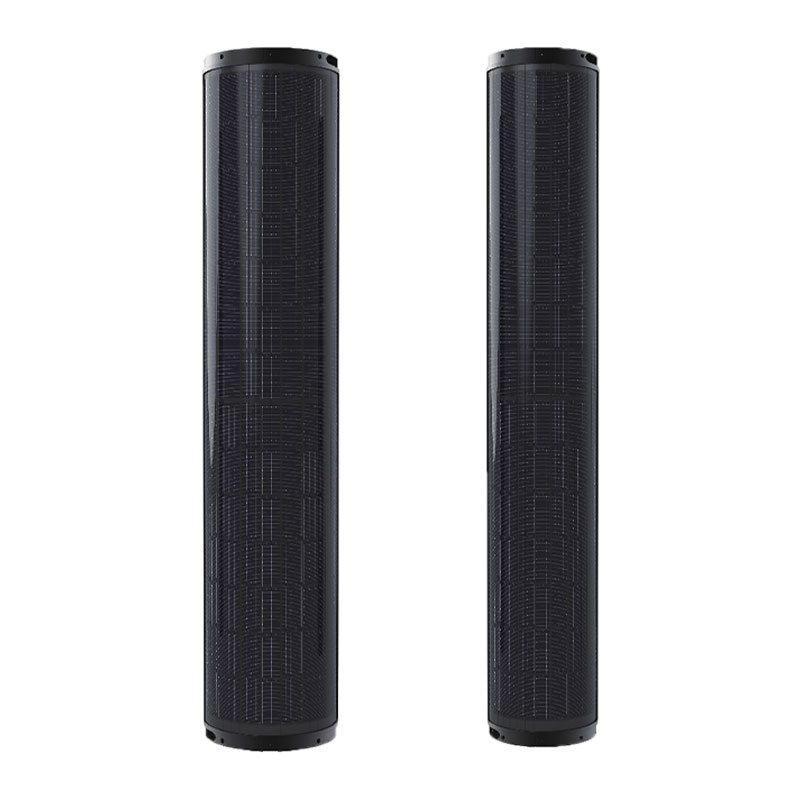
 ESCH Aluminum Solar Light Pole with Integrated LED and BatteryA one-meter aluminum solar bollard with integrated module, battery, and 10 W LED; suited to paths where winter output is the design case.View Product →
A Short Procurement Checklist for Office Projects
Most site problems trace back to one of the following items being left open until delivery week.
- Confirm pole height, arm configuration and tenon size against the fixture cut sheet.
- Decide base flange or direct burial, and issue foundation or excavation details to the civil contractor.
- State the design wind speed and the total projected load, including cameras and banners.
- Choose material and finish with the site environment in mind, including coastal air and winter road salt.
- Agree colour, hand hole position, cable entry and earthing before production starts.
- Request the pole schedule, drawings and inspection record to be issued with the delivery.
- Keep one spare tenon adapter and one touch-up kit per finish on site.
Getting the Pole Schedule Right the First Time
Office exterior lighting is judged at night but delivered as a structural package, and the poles set the limits for everything above them. Settling height, tenon size, mounting, material and wind load before the fixture order is placed removes most of the surprises that appear on site. If you are preparing a schedule for a campus, a car park or a mix of both, get in touch with our team and send the layout together with your fixture list; we can match pole types, mounting and finishes to the conditions on site.