English
 Español
 Français
 عربى
عربى italiano
Replacing a run of street or park lighting looks like a luminaire project. It is not. The pole is the part that stays in the ground for twenty-five years or more, and it carries most of the material, most of the freight weight and most of the maintenance risk. If the goal is eco friendly outdoor lighting, the order that works is simple: choose the pole, then the power supply, then the light. Get the first two right, and the third becomes an easy calculation.
Content
- 1 What Makes Outdoor Lighting Eco Friendly in Practice
- 2 Aluminium or Steel: Which Pole Material Is Greener
- 3 Solar Poles Remove the Trench, Not Just the Meter Reading
- 4 Retrofitting an Existing Pole Beats Replacing It
- 5 Coatings, Water and the Maintenance Bill Nobody Budgets For
- 6 Smart Poles and the Case for Fewer Foundations
- 7 A Specification Checklist for Buyers
What Makes Outdoor Lighting Eco Friendly in Practice
Three things decide the environmental score of an outdoor lighting installation, and only one of them is visible at night. The first is embodied material: how much metal, concrete and cable the scheme consumes, and how much of it can be recovered at the end of life. The second is operational energy, which is where solar poles and efficient LED modules earn their place. The third is service life, and it is the one buyers underestimate. A pole that needs recoating every eight years, or a battery pack that cannot be reached without a crane, will undo the savings of a highly efficient lamp within a decade.
This is why manufacturers with their own finishing lines tend to talk about recycling and coatings before they talk about lumens. Morelux, the Ningbo pole maker also known as Ningbo Morelux Pole Technology Limited, has produced aluminium and steel poles since 1998 and describes 100 per cent recyclable aluminium alloy, green building compliance and lower manufacturing emissions as standard practice rather than an upgrade. That claim is worth testing in a specification, which is what the rest of this article is about.
Aluminium or Steel: Which Pole Material Is Greener
Both materials are recyclable, so the choice rarely comes down to green versus not green. It comes down to weight, corrosion behaviour, maintenance interval and where the pole is going.
| Criterion | Aluminium poles | Steel poles |
|---|---|---|
| Recyclability | 100 per cent recyclable alloy with strong scrap value; poles are routinely remelted into new products | Also fully recyclable, but the higher weight means more handling and freight before it reaches the smelter |
| Weight and freight | About one third the density of steel, so a six metre pole is easier to move and needs a smaller foundation | Higher unit weight, larger foundations and heavier lifting equipment on site |
| Corrosion behaviour | Forms a protective oxide layer and does not rust through while the surface is intact | Depends on galvanising or a coating system; once the film is breached, rust spreads underneath it |
| Surface finish | Anodising and powder coating both work well; an anodised pole needs no paint at all | Hot dip galvanising or powder coating over blast cleaned steel |
| Maintenance load | Rinsing and inspection are usually enough in most climates | Re-coating every ten to fifteen years is common in coastal or humid areas |
| Typical best fit | Coastal sites, parks, landscape schemes, solar poles and retrofit projects | High mast, floodlight and camera poles where stiffness and budget drive the decision |
The practical reading is not that aluminium wins everywhere. It usually wins where the pole has to survive salt air, where the site is awkward to reach, and where the coating is expected to stay intact without a repainting crew. Steel remains the sensible choice for high masts and heavy duty structures, and a competent supplier will say so rather than sell one material for every job.
Solar Poles Remove the Trench, Not Just the Meter Reading
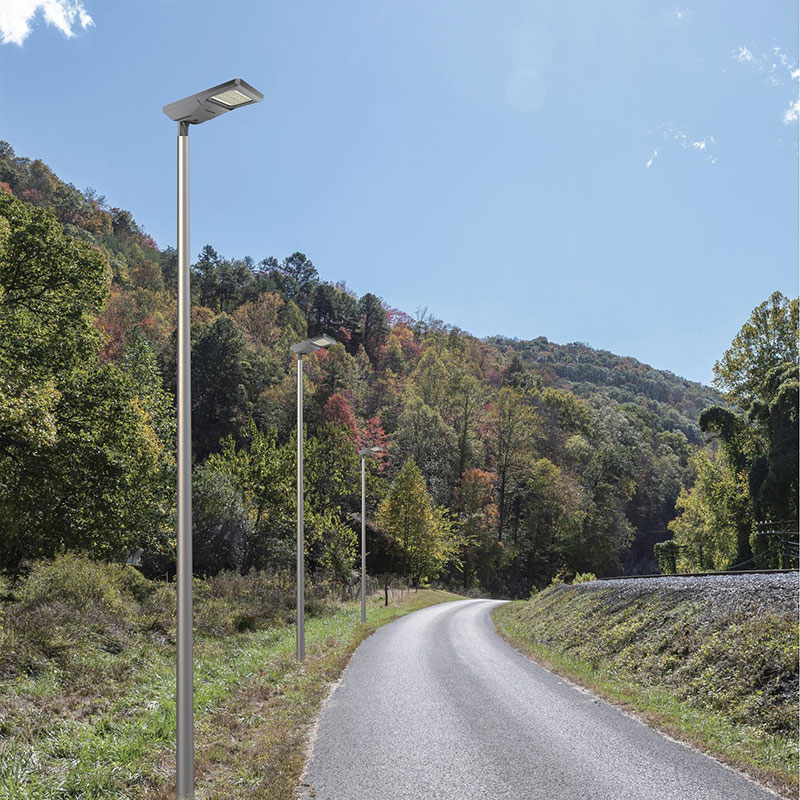
A solar pole avoids the part of the project that is hardest to undo: the trench, the duct bank and the copper. On a park path or a lake trail, that civil work can involve far more material and ground disturbance than the poles themselves. A solar pole arrives, is planted or bolted to a flange, and starts working.
Sizing is where projects succeed or fail. Four numbers decide whether a solar pole performs: the panel type and rating, the battery capacity, the autonomy days you actually need, and the daily load profile. Flexible HJT panels and monocrystalline silicon modules behave differently in partial shade, and a double lamp head roughly doubles the load. If you want the reasoning behind pole mounted solar design, this look at how solar poles work through the seasons is a useful starting point.
A range that covers the usual configurations saves a lot of specification time. Morelux lists flexible HJT and monocrystalline silicon solar poles, coated and metal powder sprayed versions, double lamp head variants and corrosion resistant models for coastal sites. A representative option for a general purpose park or estate road is the Assisi eco friendly flexible HJT solar light pole, which pairs a flexible panel with an aluminium pole body.
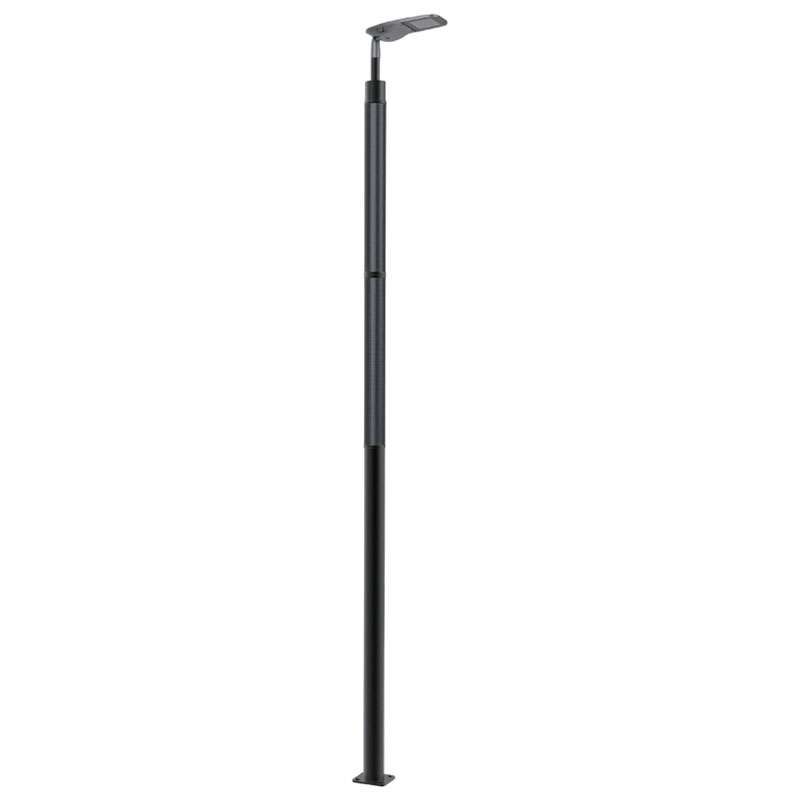 ASSISI Eco-Friendly Flexible HJT Solar Light PoleTwo heights with dual flexible HJT panels, LiFePO4 storage, and recyclable aluminum pole, a representative option for general-purpose park or estate road lighting.View Product →
Retrofitting an Existing Pole Beats Replacing It
If the poles are structurally sound and the coating is intact, the lowest carbon option is to keep them and change the power source. Retrofits normally take one of two forms: adding a solar module and battery to an existing pole, or swapping the luminaire and leaving the pole untouched.
Two piece kits exist for both circular and hexagonal modules, which means a panel can be split around an existing column instead of demanding a new one. The battery is usually the limiting component. A compact battery pack that mounts on the pole shaft and can be swapped by one technician keeps lifecycle cost predictable, because a battery change at year eight costs far less than replacing the whole assembly.
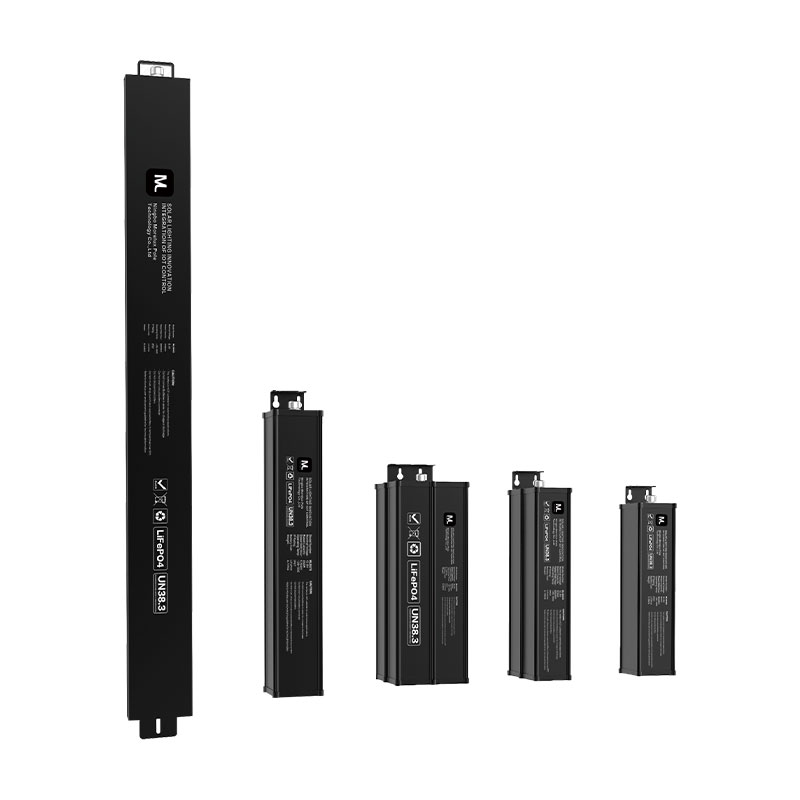 New Compact Battery Pack Series for Solar Light PolesSealed aluminum battery pack rated over 2,000 cycles, with wide-temperature operation and built-in heating/insulation; designed as a replaceable pole-shaft battery for solar light poles.View Product →
Before ordering, confirm the shaft diameter, wall thickness, condition of the existing coating, and whether the tenon or bracket needs a different fitting.
Coatings, Water and the Maintenance Bill Nobody Budgets For
Powder coating and anodising are the two finish routes that matter outdoors, and both are controlled industrial processes rather than paint. A pole that is cut, welded and coated in the same factory avoids the most common failure point in imported lighting: a coating applied over poorly prepared metal. Morelux carries out cutting, bending, spinning, welding, polishing, powder coating, anodising and inspection in its own facility, which is the kind of vertical control that decides whether a finish survives a coastal winter.
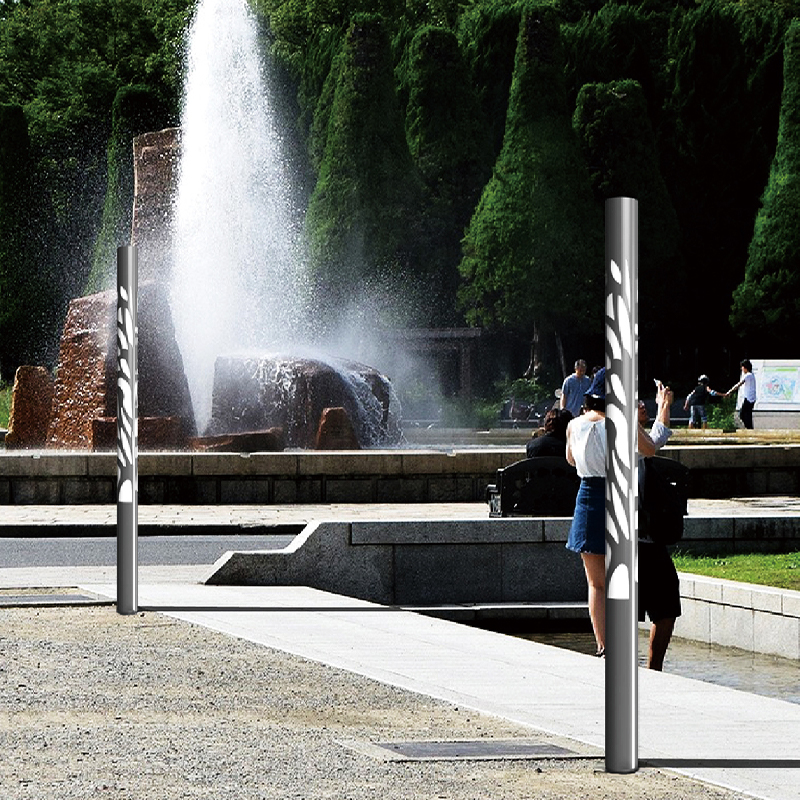
Where a pole stands near fountains, on a waterfront promenade or in a drainage channel, sealing details matter as much as the finish. Waterproof aluminium light columns are designed around exactly that environment.
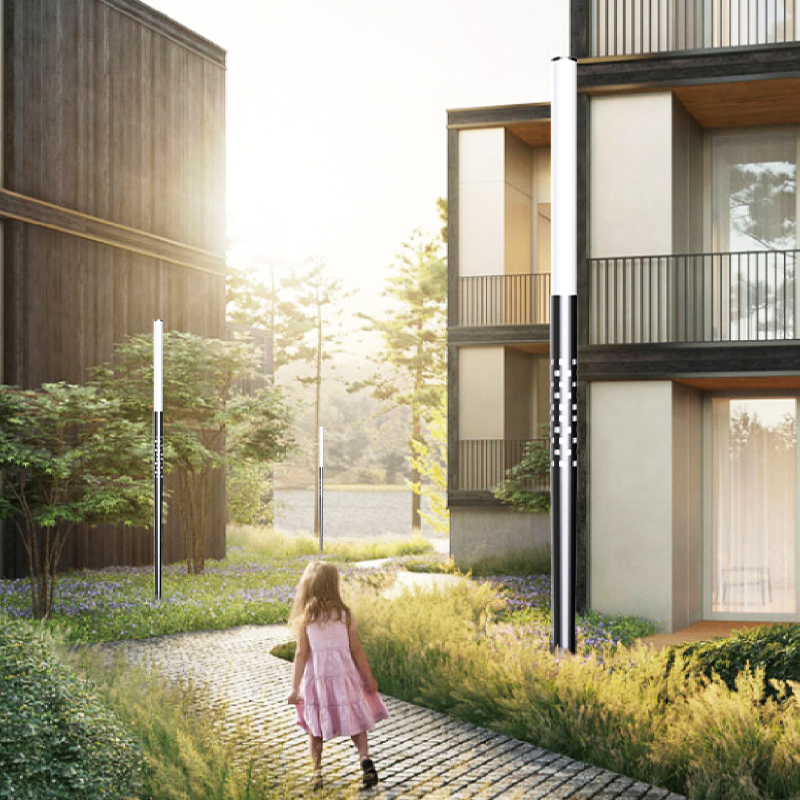 ABERRANT Aluminum Waterproof Light Column6063-T6 aluminum column in 2.5–4 m flange-mount heights with satin, anodized, or powder-coated finishes, intended for sealing-sensitive waterfront or drainage settings.View Product →
Smart Poles and the Case for Fewer Foundations
A smart pole carries lighting, cameras, signage or communications equipment on one column. From a materials standpoint that is one foundation, one trench and one coating system instead of three, which is a real saving in concrete, ducting and disruption. The catch is that smart pole specification is still uneven across the industry: published data on payload, cable routing and interface standards varies widely, so ask for drawings rather than brochures. Morelux builds aluminium alloy multifunctional smart poles and integrated city poles, but the technical parameters behind those names are not published, so treat the pole as the platform and confirm equipment interfaces separately.
A Specification Checklist for Buyers
- Material and end of life. Confirm the alloy grade, whether it is 100 per cent recyclable, and whether the supplier will take back scrap at replacement.
- Coating system. Ask for pre-treatment steps, powder thickness in microns or anodising film thickness, and salt spray test hours rather than a colour card.
- Mounting method. Base flange or planted mounting changes the foundation, the excavation and the volume of concrete on site.
- Power supply. For solar, request the panel type, battery chemistry, autonomy days at your latitude and the replacement procedure.
- Serviceability. Batteries, modules and fittings should be reachable from a platform or a small crane, not a large one.
- Accessory compatibility. Four inch and five inch tenon adapters and wall mount brackets decide whether you can reuse luminaires you already own instead of buying new ones.
- Documentation. Drawings, wind load calculations and finish specifications should arrive before the purchase order, not after it.
The pattern across all of this is the same one that shows up in almost every lighting upgrade: the parts you cannot see at night decide the footprint. Aluminium that can be remelted, a coating that survives salt air, a battery that can be swapped in an afternoon and a solar panel that removes the trench altogether will do more for a project's environmental case than another two lumens per watt.
If you are comparing options for a specific site, the fastest route to a workable answer is to send the site conditions and required height. From there the pole, finish and mounting recommendation can be matched to the location rather than picked from a catalogue page.