English
 Español
 Français
 عربى
عربى italiano
When a community ballfield installs new LED fixtures and the first night game still shows dark patches along the outfield arc, the fault is rarely the luminaire itself. More often the poles stood too low, too close or too few, and the structure was never sized for the fixture load it had to carry. That observation leads to the central conclusion of this guide: baseball field lights succeed or fail on the structures that hold them. The sections below cover the numbers that decide the outcome, written from the manufacturing side, where a pole factory operating since 1998 has shipped lighting structures to more than thirty countries.
Content
What Baseball Field Lights Must Deliver
Lighting level is the first specification to lock down, because every other decision scales from it. Illuminance is measured in footcandles at the playing surface, and typical targets rise sharply with the level of play. Youth and recreational fields operate near 30 footcandles in the infield, high school programs plan 30 to 50, college venues push toward 70 to 100, and professional parks design for 125 or more once broadcast coverage is involved. Outfield targets usually sit at about two thirds of the infield figure. Uniformity matters as much as raw output, so designers also hold the infield max to min ratio near 2 to 1 to keep shadows from hiding fly balls.
Figure 1 compares typical infield illuminance targets across levels of play, measured in footcandles at the surface. A youth or recreational field can operate near 30 footcandles, which keeps the ball visible without competition grade cost. High school programs plan closer to 50 footcandles so ground balls and fly balls stay trackable under the lights. College play pushes toward 75 footcandles, and professional venues design for 125 footcandles or more once broadcast requirements enter. Outfield levels usually sit at about two thirds of the infield figure, so every step up in play level roughly doubles the demand on fixtures, poles and electrical service.
Pole Height and Layout Geometry
Most installations use six or eight poles with mounting heights between 50 and 80 feet, and aiming angle drives those numbers. Fixtures aimed steeper than roughly 70 degrees from vertical throw glare toward batters and flatten shadows on the infield, so designers push poles outward and upward and let light cross the field from opposing directions.
- Four pole layouts suit small youth fields and protect the budget, but uniformity suffers in the outfield gaps.
- Six pole layouts are the community standard, balancing coverage behind the plate with foul line and outfield aim points.
- Eight pole layouts serve competition fields, tightening uniformity while reducing the fixture load on each structure.
Whatever the arrangement, each pole carries a wide, wind catching cluster of fixtures, so the shaft must be engineered for real fixture drag rather than a generic streetlight load. Purpose built structures such as a dedicated steel floodlight pole let the manufacturer match shaft strength, crossarms and base details to the actual fixture package. Power is part of the same geometry: a full size baseball lighting package draws more current than pole mounted solar can realistically supply, so photovoltaic structures belong on walkways, parking rows and practice corners around the complex.
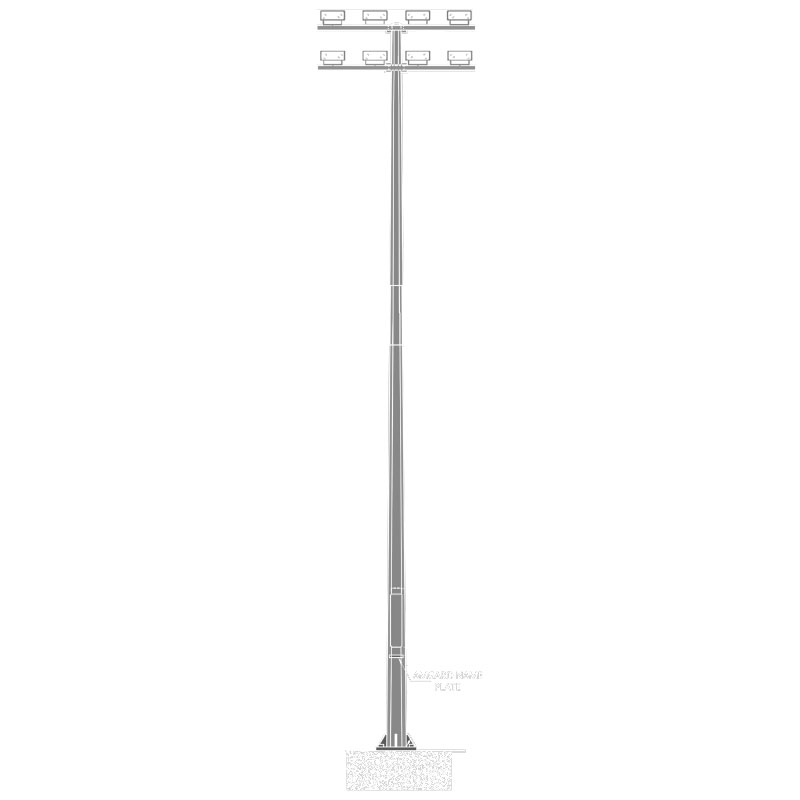 Steel Floodlight Pole for Heavy Fixture PackagesAvailable in conical, cylindrical, octagonal and step shapes from 3m to 20m per EN40, this steel pole lets shaft strength, crossarms and base details be matched to a full baseball fixture cluster with real wind drag.View Product →
Steel or Aluminum: Choosing the Pole Structure
Steel carries more load per dollar and damps vibration better, which is why engineers default to it for tall structures with heavy fixture banks, a preference our article on why steel light poles have become the preferred choice examines from the shop floor. The trade-off is corrosion protection, since steel needs hot-dip galvanizing plus a powder coat finish near coastal salt air. Aluminum answers with low weight, natural corrosion resistance and easier site handling, but its cost climbs quickly as height and load grow, which is why aluminum dominates shorter columns far more often than 80 foot field structures.
Figure 2 rates steel and aluminum structures on the five attributes that decide pole selection in baseball projects. Steel scores higher on wind load capacity and vibration damping, which matters because a bank of fixtures on a 70 foot pole presents a large surface to storm gusts. Steel also delivers more load capacity per dollar, keeping it the default for tall foul territory and outfield structures. Aluminum answers with superior corrosion resistance and a stronger recycling profile for sustainability driven procurement. In practice, coastal and high wind sites drift toward galvanized steel with powder coat, while smaller community fields often choose aluminum to simplify handling and installation.
Multiple fields on one campus change the math again. Consolidating lighting into fewer, taller structures cuts trenching, transformer count and crane days, and a steel high mast light pole exists for exactly that duty.
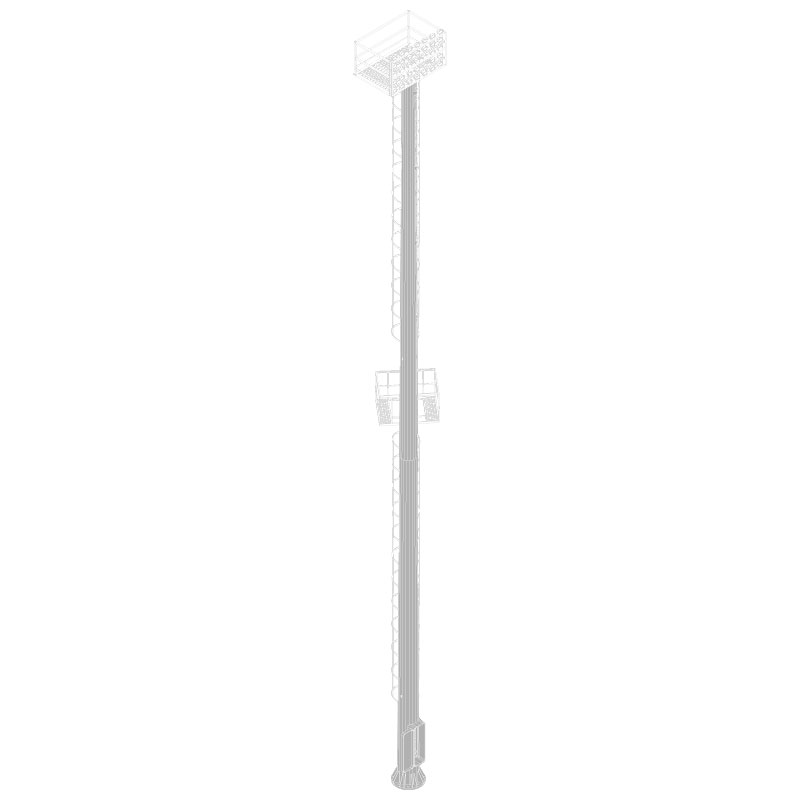 Steel High Mast Light Pole for Multi-Field SitesTapered polygonal masts from 16m to 50m per EN40 consolidate lighting for large areas like ports and sports grounds, cutting trenching, transformer count and crane days when several fields share one campus.View Product →
Budgeting: Where the Money Actually Goes
Recent United States estimates place a complete installed LED baseball lighting system between roughly 200,000 and 654,000 dollars, with the spread driven by level of play, pole count, soil conditions and trenching distance. Within that range, structure is the line item buyers most often underestimate, because foundations, anchor bolts, crane time and conduit runs all attach to the pole decision.
Figure 3 shows how a typical baseball lighting budget divides across the major cost groups. Fixtures and optics take the largest share near 45 percent, because luminaire count and quality drive both performance and price. Poles and foundations follow at roughly 30 percent, a figure that surprises buyers who assumed structure was a minor line item. Installation and labor add about 15 percent for crane time, wiring, aiming and commissioning, while controls and electrical hardware take the remaining 10 percent. The takeaway is that pole decisions touch nearly a third of the budget, which is why quoting poles as an afterthought is where overruns begin.
Long-Term Performance: Fixtures Age, Structures Age Differently
Quality LED fixtures are rated for up to 150,000 hours and lose brightness gradually rather than failing overnight. Poles run on a different clock, aging through wind induced vibration, fastener loosening and coating wear, so a twenty year fixture should never sit on a fifteen year finish. Sensible maintenance budgets include torque checks on fixture hardware, coating inspection at the base where moisture collects, and re-aiming after any structural work.
Figure 4 plots a typical lumen maintenance curve for a quality LED fixture, showing the share of initial output retained over twenty years. Output declines gradually and passes the commonly cited L80 threshold near the twenty year mark. That slow decline is why LED systems hold specified light levels for most of their service life while cutting energy use. It also removes the relamping schedules that metal halide systems forced onto maintenance budgets. Poles age on a different clock, through wind fatigue, coating wear and corrosion at the base. A twenty year fixture mounted on a pole with a fifteen year finish turns the cheapest original decision into the most expensive repair.
A Procurement Checklist Before You Order
Confirm these pole specifications
| Specification item | Typical value or tolerance | Why it matters |
|---|---|---|
| Mounting height | 50 to 80 feet by level of play | Sets aiming angles, glare control and shaft strength |
| Fixture EPA wind load | Matched to site basic wind speed | Governs shaft, crossarm and foundation design |
| Base type | Anchor flange or direct burial | Affects install cost and future replacement |
| Finish system | Hot-dip galvanizing plus powder coat | Determines corrosion life near coast or humidity |
| Fitter interface | 4 inch or 5 inch tenon | Prevents adapter mismatch at installation |
| Vibration rating | Damped per manufacturer loading chart | Protects drivers and fasteners from fatigue |
A note for United States buyers
North American fields typically use round tapered steel shafts engineered to local wind maps, with anchor base flanges where future replacement matters. Give equal attention to the fitter interface, since tenons and adapters are commonly sized at 4 or 5 inches and confirming that dimension against the fixture fitter prevents mismatched hardware from stalling the crew.
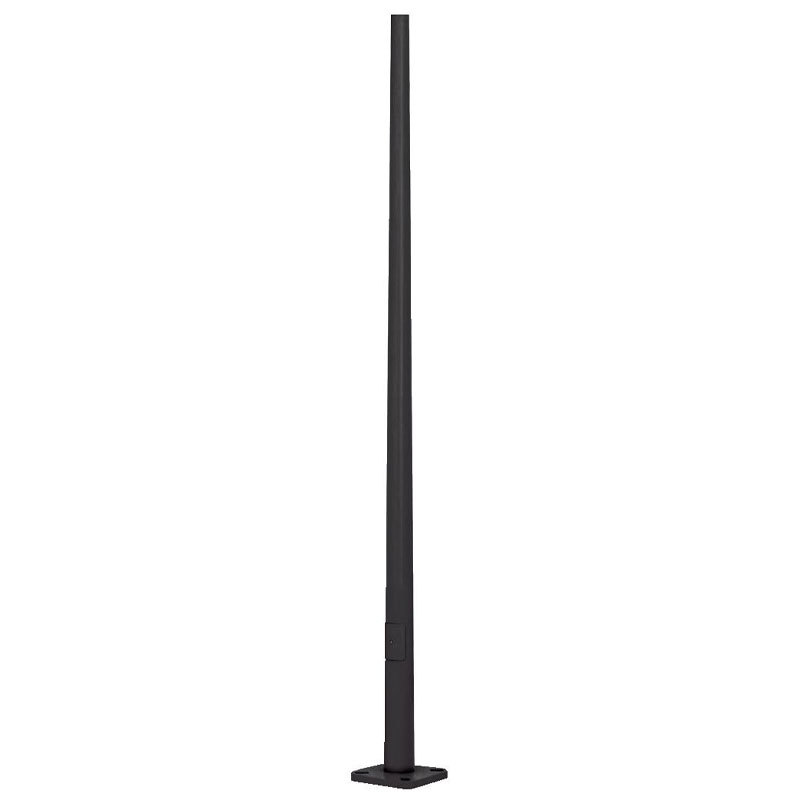 Round Tapered Steel Light PoleA conical steel shaft with ASTM A500 Grade C walls, A36 base flange and F1554 anchor bolts, engineered to local wind maps with anchor base for future replacement on North American baseball fields.View Product →
The short version: fix the level of play first and let it set footcandles and pole height, then put real engineering attention into the structure, which carries roughly 30 percent of the budget and all of the equipment for the next two decades. Confirm finish systems, wind ratings and mounting interfaces in writing before the purchase order is signed. If a second set of experienced eyes would help, send us your field dimensions and fixture schedule and our engineers will reply with pole recommendations matched to your site.