English
 Español
 Français
 عربى
عربى italiano
Arena lighting projects succeed or fail long before anyone flips a switch. Take a 250 by 150 ft outdoor riding arena as a working example: installers typically reach comfortable training levels there with about sixteen 300-watt LED area fixtures on poles roughly 30 ft tall. Shift the mounting height, the spacing or the structural design, and the same fixtures can deliver glare, dark patches or an energy bill nobody wants. The poles and the layout carry the project, which is exactly where buyers should spend their planning time. This guide covers the light levels to target, how height and placement shape the result, how to choose between aluminum and steel structures, and where LED technology changes the math.
Content
Start With Light Levels, Not Fixture Catalogs
The core principle is simple: define the target illuminance first, then design backward to fixtures and poles. Average horizontal illuminance, measured in footcandles, drives fixture count, pole count, aiming angles and, ultimately, the budget. Schooling and recreational arenas work well at 10 to 20 fc. Club and regional competition generally needs 30 to 50 fc, collegiate venues step up again, and televised events often require 100 fc or more with strict uniformity so cameras never lose the action in a shadow.
Uniformity matters as much as raw brightness. A field that averages 40 fc with hot spots and dark bands feels worse than an even 25 fc design, especially for ball sports and for horses, which startle at sharp light-to-dark transitions. That is why a photometric study built on real pole locations, mounting heights and fixture photometric files is standard practice for anything beyond a private practice ring.
| Arena use | Typical average illuminance | Typical uniformity target |
|---|---|---|
| Schooling and recreational riding | 10 to 20 fc | 4:1 max to min or better |
| Club and regional competition | 30 to 50 fc | 3:1 max to min or better |
| Collegiate and semi-professional | 50 to 75 fc | 2.5:1 max to min or better |
| Professional and broadcast | 100 to 125 fc | 2:1 max to min or better |
The horizontal bar chart compares typical average illuminance targets across five levels of play. The step from recreational riding at about 15 fc to club play near 30 fc is the jump most private arena owners actually face. Collegiate and professional levels demand two to eight times more light, which multiplies fixture count and pole loading quickly. Broadcast venues sit at the top because cameras need strong vertical illuminance and tight uniformity, not merely bright turf. Designing to your real level of use keeps capital costs and energy bills proportional to need.
Mounting Height and Pole Placement Do the Heavy Lifting
A practical rule drawn from sports lighting practice: keep each aim point within roughly three to four mounting heights of its pole. Push fixtures to throw farther than that, and spill light, glare and shadows climb while useful footcandles on the surface fall. For a 150 ft wide riding arena lit from both long sides, poles at 30 to 40 ft keep aiming angles comfortable and keep the structure clear of the riding surface. Height also interacts with glare control, so it should be locked early in the photometric study rather than adjusted after installation.
Placement follows safety as much as optics. Outdoor equestrian venues normally take light from poles outside the footprint so nothing stands where a horse, a vehicle or a plow can reach it. Full cutoff visors and disciplined aiming keep light on the playing surface and relations with neighbors calm. Indoor arenas shift the work to ceiling-mounted high bay fixtures, where vapor-proof and shatterproof housings handle dust, humidity and stray balls, and a color rendering index of 70 or better helps riders judge footing and movement. When a site is simply too large for conventional poles, high mast structures carry multi-fixture arrays from a single shaft.
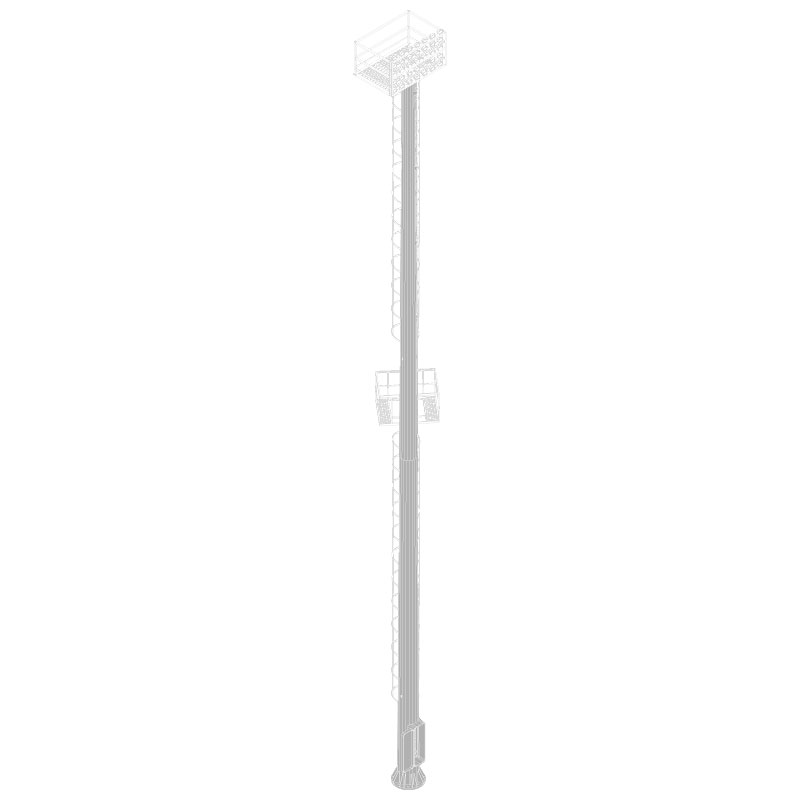 Steel High Mast Light Pole for Large Area LightingFor sites too large for conventional poles, these tapered steel masts from 16m to 50m carry multi-fixture arrays on one shaft, giving uniform high-intensity light for stadiums, ports and sports grounds.View Product →
The bar chart shows the mounting heights most often specified for common venues. Practice courts and outdoor riding arenas sit in the 25 to 40 ft band, where standard tapered shafts work efficiently. Larger field sports push mounting heights toward 50 ft so beam spread covers the full play area without hot spots between poles. Baseball demands even more height in the outfield because of long throw distances and high fly balls. At the top of the range, high mast designs from 80 to 100 ft serve stadiums where a dozen or more fixtures share one structure.
Aluminum or Steel: Choosing the Structure Behind the Fixtures
Both materials build dependable arena lighting structures, and the honest answer is that site conditions and mounting height choose the material. Aluminum weighs roughly a third as much as an equivalent steel shaft, resists corrosion naturally, takes powder coated or anodized finishes well, and ends its service life as a fully recyclable alloy, which makes it a favorite for coastal sites, school campuses and standard-height installations. Steel answers with higher rigidity and impact tolerance, which is why it dominates high mast projects and venues carrying heavy floodlight arrays where deflection control in wind matters.
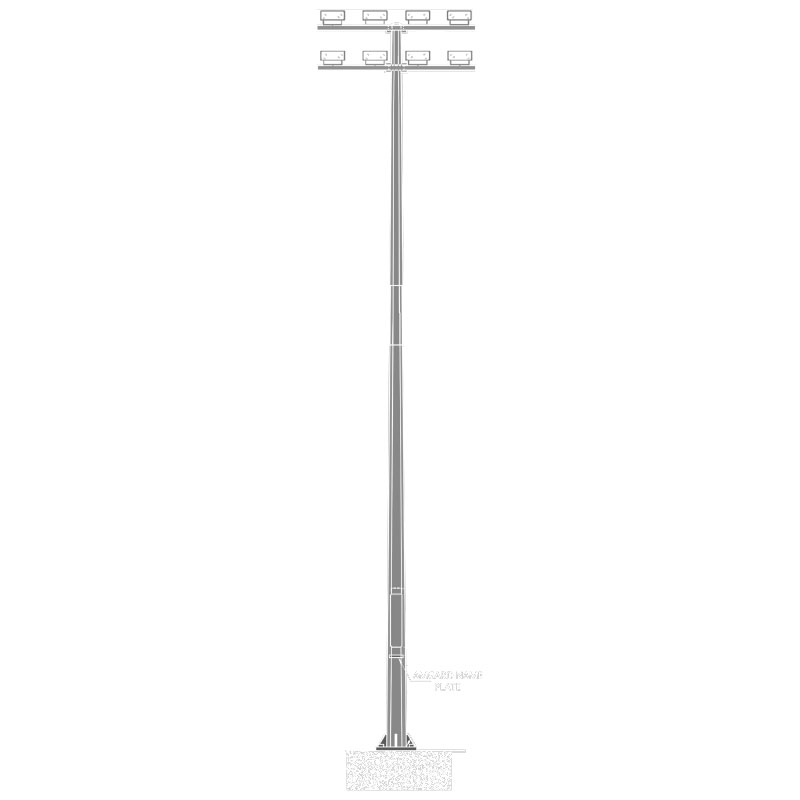 Steel Floodlight Pole for Heavy Floodlight ArraysWhere venues carry heavy floodlight arrays and need rigidity and deflection control in wind, steel poles in heights from 3m to 20m mount broad-beamed fixtures for stadiums and large outdoor areas.View Product →
Three engineering inputs settle the decision in practice. First, the effective projected area, or EPA, of the fixture array must match the pole shaft rating, and large LED arrays push that number up quickly. Second, the environment matters: salt air, industrial atmospheres and de-icing chemicals punish weak finishes, so galvanized steel or properly coated aluminum must match the site. Third, maintenance expectations differ, because aluminum typically needs only periodic finish checks while steel depends on the long-term integrity of its coating system. Our industry overview on why steel light poles become the preferred choice for demanding outdoor structures covers that decision in depth.
The radar chart scores the two materials on six practical attributes using a one-to-five scale. Aluminum leads corrosion resistance, installation ease thanks to low weight, finish flexibility and end-of-life recyclability. Steel takes a clear lead in rigidity at height and impact resistance, which explains its grip on high mast and heavy floodlight work. For a 30 to 40 ft arena installation, particularly near the coast, aluminum usually wins on total cost of ownership. For an 80 ft stadium mast carrying a dozen fixtures, steel remains the engineering default.
For typical 30 to 40 ft installations in North America, conical aluminum shafts with dual arm brackets are a frequent spec, since one pole can serve two aiming zones across the arena.
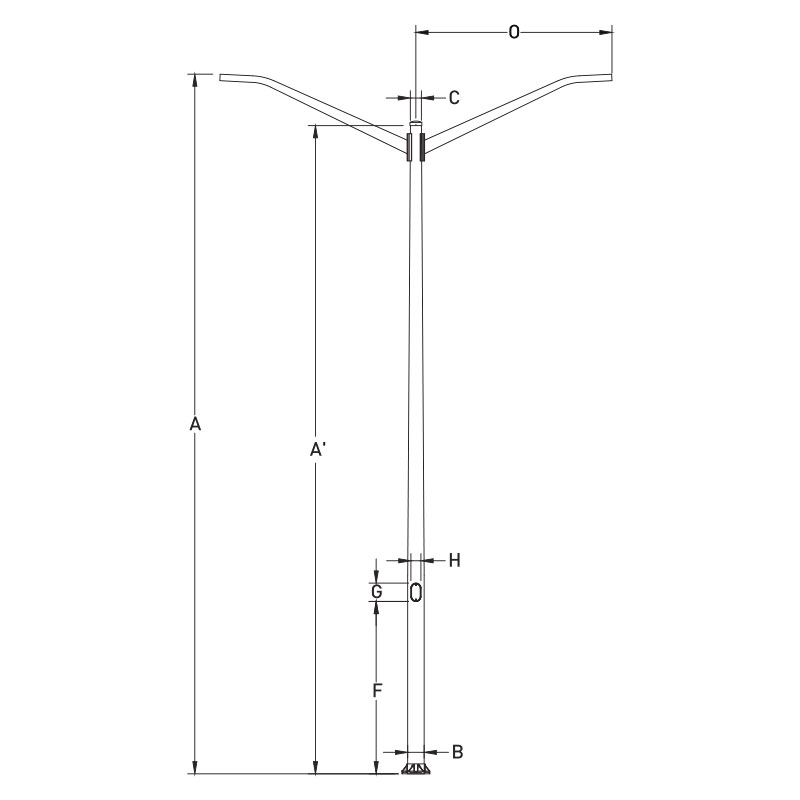 20-40ft Aluminum Conical Light Pole with Dual ArmsA frequent spec for typical 30 to 40 ft arena installations: the extruded AL6063 conical shaft with dual arm brackets lets one base-flange-mounted pole serve two aiming zones across the arena.View Product →
Why LED Redefined the Economics of Arena Lighting
LED converted arena lighting from a maintenance chore into a predictable asset. Restrike is instant after a power blip, directional optics send light onto the playing surface instead of into the sky, and a 300-watt LED can stand in for a 1,500-watt metal halide while delivering comparable usable light. Two charts show what that means over the life of the installation.
Light Output Retention Over Time
The line chart tracks the share of initial light output each source retains over a ten-year service life. Metal halide drops to roughly 85 percent within two years and to less than half by year eight, which is when most arenas start looking faded and patchy. LED fixtures hold near their initial output for years and typically remain at 80 percent or better at the ten-year mark. The practical consequence is that a metal halide design loses uniformity as individual lamps age at different rates, while an LED array ages evenly. Fewer relamping cycles also remove bucket-truck rentals and scheduling downtime from the facility calendar.
Annual Energy Cost Comparison
The column chart converts wattage into money for a sixteen-fixture arena running 1,500 hours per year at $0.12 per kWh. Moving from 1,500-watt metal halide to 300-watt LED cuts the annual energy line from about $4,320 to roughly $864. The middle bar shows the partial step many facilities take with 1,000-watt lamps before converting fully. Maintenance savings stack on top, because a single avoided bucket-truck visit for lamp changes can cost several hundred dollars. Combined, the two effects usually repay the LED premium within a few seasons, especially where arenas run long winter hours. Add scheduling or motion controls, and the operating numbers improve again.
Procurement Checks Worth Running Before You Sign
The costliest arena lighting mistakes are structural and contractual, not photometric. Before committing to a supplier or a design package, run through these checks.
- Wind load and EPA: confirm the pole shaft rating covers the full fixture array, brackets and any attachments at your site design wind speed.
- Foundations and anchorage: anchor bolt patterns, base plates and concrete foundations must match soil conditions and local code.
- Finish system: match powder coating, anodizing or hot-dip galvanizing to coastal, industrial or roadside exposure.
- Mounting hardware: tenon adapters, fitter brackets and crossarms must fit both the pole top and the fixture, so order them as one package.
- Photometric study: require calculations based on your actual pole locations and heights, not a generic layout.
- Documentation: ask for structural calculations, finish test reports and warranty terms in writing.
Plan the light levels first, fix mounting height and placement early, choose the pole material for the site, and let LED economics close the business case. That sequence protects the players and horses under the lights as well as the budget behind them. If you are sizing structures for a riding arena, a school field or a stadium upgrade, share your layout and fixture schedule with our team and request a pole specification and quote for your project.