English
 Español
 Français
 عربى
عربى italiano
A light pole wall mount bracket is a structural hardware assembly that attaches a light pole or luminaire arm directly to a vertical surface — such as a building wall, concrete column, or bridge structure — eliminating the need to install a freestanding pole base in the ground. It transfers the weight and wind load of the lighting fixture from the pole or arm to the wall it is anchored to, providing a stable, secure, and code-compliant mounting solution in locations where ground installation is impractical or impossible.
These brackets are widely used in parking garages, building perimeters, underpasses, tunnels, sports facilities, industrial yards, and any location where overhead clearance, paved surfaces, or structural constraints prevent conventional pole installation.
Content
- 1 How a Wall Mount Bracket Works
- 2 Materials and Structural Standards
- 3 Finish Options and Corrosion Protection
- 4 Types of Wall Mount Brackets by Configuration
- 5 Load Capacity and Wind Rating Considerations
- 6 Where Wall Mount Brackets Are Typically Used
- 7 Wall Mount Bracket vs Freestanding Pole: Which to Choose
- 8 Installation Best Practices for Wall Mount Brackets
- 9 Key Specifications to Check Before Purchasing
How a Wall Mount Bracket Works
The bracket acts as the mechanical interface between the mounting surface and the lighting assembly. A typical wall mount bracket system works as follows:
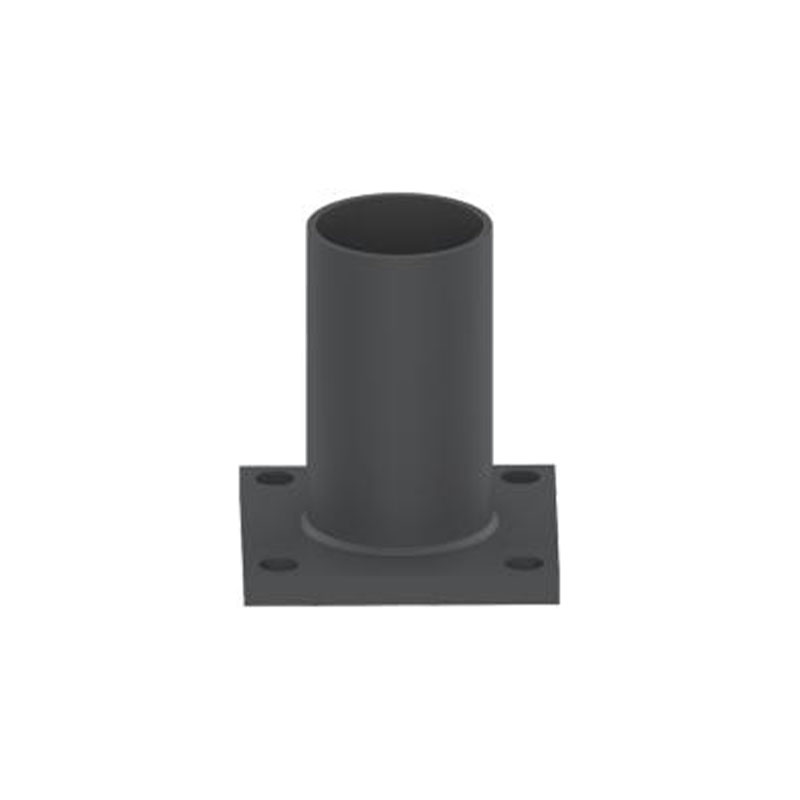
- Back plate anchoring: A flat steel back plate with pre-drilled bolt holes is fastened directly to the wall surface using anchor bolts sized for the expected load. The back plate distributes the load stress across a broad surface area of the wall.
- Bracket arm projection: One or more horizontal or angled arms extend outward from the back plate, providing the offset distance needed to position the light fixture at the correct horizontal distance from the wall and at the right height above grade.
- Pole or fixture attachment: The outer end of the bracket arm accepts either a tenon (a round post adapter) for a pole-mounted fixture, or a direct fixture mount for arm-mounted luminaires. All-stainless-steel hardware fastens the fixture securely.
- Wiring management: Most brackets include internal or channel-routed conduit pathways to run electrical wiring from the wall through the bracket arm to the fixture, keeping the installation clean, weatherproof, and compliant with electrical codes.
The entire assembly must be engineered to withstand not just the static weight of the luminaire, but also dynamic wind loads, which can exert far greater stress on the bracket and wall anchor system than the fixture weight alone.
Materials and Structural Standards
The structural integrity of a wall mount bracket is its most critical attribute. Light pole brackets are exposed to continuous outdoor loading, temperature cycling, moisture, and wind — conditions that demand premium-grade materials and verified engineering standards.
Structural Steel Construction
Quality wall mount brackets are fabricated from highest-grade structural steel, with selected models incorporating cast iron components for additional rigidity at high-stress connection points. The steel used conforms to ASTM A500 Grade C, which specifies a minimum yield strength of 50,000 PSI (345 MPa) — the same standard applied to structural steel columns in building construction. This ensures the bracket can sustain significant static and dynamic loads without permanent deformation.
Wall Thickness
Wall thickness directly determines load-bearing capacity and resistance to deformation under wind loading. Standard brackets are available in 11-gauge steel (0.120 inches / approximately 3 mm wall thickness), which provides the right balance between structural strength and manageable installed weight for most commercial and municipal lighting applications.
Hardware
All fastening hardware — bolts, nuts, washers, and anchor components — should be all-stainless steel (typically 304 or 316 grade). Stainless hardware resists corrosion indefinitely in wet and coastal environments, preventing the fastener failures that are the most common cause of bracket loosening over time. Using mild steel or zinc-plated hardware in outdoor bracket installations is a common cause of premature failure.
Finish Options and Corrosion Protection
A wall mount bracket's exterior finish determines its long-term corrosion resistance and its visual compatibility with the architectural environment. Standard finish options include:
| Finish Type | Description | Best For |
|---|---|---|
| Textured Architectural Bronze Powder Coat | Warm bronze tone with textured surface that conceals minor abrasions | Historic districts, upscale commercial areas, decorative installations |
| Hot-Dip Galvanized | Zinc coating applied by immersion, providing sacrificial corrosion protection | Industrial sites, coastal areas, high-humidity environments |
| Powder Coat over Galvanized | Galvanized base layer plus powder coat topcoat — dual-layer protection | Demanding outdoor environments requiring both maximum corrosion resistance and color specification |
| Custom Color Powder Coat | Any specified RAL or custom color available per project requirement | Projects requiring color-matched infrastructure, branded environments |
For the most demanding outdoor environments — marine coastal zones, industrial chemical exposure areas, or regions with heavy de-icing salt use — powder coat over galvanized provides the best long-term corrosion protection by combining sacrificial zinc protection with a hard, sealed topcoat barrier.
Types of Wall Mount Brackets by Configuration
Wall mount brackets come in several configurations to suit different installation geometries and lighting requirements:
Single-Arm Bracket
The most common type — a single horizontal or upward-angled arm projecting from the back plate. Suitable for most standard wall-mounted area lighting applications. The arm length (projection) determines how far the fixture is positioned from the wall, typically ranging from 12 inches to 36 inches (300 mm to 900 mm) depending on the installation requirement.
Double-Arm Bracket
Two arms extend from a single back plate, often angled outward in opposite directions. Used where a single wall attachment point must support two luminaires — for example, at corners or midpoints of building facades where bidirectional coverage is needed.
Davit-Style Wall Bracket
A curved, crane-like arm profile that rises vertically from the bracket base before curving over at the top. This style positions the luminaire overhead rather than at arm's-end level, providing a lighting geometry similar to a freestanding street pole. Often used at building entrances, loading docks, and covered walkways.
Adjustable Tilt Bracket
Features a pivot mechanism that allows the arm angle to be set at installation, directing the fixture precisely toward the target illumination area. Used in security lighting, sports area lighting, and façade illumination where fixture aim angle matters significantly.
Load Capacity and Wind Rating Considerations
Selecting a bracket with the correct load rating is critical to both safety and code compliance. Two load types must be assessed:
Static Load (Fixture Weight)
The bracket must support the total weight of the arm, luminaire housing, and lens assembly. Typical LED area light fixtures weigh between 5 kg and 25 kg depending on wattage and housing size. The bracket's rated static load must exceed the total fixture weight with an appropriate safety factor — typically a minimum safety factor of 3:1 is specified for structural lighting hardware.
Dynamic Wind Load
Wind loading generates bending moments at the bracket-wall interface that can be 5 to 10 times greater than the static fixture weight in high-wind zones. The bracket, wall anchors, and the wall itself must all be verified to handle the expected wind load based on local design wind speed, EPA (Effective Projected Area) of the fixture, and bracket arm length. In most jurisdictions, structural lighting installations must conform to AASHTO LTS (Luminaire Technical Specifications) or equivalent local structural codes.
Where Wall Mount Brackets Are Typically Used
Wall mount brackets are the preferred solution when ground installation is not feasible or cost-effective:
| Installation Location | Why Wall Mount Is Used | Typical Bracket Type |
|---|---|---|
| Multi-storey parking garages | Concrete deck floors prevent ground anchoring | Single-arm or double-arm bracket |
| Building perimeters and façades | No ground space available adjacent to building | Single-arm or davit bracket |
| Underpasses and tunnels | No above-grade clearance for freestanding poles | Low-profile single-arm bracket |
| Loading docks and warehouse exteriors | Vehicle traffic areas cannot accommodate ground poles | Heavy-duty single-arm bracket |
| Bridge structures | Structural deck prevents conventional pole bases | Engineered davit or custom bracket |
| Sports facility perimeter walls | Playing field area must remain unobstructed | Adjustable tilt bracket |
Wall Mount Bracket vs Freestanding Pole: Which to Choose
Both solutions have distinct advantages depending on the site conditions:
| Criterion | Wall Mount Bracket | Freestanding Pole |
|---|---|---|
| Ground excavation required | No | Yes — concrete base required |
| Installation cost | Lower (no concrete pour) | Higher (excavation and curing time) |
| Positioning flexibility | Limited to wall locations | Anywhere with suitable ground |
| Mounting height range | Determined by wall height | Flexible — pole length chosen freely |
| Suitable for paved/indoor areas | Yes | No (without core drilling) |
| Obstruction to traffic/pedestrians | None at ground level | Pole base occupies ground space |
Wall mount brackets are the clear choice wherever an existing structural wall or column is available, particularly in paved areas, enclosed structures, or sites where ground excavation would be disruptive or prohibitively expensive.
Installation Best Practices for Wall Mount Brackets
Correct installation is essential for both safety and long-term performance. The following steps apply to most commercial wall mount bracket installations:
- Verify wall structural capacity. Confirm that the wall material — concrete, masonry, or structural steel — can accept the anchor bolt pattern and sustain the expected combined static and wind loads. Unreinforced brick or lightweight block may require a structural engineer's assessment before installation.
- Use correctly specified anchor bolts. Anchor bolt diameter, embedment depth, and edge distance from wall corners must all conform to the bracket manufacturer's specifications and local structural code requirements. Under-specified anchors are the most common failure point in wall-mounted lighting installations.
- Apply sealant at all wall penetrations. Any hole drilled through the wall face for anchor bolts or conduit must be sealed with a weatherproof sealant to prevent water infiltration into the wall structure, which accelerates anchor corrosion and structural degradation.
- Torque all hardware to specification. Use a calibrated torque wrench to tighten all stainless steel fasteners to the manufacturer's torque values. Both under-torqued and over-torqued fasteners create failure risks — under-torqued joints vibrate loose; over-torqued threads strip or the fastener yields.
- Inspect annually. Check all fasteners for corrosion or loosening, inspect the powder coat or galvanized finish for chips or rust bleed, and verify that the bracket arm has not developed any permanent set (bending) under sustained load. Address any deficiencies before the next winter or storm season.
Key Specifications to Check Before Purchasing
When selecting a wall mount bracket for a specific project, verify these specifications against your installation requirements:
- Steel standard: Confirm ASTM A500 Grade C or equivalent with documented minimum yield strength of 50,000 PSI.
- Wall thickness: 11 gauge (0.120 inch) is standard for commercial-grade brackets. Lighter gauges (14 or 16 gauge) are suitable only for very light-duty residential applications.
- Arm projection length: Measured from the wall face to the fixture mounting point. Match to the required setback distance for your lighting layout.
- Tenon size compatibility: If mounting a pole-top fixture via a tenon, confirm the bracket arm's tenon outer diameter matches the fixture's slip fitter inner diameter (commonly 2⅜ inch O.D. for standard area lights).
- Finish and warranty: Confirm the finish type, coating thickness (powder coat minimum 3–4 mils dry film thickness is standard), and the manufacturer's finish warranty period.
- Hardware inclusion: Verify that all stainless steel mounting hardware is included in the package. Individually sourced hardware of unknown grade creates inconsistency in the assembly's corrosion resistance and structural performance.
- Packaging: Brackets packed in individual cartons prevent transit damage to the finish — particularly important for textured bronze or custom colour powder coat finishes that are difficult to touch up in the field.