English
 Español
 Français
 عربى
عربى italiano
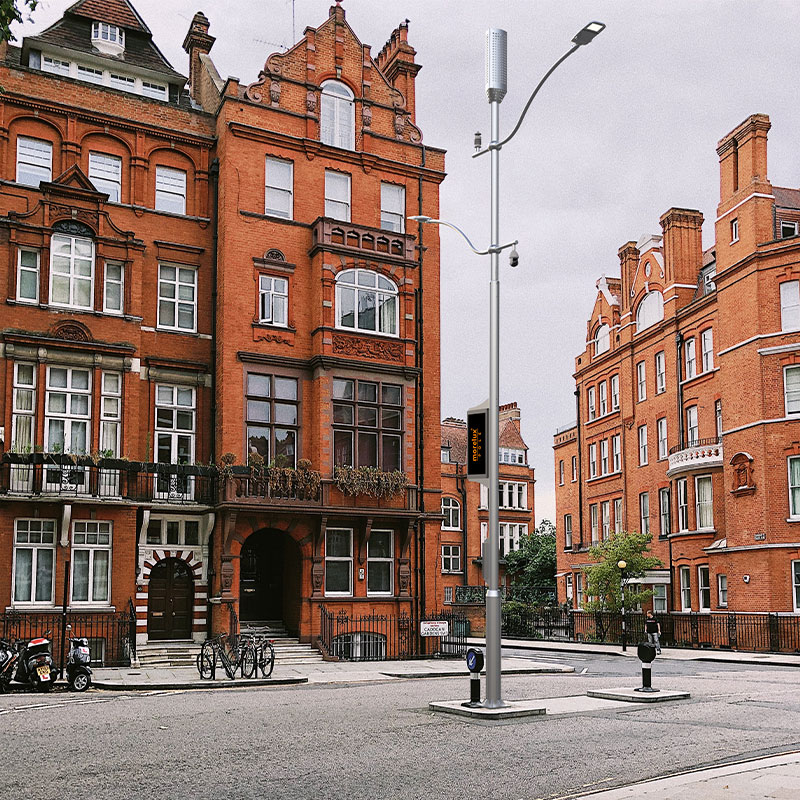
A smart light pole is a multifunctional urban infrastructure platform that goes far beyond traditional street lighting. While it continues to fulfill basic road illumination needs, it simultaneously serves as a hub for connectivity, surveillance, environmental monitoring, public communication, and data management — all integrated into a single pole. Smart light poles are the physical foundation of smart city networks, enabling precise, real-time management of urban resources across multiple domains from a single connected point.
Under the global wave of new infrastructure investment, smart light poles have emerged as one of the most strategically positioned assets in modern cities — already deployed by the thousands along highways, in urban districts, parks, campuses, and commercial zones worldwide.
Content
- 1 How Smart Light Poles Differ from Traditional Street Poles
- 2 The Architecture of a Smart Light Pole System
- 3 Core Functions Integrated into a Smart Light Pole
- 4 Where Smart Light Poles Are Deployed
- 5 Key Benefits for City Managers and Residents
- 6 Smart Light Poles and 5G: A Critical Relationship
- 7 Technical Specifications: What to Look for in a Smart Light Pole
- 8 The Role of Smart Light Poles in Building Smart Cities
How Smart Light Poles Differ from Traditional Street Poles
Traditional street lamp poles perform a single function: holding a light fixture. Smart light poles, by contrast, are engineered from the ground up as multi-layer platforms. The key differences are significant:
| Feature | Traditional Pole | Smart Light Pole |
|---|---|---|
| Primary function | Road lighting only | Lighting + data + connectivity + services |
| Remote control | None or basic timer | Full remote on/off/dimming via PC or mobile |
| Data collection | None | Environmental, traffic, and usage data in real time |
| Network provision | None | 5G, Wi-Fi hotspot, and AP signal output |
| Public safety tools | None | HD cameras, emergency alarm buttons, broadcasting |
| EV charging support | None | Integrated charging pile management |
| Information display | None | Digital screens for real-time public information |
The Architecture of a Smart Light Pole System
A smart light pole does not operate in isolation — it is part of a structured, layered platform architecture that connects physical hardware to city-wide management systems. This architecture typically consists of four layers:
1. Device Perception Layer
The physical layer — all sensors, cameras, detectors, and input devices mounted on or inside the pole. This includes meteorological sensors, HD cameras, emergency buttons, environmental monitors, and vehicle detection units. This layer collects raw data from the urban environment continuously.
2. Network Communication Layer
The transmission layer — consisting of 5G modules, Wi-Fi AP nodes, fibre connections, and power line communication technology. This layer ensures all data captured at the pole is transmitted reliably and in real time to management platforms, and that commands from management platforms reach the pole instantly.
3. Data Aggregation Layer
The processing layer — cloud-based or edge computing infrastructure that receives, stores, normalizes, and analyses data from all connected poles across a city. This layer transforms raw sensor readings into actionable urban intelligence — traffic flow analysis, environmental trend reporting, energy consumption auditing, and more.
4. System Application Layer
The management layer — the PC-based and mobile management platforms used by city operators, utility managers, and emergency services to monitor, control, and respond. This is where operators dim street lights remotely, view live camera feeds, push public announcements, and receive automated fault alerts.
Core Functions Integrated into a Smart Light Pole
A fully equipped smart light pole integrates a wide range of hardware and software functions within a single structure. Here is a breakdown of the primary capabilities:
Smart Lighting Management
The core function remains intelligent street lighting. Operators can remotely turn lights on or off, adjust brightness levels (dimming), and programme time-scheduled tasks — all via mobile phone or PC. Adaptive dimming based on real-time traffic or pedestrian activity can reduce street lighting energy consumption by 30–50% compared to fixed-schedule systems.
5G and Wi-Fi Connectivity
Smart poles serve as small cell nodes for 5G signal output, dramatically extending network coverage in urban areas without requiring dedicated tower installations. Additionally, built-in Wi-Fi AP hotspot devices allow residents and visitors to connect to the internet simply by being near a pole — providing area-wide wireless coverage at street level.
Video Surveillance
Built-in high-definition cameras with infrared capability provide 24-hour remote monitoring of road scenes and public spaces. Camera feeds are accessible in real time via mobile or PC management platforms, and can support AI-powered analytics such as licence plate recognition, pedestrian counting, and abnormal behaviour detection.
Environmental Monitoring
Multiple integrated meteorological sensors continuously measure and report:
- Air temperature and humidity
- Wind speed and wind direction
- Rainfall intensity
- Ultraviolet radiation levels
- Ambient noise intensity
- Light intensity (for adaptive lighting adjustment)
- PM2.5 and air quality indices (on advanced models)
This dense, street-level sensor network enables cities to build highly granular environmental datasets that far exceed what traditional weather station networks can provide.
Multimedia Information Display
Digital display screens mounted on smart poles support remote content publishing. Cities and property managers can broadcast real-time meteorological information, emergency announcements, public notices, transit updates, and controlled advertising content — updated instantly from a central management platform without any physical intervention at the pole.
Public Address Broadcasting and Intercom
Built-in broadcast speakers allow management centres to transmit audio announcements remotely to specific poles or zone-wide groups of poles simultaneously. Two-way remote intercom capability enables real-time voice communication between the management centre and individuals at the pole location.
One-Click Emergency Alarm
A physical emergency button on the pole allows people in distress to instantly alert the background management centre with a single press. The centre receives the signal with the pole's precise GPS location and can immediately dispatch personnel or emergency services to the exact site — significantly improving urban public safety response times.
EV Charging Pile Management
By drawing from existing street light power supply infrastructure, smart poles can host electric vehicle charging points without requiring separate power installation. Remote PC-side management of charging piles is supported, along with user-facing features including mobile phone charging reservations and online payment processing.
Vehicle-Road Collaboration (V2X)
Advanced smart poles support vehicle-to-infrastructure communication protocols, enabling connected and autonomous vehicles to receive real-time road condition data, traffic signal status, and hazard alerts directly from the pole network — a foundational capability for autonomous driving deployment at city scale.
Where Smart Light Poles Are Deployed
Smart light poles are not limited to highways and arterial roads. Their versatile platform architecture makes them suitable for a wide range of urban and semi-urban environments:
| Deployment Location | Key Functions Used | Primary Benefit |
|---|---|---|
| Urban arterial roads | Lighting, CCTV, 5G, traffic monitoring | Traffic management and public safety |
| Parks and plazas | Wi-Fi, environmental sensors, info display, alarm | Public amenity and safety |
| University and business campuses | Wi-Fi, broadcasting, EV charging, CCTV | Connectivity and campus management |
| Residential communities | Lighting control, EV charging, emergency alarm | Energy saving and resident safety |
| Highways and expressways | V2X, CCTV, meteorological sensors, 5G | Autonomous driving support and road safety |
| Commercial districts | Info display, Wi-Fi, advertising screens, lighting | Retail engagement and wayfinding |
Key Benefits for City Managers and Residents
The convergence of multiple systems into a single pole delivers tangible benefits at both the operational and citizen level:
For City Managers and Operators
- Reduced infrastructure duplication: A single pole replaces what would otherwise require separate installations for street lights, CCTV towers, Wi-Fi access points, environmental stations, and public address systems — significantly reducing capital expenditure and street clutter.
- Centralised management: All devices across an entire city can be monitored and controlled from a single platform, reducing the need for physical inspection patrols and enabling faster fault response.
- Energy cost savings: Remote dimming and adaptive lighting scheduling reduce electricity consumption. Cities deploying smart pole lighting management have reported energy savings of 40–60% on street lighting budgets.
- Data-driven urban planning: The dense sensor networks enable evidence-based decisions on traffic management, environmental policy, public safety resource allocation, and infrastructure investment priorities.
For Residents and the Public
- Free or low-cost Wi-Fi access in public spaces
- Real-time access to environmental and public information on nearby digital screens
- Faster emergency response through one-click alarm systems
- Convenient EV charging reservations and payment within walking distance
- Improved overall safety from 24-hour lighting management and surveillance coverage
Smart Light Poles and 5G: A Critical Relationship
The rollout of 5G networks and smart light pole deployment are deeply interconnected. 5G's high-frequency signals have a shorter effective range than 4G, requiring a much denser network of small cell nodes — ideally positioned every 100 to 300 metres in urban environments. Street light poles, already distributed at roughly this spacing throughout most cities, provide the ideal mounting points for 5G small cells.
This means smart light pole networks serve a dual purpose: they are both consumers of high-speed connectivity (for their own data transmission needs) and providers of it (hosting 5G nodes that serve the surrounding area). As 5G becomes the backbone of smart city IoT, smart poles become the most cost-effective and logistically practical way to achieve dense urban 5G coverage without separate tower construction programmes.
Technical Specifications: What to Look for in a Smart Light Pole
When evaluating smart light pole systems for deployment, the following specifications are the most important to assess:
- Connectivity modules: Confirm support for 5G NR, Wi-Fi 6 (802.11ax) AP, Ethernet, and power line communication (PLC) for maximum coverage and redundancy.
- Camera resolution and night vision: Look for at least 4K resolution cameras with infrared night vision capability and wide-angle coverage. AI analytics integration (people counting, vehicle detection) adds significant value.
- Sensor suite completeness: Verify the number and type of environmental sensors included. A full suite should cover at minimum temperature, humidity, wind, rainfall, noise, UV, and light intensity.
- Display screen brightness: Outdoor digital displays require a minimum brightness of 2,500 nits to remain readable in direct sunlight. Lower-brightness screens are effectively invisible during daytime.
- IP and IK protection ratings: Outdoor pole-mounted equipment should carry at minimum IP65 (dust and water jet protection) and IK08 (impact resistance) ratings for reliable long-term operation.
- Power supply design: A well-engineered smart pole draws from the existing street light power supply, minimising the civil works required for installation. Confirm rated power capacity is sufficient to support all active devices simultaneously.
- Platform openness: A smart pole management platform using open API architecture can integrate with existing city management systems — traffic management, emergency services, utility management — without requiring a complete system rebuild.
The Role of Smart Light Poles in Building Smart Cities
Smart cities require a physical infrastructure layer that can carry sensing, communication, and control functions at street level across an entire urban area. Building dedicated infrastructure for each individual smart city function — separate towers for 5G, separate poles for CCTV, separate stations for environmental monitoring — is economically and logistically impractical at city scale.
Smart light poles solve this by consolidating all of these functions into existing urban infrastructure that cities must install and maintain regardless. Every city needs street lighting. By upgrading that mandatory asset into a multi-function smart platform, cities achieve smart city capabilities at a fraction of the cost of building them from scratch.
The result is a city where every street, park, and public space becomes a data-rich, connected environment — enabling the precise, real-time urban management that defines a genuinely smart city. Smart light poles are not just an upgrade to street furniture; they are the physical nervous system of the intelligent city.