English
 Español
 Français
 عربى
عربى italiano
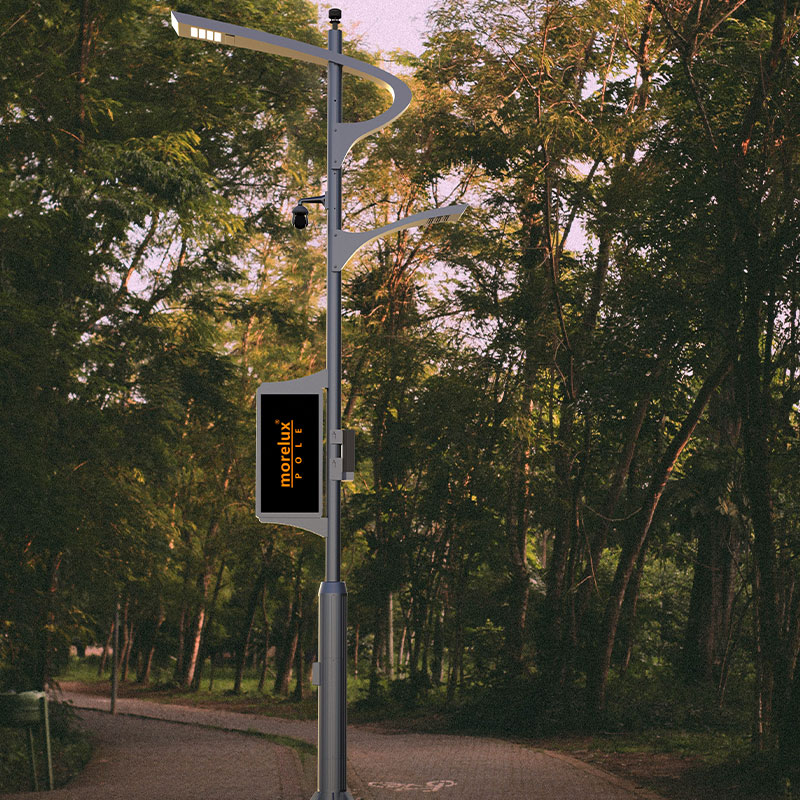
Smart light poles go far beyond simply holding a luminaire. They function as multi-purpose urban infrastructure platforms that integrate intelligent street lighting management with 5G connectivity, environmental sensing, video surveillance, public broadcasting, EV charging, Wi-Fi access, and emergency communication — all mounted on a single pole connected to a centralized smart city management system. By consolidating what would otherwise be separate pieces of urban equipment onto one structure, smart light poles reduce installation costs, simplify city management, and enable data-driven decision-making across multiple municipal services simultaneously.
Content
Intelligent Street Lighting Management
The foundational function of a smart light pole remains lighting — but executed with a level of control and efficiency that conventional poles cannot match. Smart lighting management capabilities include:
- Remote on/off and dimming control: individual lights or groups can be switched and dimmed via mobile app or PC dashboard — eliminating the need for physical site visits for routine adjustments
- Scheduled task automation: lighting profiles can be programmed to adjust output automatically at specific times — for example, dimming to 30% after midnight when pedestrian traffic is minimal, saving up to 30–50% in energy costs compared to fixed-output operation
- Fault detection and reporting: the system automatically detects and reports luminaire faults, driver failures, or power supply anomalies to the management center — enabling targeted maintenance dispatch without manual inspection rounds
- Energy metering: per-pole energy consumption data supports billing verification, efficiency audits, and carbon reporting for municipal sustainability targets
5G and Wireless Connectivity Infrastructure
Smart light poles are a primary deployment platform for 5G small cell equipment in urban environments. Because 5G operates at high frequencies with short propagation range, dense networks of small antennas are required — and existing light pole infrastructure provides the ideal mounting points at the correct height, spacing, and power supply availability.
In addition to 5G hosting, smart poles provide:
- Wi-Fi hotspot access points: built-in Wi-Fi AP devices provide public internet connectivity within a coverage radius of 50–100 meters per pole — enabling free public Wi-Fi corridors along streets, in parks, and across public plazas
- IoT sensor network connectivity: the pole acts as a local data aggregation hub for connected sensors, vehicles, and devices in its vicinity — supporting smart city data collection across traffic, environment, and public safety domains
Environmental Monitoring
Smart light poles equipped with meteorological sensor arrays function as distributed urban weather and air quality monitoring stations. Sensors integrated into or mounted on the pole can detect and transmit real-time data on:
- Air temperature and relative humidity
- Wind speed and wind direction
- Rainfall intensity and accumulation
- UV radiation intensity
- Ambient noise levels (dB)
- Ambient light intensity (for adaptive lighting control)
- PM2.5 and PM10 particulate matter concentration (air quality index)
A network of smart poles across a city creates a high-resolution environmental monitoring grid that supports real-time public health alerts, urban heat island mapping, and data-driven environmental policy — far more granular than the sparse fixed weather station networks traditional cities rely on.
Video Surveillance and Public Safety
Built-in high-definition cameras allow smart light poles to function as continuous video surveillance nodes across the urban environment. From a single management platform, operators can:
- Monitor road scenes, intersections, parks, and pedestrian areas 24 hours a day via mobile or PC interface
- Record and archive footage for incident investigation and evidence collection
- Integrate with AI video analytics for license plate recognition, crowd counting, or anomaly detection
- Support vehicle-road collaboration systems where cameras communicate traffic conditions to connected vehicles
The integration of cameras on lighting infrastructure eliminates the need for separate CCTV pole installations — significantly reducing both capital expenditure and the visual clutter of multiple separate structures in public spaces.
Public Information Display and Broadcasting
Smart light poles support two-way public communication functions that transform them into active civic information infrastructure:
- LED display screens: mounted panels can broadcast real-time information including weather conditions, traffic updates, emergency alerts, public announcements, and commercial advertising content — all managed and updated remotely from the central platform
- Broadcast speaker system: built-in speakers enable remote audio broadcasting for public announcements, emergency warnings, and background music in commercial or leisure zones; remote intercom capability allows two-way voice communication between the pole and the management center
- One-click emergency alarm: a physical distress button on the pole allows members of the public to instantly report emergencies to the management center, which can immediately dispatch response personnel — a critical public safety feature for parks, underpasses, and other locations with limited natural surveillance
EV Charging and Power Management
Smart light poles utilize the existing electrical supply infrastructure of the street lighting network to host EV charging points — one of the most cost-effective deployment strategies for urban EV charging infrastructure. Features include:
- Integrated charging pile management: PC-side remote monitoring of charging pile status, energy output, and revenue collection
- Mobile reservation and payment: users can book charging slots and complete payment via smartphone app — reducing waiting time and improving utilization of the charging point
- Load management integration: charging output can be adjusted in response to grid demand signals or time-of-use pricing to minimize peak demand charges
Smart Light Pole Function Summary
| Function Category | Key Capabilities | Primary Benefit |
|---|---|---|
| Smart lighting | Remote dim/switch, scheduling, fault alerts | 30–50% energy saving |
| Connectivity | 5G small cell, Wi-Fi AP hotspot | Urban connectivity coverage |
| Environmental monitoring | Weather, air quality, noise sensors | Real-time urban data grid |
| Surveillance | HD camera, 24/7 remote monitoring | Public safety improvement |
| Public communication | Display screen, speaker, emergency alarm | Civic information and safety |
| EV charging | Integrated charging pile, mobile payment | Low-cost EV infrastructure rollout |