English
 Español
 Français
 عربى
عربى italiano
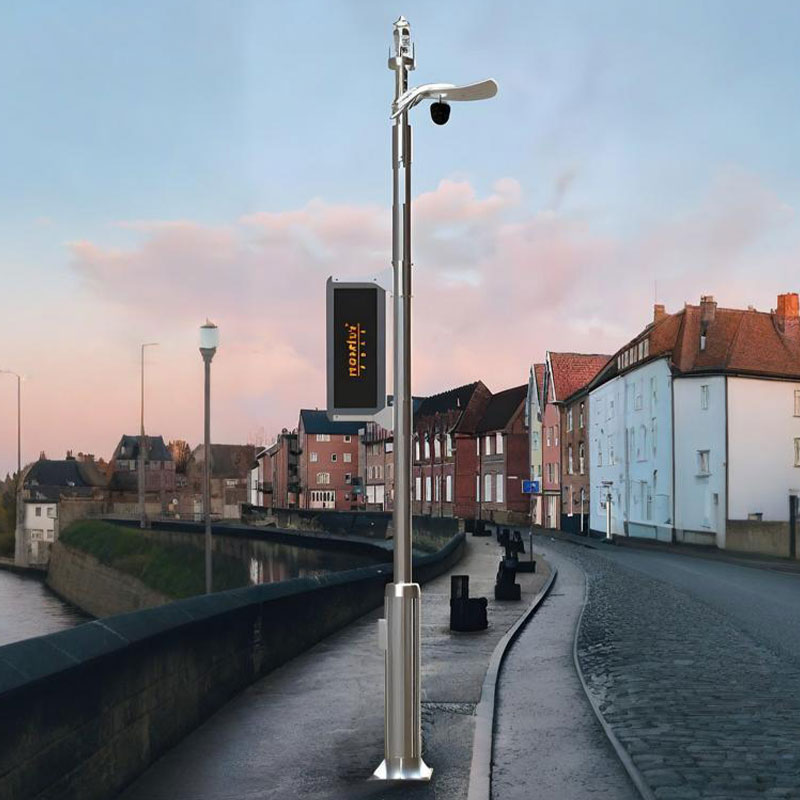
A smart street light pole works by integrating multiple sensing, communication, and control modules into a single vertical infrastructure unit, connected to a centralized cloud-based management platform. The pole collects data from embedded sensors, transmits it through a communications layer (4G/5G/NB-IoT), processes and aggregates it at the platform level, and executes commands sent back from operators — all in real time. Unlike a conventional street light that simply switches on at dusk and off at dawn, a smart pole operates as an active node in the urban data network: simultaneously managing lighting, collecting environmental data, hosting wireless connectivity, streaming video surveillance, and enabling two-way public communication from a single structure powered by the city's electrical supply.
Content
The Four-Layer Platform Architecture
The operating architecture of a smart street light pole system is organized into four functional layers that work together from physical sensing to end-user application:
Layer 1: Device Perception Layer
The perception layer consists of all the physical sensors and input devices mounted on or within the pole. These generate the raw data that the system acts upon. Components typically include PIR motion sensors (triggering adaptive dimming), cameras (capturing video streams), environmental sensors (measuring air quality, temperature, humidity, wind, UV, and noise), and power metering modules (recording energy consumption per pole). The perception layer translates physical world conditions into digital data signals that are passed upward to the communications layer.
Layer 2: Network Communication Layer
The communication layer handles data transmission between the pole and the management platform. Smart poles use one or more connectivity technologies depending on the infrastructure available: 4G/5G cellular networks for video-heavy applications requiring high bandwidth; NB-IoT or LoRaWAN for low-bandwidth sensor data transmission at low power; Ethernet over the existing street light power cable for sites with physical network infrastructure; and Wi-Fi AP nodes mounted on the pole itself that provide public internet connectivity while also serving as a local network backhaul option. The pole both transmits its own data and acts as a relay node for other connected devices in its vicinity.
Layer 3: Data Aggregation Layer
At the data aggregation layer, the cloud platform receives, stores, processes, and analyzes the data streams from every pole in the network. This layer applies algorithms to identify patterns — unusual energy consumption (potential lamp fault), persistent motion detection at an unexpected location (potential security incident), or air quality readings above threshold (pollution alert). Aggregated data at this layer generates the actionable intelligence that drives the system application layer.
Layer 4: System Application Layer
The application layer presents processed data and control functions to operators through web dashboards and mobile applications. From this interface, city managers can view real-time system status across thousands of poles simultaneously, receive automated fault alerts, adjust lighting schedules remotely, review camera footage, push public announcements to pole-mounted screens and speakers, and generate energy and maintenance reports — all from a single management center.
Intelligent Lighting Control: How Dimming and Scheduling Work
The lighting management function of a smart pole operates through a control unit (typically a DALI or 0-10V compatible driver with a wireless interface) that receives commands from the platform and adjusts the LED luminaire output accordingly. The system can operate in several modes simultaneously:
- Scheduled dimming: pre-programmed output profiles reduce lighting to 30–50% during low-traffic hours (e.g., midnight to 5:00 am), saving up to 40% of annual lighting energy compared to fixed-output operation
- Adaptive motion-triggered brightening: PIR motion sensors detect approaching pedestrians or vehicles and briefly boost the relevant pole to 100% output, returning to reduced output after the person or vehicle has passed
- Remote manual override: operators can remotely switch individual poles or groups on, off, or to any intermediate output level via mobile phone or PC in response to incidents or events
- Fault detection and alerting: the luminaire driver continuously monitors lamp status and driver health, automatically generating fault alerts when anomalies are detected — eliminating the need for manual night patrols to identify failed lights
Environmental Sensing: How the Pole Monitors Urban Conditions
Built-in meteorological and environmental sensor arrays transform smart poles into distributed urban monitoring stations. Each pole's sensor suite typically measures:
- Air temperature, relative humidity, and atmospheric pressure
- Wind speed and direction
- Rainfall intensity and accumulation
- UV radiation intensity
- Ambient noise level (decibels)
- PM2.5 and PM10 particulate matter concentration
- Ambient light level (used for adaptive lighting activation threshold)
When hundreds of poles across a city report sensor data to the same platform, the aggregated dataset creates a high-spatial-resolution urban environmental monitoring network — far more granular than the sparse fixed weather station networks cities traditionally rely on.
Video Surveillance and Public Safety Integration
Built-in high-definition cameras operate as continuous video surveillance nodes, streaming to the management platform and accessible to authorized operators via mobile or PC interfaces around the clock. The camera system operates at the pole's standard illumination height — typically 6–10 meters — providing a clear field of view across the road scene, intersection, or public space below.
Beyond passive monitoring, the system incorporates an emergency alarm button on the pole body that allows anyone in distress to immediately notify the management center. When activated, the pole transmits a GPS-located alert to the platform, which can dispatch response personnel and direct the nearest camera to the alarm location — significantly reducing response times compared to traditional emergency reporting methods.
Smart Pole Function Summary
| Function | Technology Used | City Benefit |
|---|---|---|
| Adaptive lighting control | PIR sensors, DALI driver, cloud scheduling | Up to 40% energy saving |
| 5G small cell hosting | 5G antenna module on pole mount | Urban 5G coverage densification |
| Public Wi-Fi hotspot | Wi-Fi AP module (50–100m radius) | Free public internet access |
| Environmental monitoring | Meteorological sensor array | Real-time urban data grid |
| Video surveillance | HD camera, 24/7 streaming | Public safety monitoring |
| Public information display | LED screen, broadcast speaker | Civic communication and alerts |
| EV charging management | Integrated charging pile, mobile payment | Low-cost EV infrastructure deployment |