
1-Material
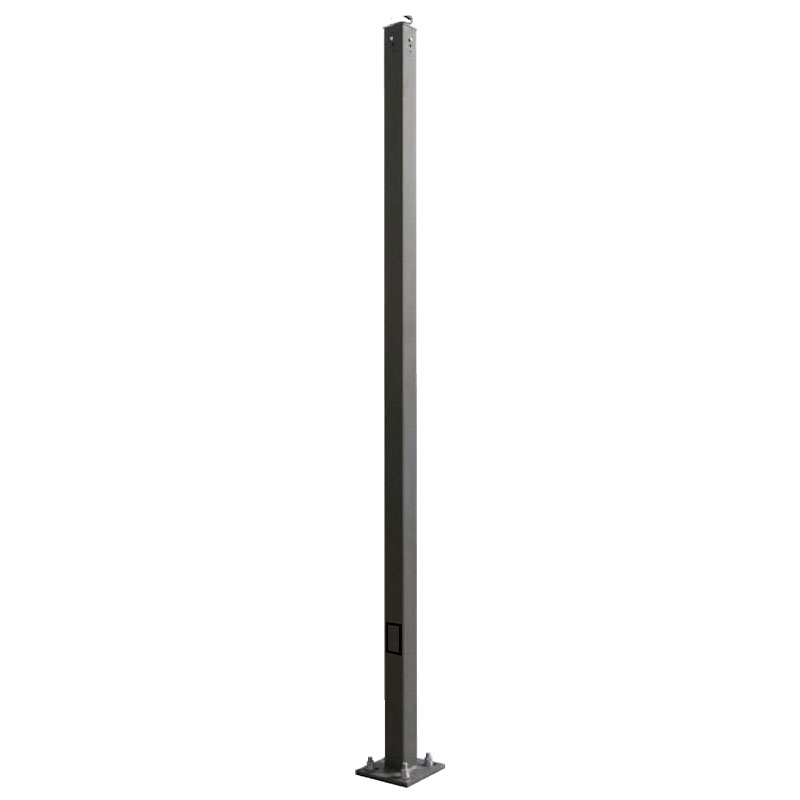
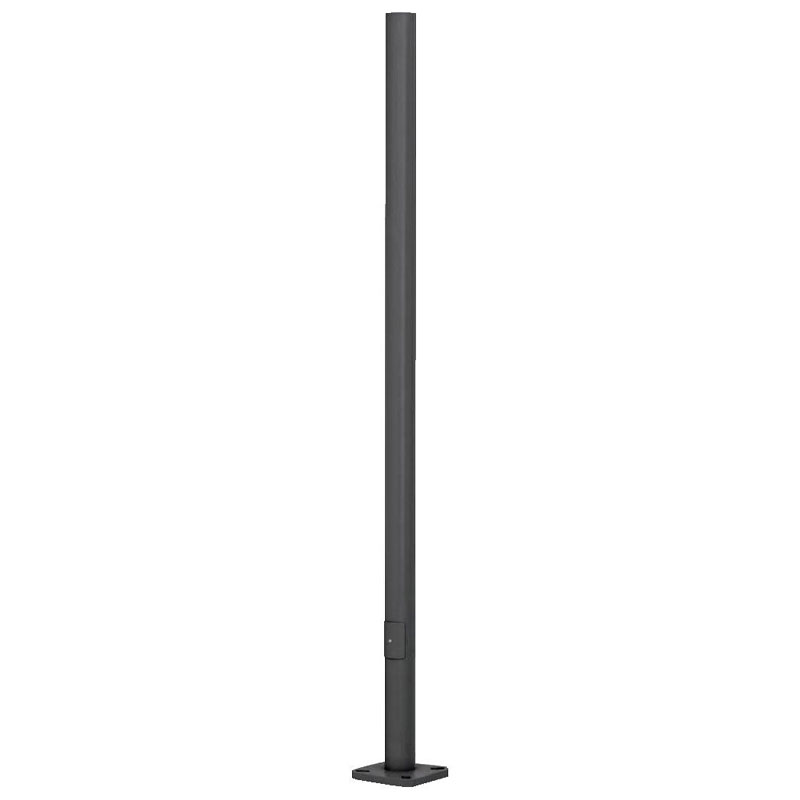
Raw materials for spinning are aluminium alloy 6063 / 6060 tube. This alloy can sustain wind pressure, is highly resistant to corrosion, and has decorative properties.
2-Spinning
Using large CNC spinning equipment, the raw materials are made into conical or profiled shapes.
3-Access Door
Each aluminium pole has a wiring chamber where the connection box is installed. The wiring chamber cover is laser cut or by a specially designed saw.
The wiring chamber of aluminium columns can achieve IP54 protection.
Earthing:
There is M8 bolt in the hole for fastening the earth grounding wire. Bolts for Wiring Chamber Cover:
The wiring chamber cover is secured by hexagonal stainless steel bolts to prevent door opening by unauthorized persons.
4-Welding For Base
The A356 low pressure casted base, and T6 heat treatment, we use automatic welding equipment to connect base and pole. The welding quality has the Canadian welding Bureau certification. In this high quality welding process, the welding strength and cosmetics are guaranteed.
5-T6 Heat Treatment
Heating at 185-195 °C for 7-8 hours makes the column stable, and the hardness reaches 9- 11HW
6-Brush
Before surface finish, we polish the pole in to fit customer requirements, or sand blasting for a matte surface
7-Surface Finishing
We have four finishes for aluminium poles:
1. Anodizing
Anodizing is an electrochemical method that creates an oxide layer on the surface of the metal, which is suitable for coastal areas. The standard anodizing coating is 15um, but we can adjust according to the customer's requirements.
2. Fluorocarbon coating
A new coating material, it has excellent anti-fade, anti-polluted air (acid rain) corrosion, and anti-UV ability
3. Powder coating
Colored polyester powder coating, bright colors, and non-fading.
4. Water transfer printing
Water pressure is used to emboss the wood design on the pole surface. Notice: Anodizing inherently results in color variation on aluminium as the material difference between the poles, the base, and the welding material is inevitable. If you want to ensure the color consistency on the surface of the poles. Powder coating or fluorocarbon coating is recommended.
8-Testing
Morelux has complete testing equipment for poles, brackets, and accessories. Our inspection includes: tensile testing, yield strength test, ductility test, oxidation/spray film thickness test, adhesion test, hardness test, and the base of mirror image analysis and testing. Ensures the quality of each aluminium pole. Our chemical laboratory is equipped to measure the quality of anodic coatings. Our laboratory has an advanced spectrometer, which determines the qualitative and quantitative composition of alloy mixtures, which is a key factor in the qualification of aluminium alloys for anodizing. The measurement of the quality of oxide coatings, colouring, separated into spectral colour intensity and matte surface level, is measured by a high-quality spectrometer.
9-Packaging
Morelux uses reinforced nylon bag, bubble bag, and corrugated packaging to multi-layer the light pole, which protects the poles during transportation.
An American aluminum light pole is a tapered or straight outdoor lighting support structure made from high-quality aluminum alloy, designed and specified to meet North American engineering, safety, and aesthetic standards for road lighting, street lighting, parking lots, plazas, parks, and landscape illumination. The ...
View MoreSmart light poles go far beyond simply holding a luminaire. They function as multi-purpose urban infrastructure platforms that integrate intelligent street lighting management with 5G connectivity, environmental sensing, video surveillance, public broadcasting, EV charging, Wi-Fi access, and emergency communication — ...
View MoreA well-manufactured aluminum light pole has a structural lifespan of 30 to 50 years under normal outdoor conditions. The aluminum shaft itself is highly resistant to corrosion and fatigue, and quality manufacturers back their poles with structural warranties of 25 years as standard. The surface finish — whether anodiz...
View MoreIn modern urban infrastructure and landscape lighting design, aluminum lamp post have become a mainstream choice, especially in situations where aesthetics are paramount, leading to an increasing demand for decorative poles. High-quality aluminum light poles must not only meet stringent structural strength and weather resistance requirements but also possess excellent decorative appeal.
High-performance decorative poles and aluminum light poles have stringent requirements for raw materials. We select 6063/6060 aluminum alloy tubing as the base material for spin forming.
6063/6060 aluminum alloy stands out for its superior performance. It has high corrosion resistance, effectively resisting moisture, salt spray, and pollutants in outdoor environments, significantly extending the lifespan of the light pole. Furthermore, this alloy has an excellent strength-to-weight ratio, sufficient to withstand external loads such as wind pressure.
Spin forming is an efficient and precise processing technology that ensures the geometric accuracy and surface finish of the aluminum light pole body, providing a solid foundation for achieving various decorative appearances.
The stability and safety of the light pole depend on the strength of the base and the quality of the connection between the base and the pole.
We use A356 aluminum alloy for low-pressure casting of the base. A356 alloy exhibits excellent casting and mechanical properties. The base undergoes T6 heat treatment (solution treatment + artificial aging), significantly improving the material's strength and hardness, ensuring the base's reliability.
The connection between the base and the pole is a critical step. We use automated welding equipment for the connection, which not only ensures weld strength but also enhances the overall aesthetics. This high-quality welding process has been certified by the Canadian Welding Bureau (CWB), fully demonstrating its compliance with internationally recognized quality standards.
This high-quality connection process ensures that the decorative pole maintains a smooth and uniform weld while bearing long-term loads, greatly enhancing the overall decorative appeal and durability of the product.
As decorative light poles, these aluminum light poles are widely used in urban squares, pedestrian streets, parks, upscale communities, and scenic areas where an emphasis on environmental atmosphere and design is needed. They are not only carriers of lighting but also an important part of the urban landscape, embodying a perfect unity of functionality and artistry.
These aluminum lamp post offer both beautification and practical illumination, making them ideal for modern urban aesthetics.
Answer: The main raw material is 6063/6060 aluminum alloy tubing used for spinning. The base is made of A356 aluminum alloy using low-pressure casting.
Answer: This alloy has high corrosion resistance, sufficient strength to withstand wind pressure, and excellent decorative and lightweight properties.
Answer: The A356 low-pressure cast base undergoes T6 heat treatment after forming, which significantly improves the strength and hardness of the base.
Answer: They are joined using automated welding equipment. The welding quality has been certified by the Canadian Welding Bureau (CWB), guaranteeing weld strength and aesthetics.
Answer: Spinning ensures that the aluminum lamp post body has a precise geometry and a smooth surface quality, contributing to a final decorative appearance.
Ningbo Morelux Pole Technology Limited All Rights Reserved. Wholesale Garden Poles Supplier OEM/ODM Decorative Poles Company



 English
 Español
 Français
 عربى
عربى italiano