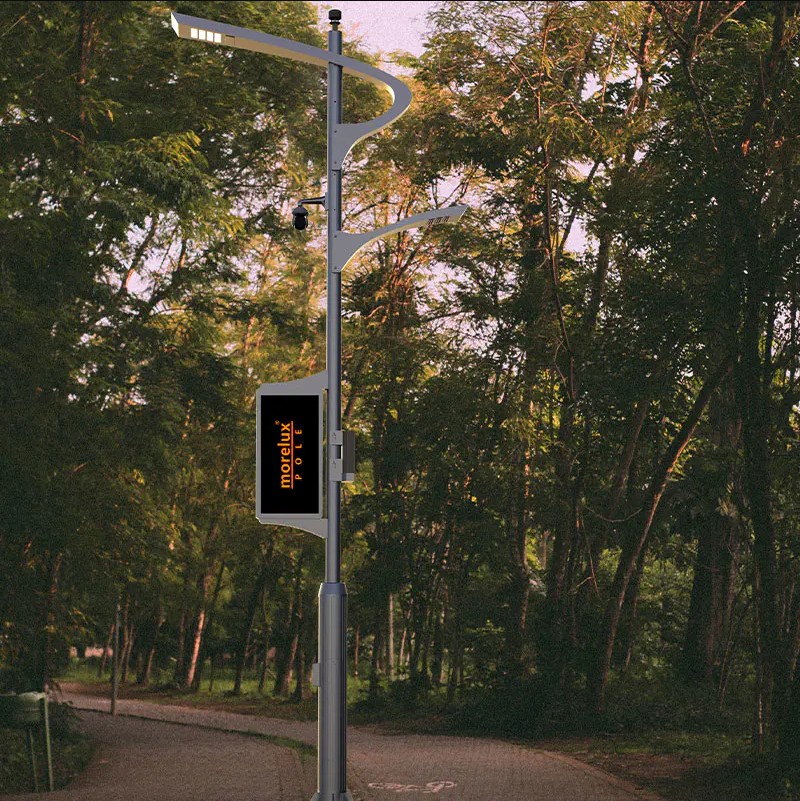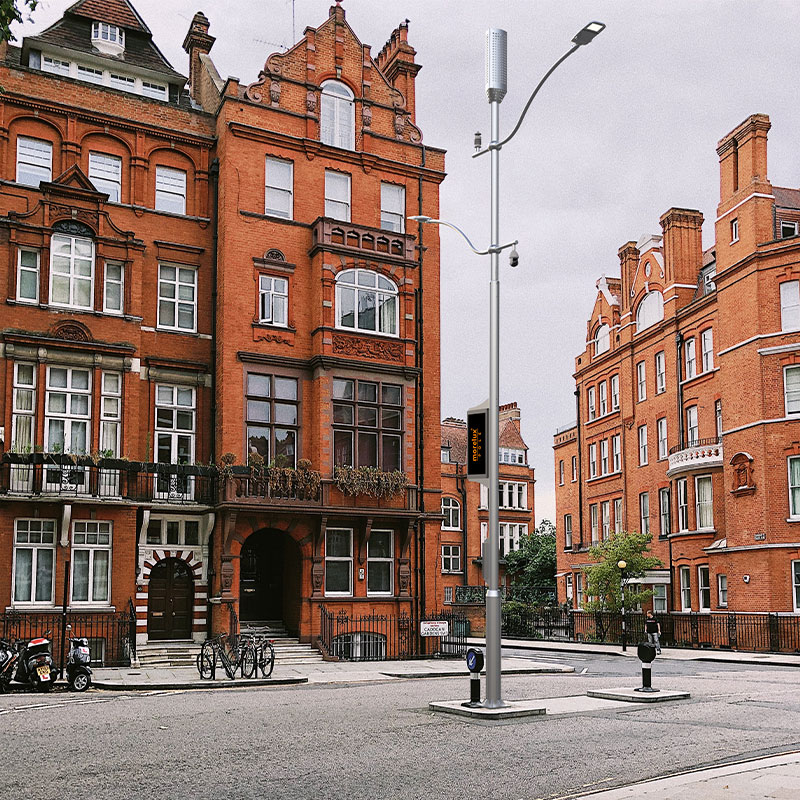
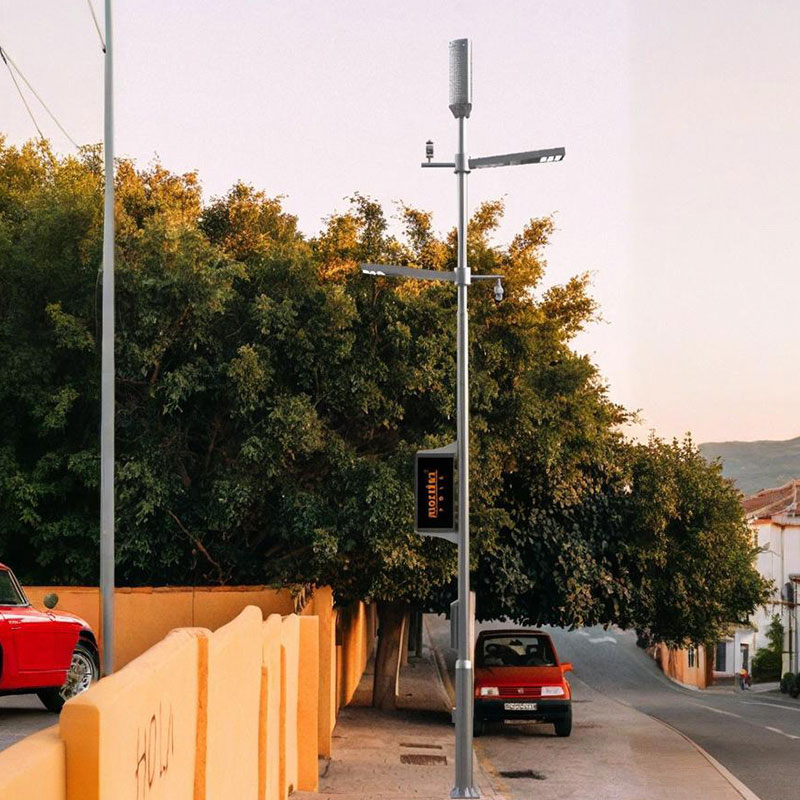
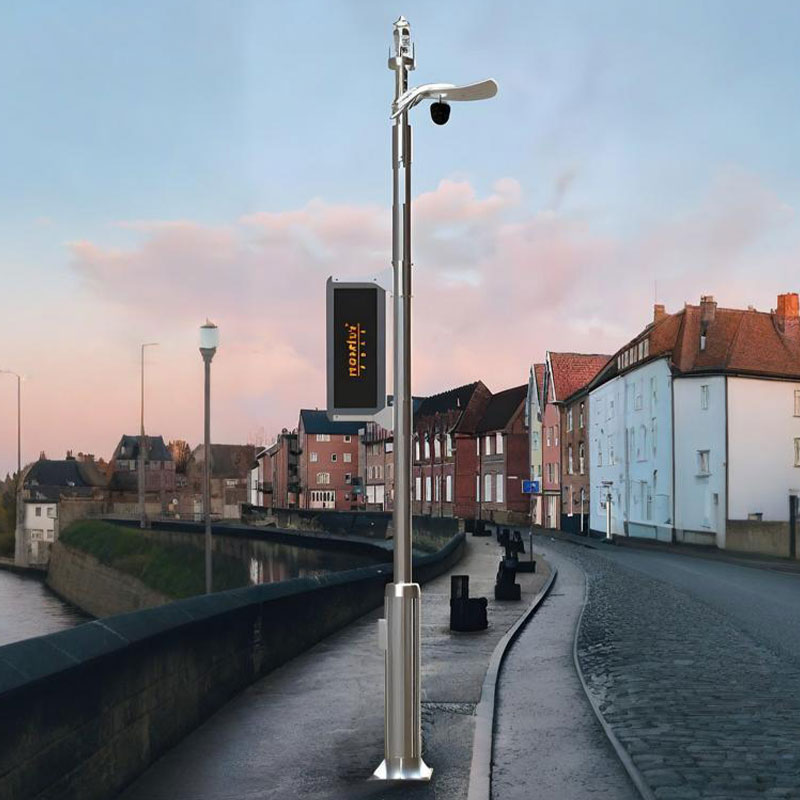
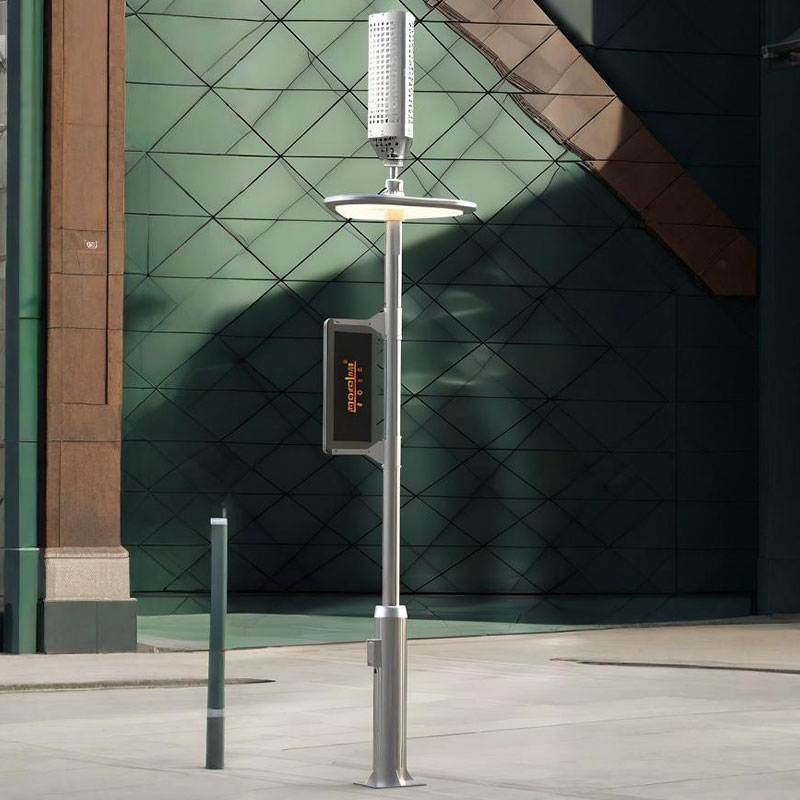
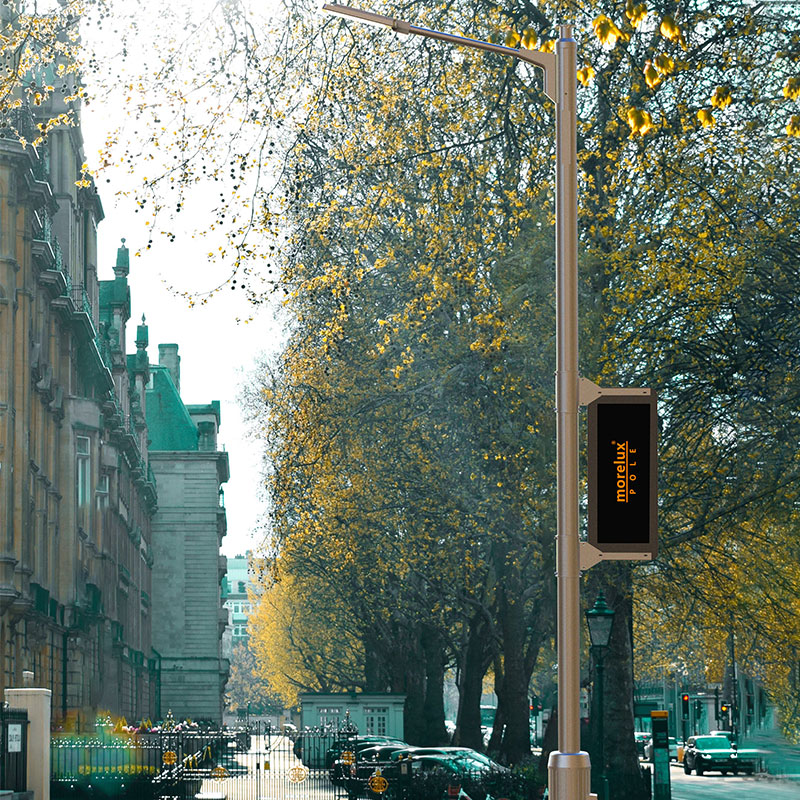
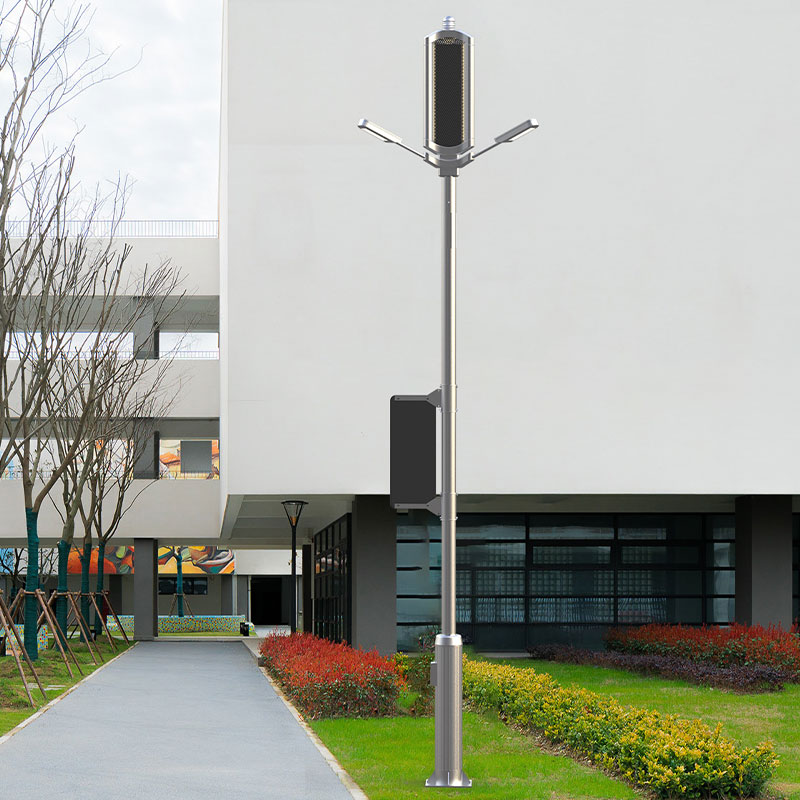
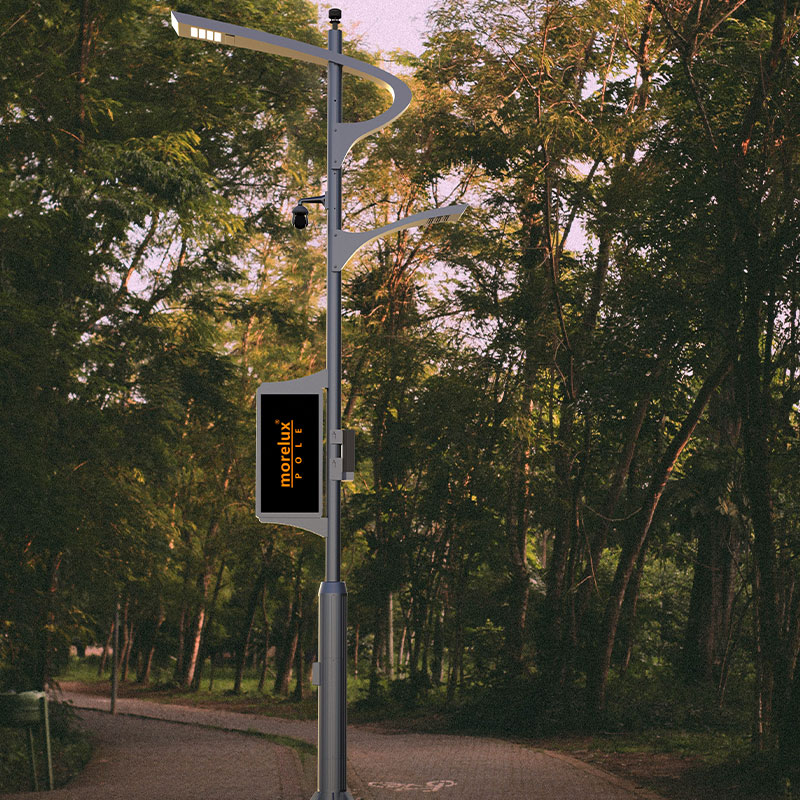
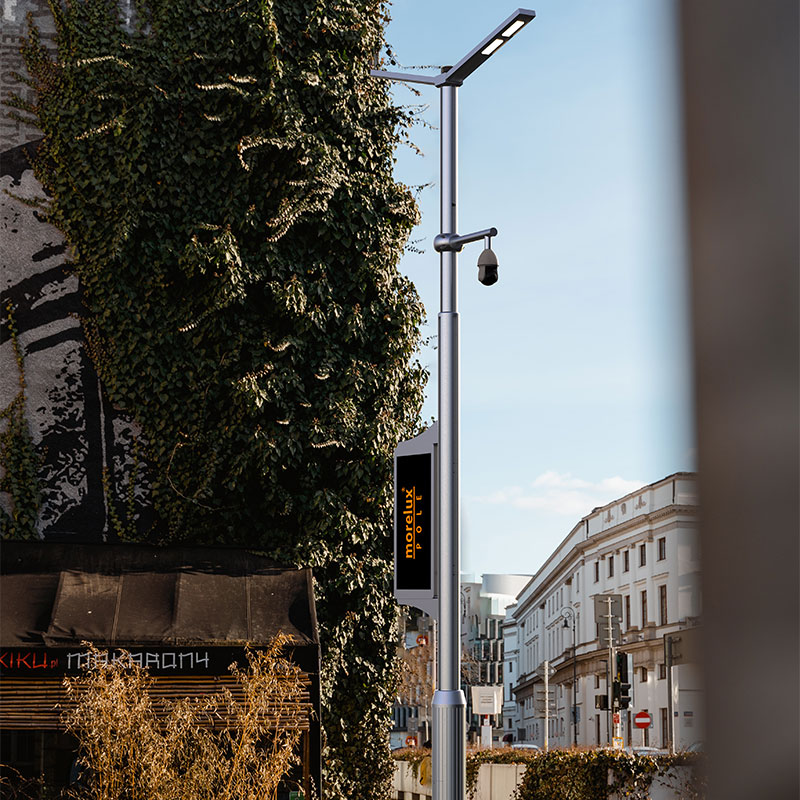
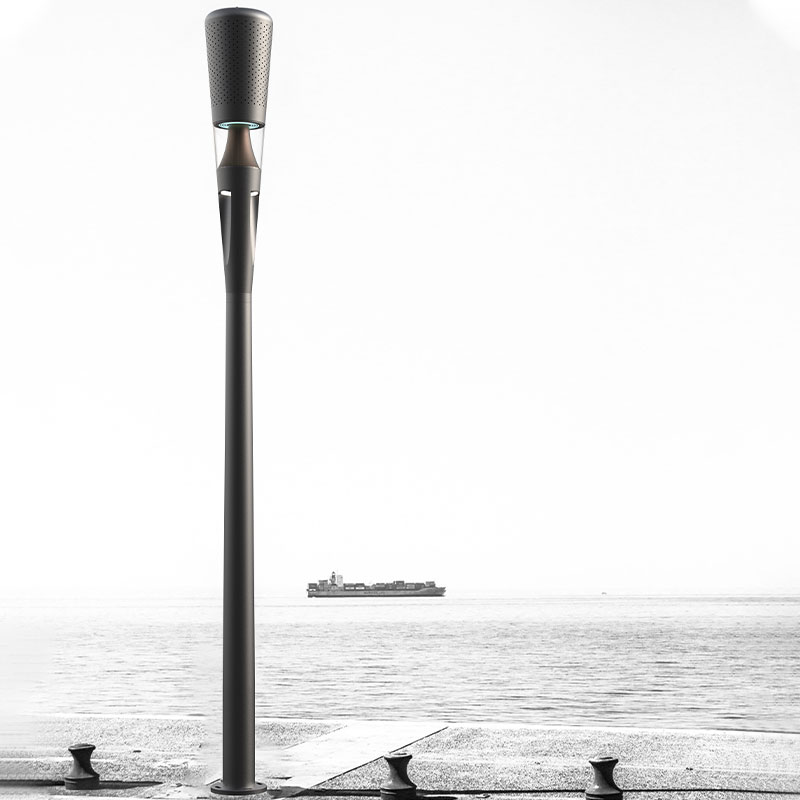
Under the wave of new infrastructure, smart cities are built into a network, and smart lamp poles carry extremely important platform functions. Different from the scope of use of traditional road lamp poles, while meeting the basic urban lighting needs, Morelux smart lamp poles have become the best platform for various smart city management facilities, truly realizing precise data management in various fields of the city, meeting the needs of intensive management of urban resources, and completing the release and collection of smart city signal endpoints.
The Morelux smart lamp pole platform architecture consists of a device perception layer, a network communication layer, a data aggregation layer, and a system application layer. Through power supply, networking, and system docking, it has penetrated various spatial fields of the city and has become a key infrastructure for the intelligent connection of all things. It integrates 5G signal output, video surveillance, multimedia information release, public relations broadcasting, environmental monitoring, cloud remote control, vehicle-road collaboration, charging management, and other software and hardware functions. The new product architecture helps the construction of safe cities and smart cities in cities across the country.
Smart Street Light Remote Management
PC equipment and sensor equipment manage and operate road lighting efficiently around the clock; camera monitoring infrared multiple smart devices, all-round and all-regional real-time control and management of 5G/WIFI/AP and other signal facilities, covering the entire area, and connecting everything.
Built-in multiple meteorological sensors can detect air temperature, humidity, wind speed, wind direction, rainfall, ultraviolet intensity, noise intensity, light intensity, etc.;
Support remote information distribution, such as publishing park property management information, displaying real-time meteorological information, advertising information, etc.;
Through the existing lines of street lights to take power and network, PC-side remote management of charging piles is realized, and mobile phone charging reservations, online payment, and other functions are supported.
People in distress can quickly report accident information through a one-click alarm, and the background management center can immediately arrange personnel to handle it on site after receiving the information.
It can realize refined management of street lights, and remotely turn on, turn off, and dim street lights via mobile phones or PCs, and support timed tasks.
With a built-in high-definition camera, users can remotely monitor road scenes 24 hours a day via mobile phones or PCs.
By installing Wi-Fi AP hotspot devices on lamp poles, users can browse the Internet by connecting to Wi-Fi hotspots.
With a built-in broadcast speaker, audio can be sent remotely, and a remote intercom can be realized.
An American aluminum light pole is a tapered or straight outdoor lighting support structure made from high-quality aluminum alloy, designed and specified to meet North American engineering, safety, and aesthetic standards for road lighting, street lighting, parking lots, plazas, parks, and landscape illumination. The ...
View MoreSmart light poles go far beyond simply holding a luminaire. They function as multi-purpose urban infrastructure platforms that integrate intelligent street lighting management with 5G connectivity, environmental sensing, video surveillance, public broadcasting, EV charging, Wi-Fi access, and emergency communication — ...
View MoreA well-manufactured aluminum light pole has a structural lifespan of 30 to 50 years under normal outdoor conditions. The aluminum shaft itself is highly resistant to corrosion and fatigue, and quality manufacturers back their poles with structural warranties of 25 years as standard. The surface finish — whether anodiz...
View MoreAs a representative of urban infrastructure upgrades, smart light poles have transcended traditional lighting functions, becoming a core carrier for building smart cities and the Internet of Things. Leveraging their natural distribution and convenient power supply within cities, they integrate various hardware and software functions, forming a multifunctional platform for urban information collection, transmission, dissemination, and management.
The smart light pole platform architecture is a layered, decoupled, and collaboratively operating system, ensuring efficient data flow and flexible functional expansion.
| Layers | Components/Technologies | Core Functions: |
| 1. Device Awareness Layer | Various sensors, surveillance cameras, environmental monitors, information display screens, charging modules, etc. | Data Acquisition and Execution: Directly senses the urban environment and operational status, and executes control commands. |
| 2. Network Communication Layer | 5G/4G/NB-IoT communication modules, LoRa, Wi-Fi hotspots, fiber optic networks, etc. | Data Transmission: Provides high-speed, reliable, and wide-coverage network connectivity to enable data uploading and command issuance. |
| 3. Data Aggregation Layer | Edge computing units, data gateways, cloud platform servers, data processing algorithms. | Data Processing and Storage: Cleans, analyzes, stores, and trains models on massive amounts of sensed data. |
| 4. System Application Layer | Urban management platforms, traffic dispatch systems, public safety systems, environmental monitoring applications, etc. | Function Implementation and Services: Based on the processed data, provides various smart applications and services to users. |
Through highly integrated hardware and software modules, smart light poles achieve "one pole, multiple uses," greatly improving the efficiency of urban resource utilization.
As a natural carrier for 5G network construction, 5G micro base stations can be installed, effectively compensating for coverage blind spots of macro base stations and achieving deep 5G signal coverage in urban areas. This is a key infrastructure for 5G network deployment.
Integrates high-definition cameras for real-time monitoring of roads and areas, used for traffic flow analysis, violation detection, and security prevention, enhancing urban public safety.
Equipped with LED displays, it can disseminate traffic information, weather warnings, commercial advertisements, government announcements, etc., and simultaneously broadcast emergency notifications or background music through a public address system.
Integrates environmental sensors (such as PM2.5, temperature, humidity, noise, wind speed, etc.) to collect urban environmental data in real time, assisting environmental protection departments in tracking pollution sources and issuing air quality warnings.
Through the integration of roadside units (RSUs), it enables information exchange between light poles and vehicles, and between light poles and traffic lights, providing real-time and accurate road condition information for autonomous driving and intelligent transportation.
Installs charging stations for new energy vehicles or electric bicycles on light poles, utilizing the power supply advantage of the light poles to solve the problem of insufficient urban charging facilities.
Through a central control platform, remote fault diagnosis, energy management, brightness adjustment, and application upgrades for all light poles are achieved, significantly reducing operation and maintenance costs.
The promotion of smart light poles is an inevitable trend in refined urban management and new infrastructure construction.
Smart light poles are considered an important component of "new infrastructure," integrating power supply, lighting, communication, and information sensing systems, serving as the "nerve endings" of urban digital transformation.
Through intelligent dimming and remote control, "on-demand lighting" can be achieved, saving electricity; centralized operation and maintenance reduces labor and time costs.
The urban operation data collected by smart light poles is a valuable urban data asset that can be used for urban planning, emergency response, and business decision-making.
The large number and wide distribution of light poles effectively penetrate every corner of the city, reserving interfaces for more innovative applications in the future (such as drone parking and urban navigation).
Smart light poles are no longer just lighting products, but open intelligent infrastructure with platform attributes, accelerating the construction of safe, efficient, and environmentally friendly smart cities across the country.
A1: The biggest difference lies in their platform architecture and integrated functions. Ordinary streetlights only provide lighting; smart light poles are urban information sensing and service platforms integrating multiple functions such as 5G, video surveillance, and environmental monitoring.
A2: It mainly consists of four layers: the device sensing layer, the network communication layer, the data aggregation layer, and the system application layer.
A3: Smart light poles can serve as carriers for 5G micro base stations, leveraging their power supply and wide distribution advantages to achieve deep 5G signal coverage in urban areas.
A4: Main functions include 5G signal output, video surveillance, multimedia information dissemination, environmental monitoring, vehicle-to-everything (V2X) communication, and charging management.
A5: Through a cloud-based remote control system, on-demand intelligent dimming of lighting is achieved, and remote fault diagnosis is possible, thereby reducing energy consumption and manpower maintenance costs.
Ningbo Morelux Pole Technology Limited All Rights Reserved. Wholesale Smart Light Pole Manufacturer OEM/ODM Smart Light Pole Company



 English
 Español
 Français
 عربى
عربى italiano