English
 Español
 Français
 عربى
عربى italiano
Outdoor Solar Light Pole systems are deployed across a wide and growing range of application environments -- from rural roads and urban plazas to remote off-grid infrastructure, coastal promenades, agricultural facilities, and public parks. Any outdoor location that requires nighttime illumination but lacks convenient access to a grid power connection, or where the cost of underground cable installation exceeds the cost of a solar system, is a viable application scenario for a solar light pole.
The breadth of applications has expanded significantly as LED luminaire efficiency has improved, lithium battery costs have fallen by over 89% between 2010 and 2023 (Source: BloombergNEF, about.bnef.com), and MPPT charge controller technology has made solar systems reliably operational in all climate zones. Today, solar light poles are specified not only for off-grid necessity but increasingly as the preferred solution in grid-connected urban areas where sustainability goals, reduced civil works cost, and installation speed make them economically competitive with conventional grid-powered alternatives.
Content
- 1 Rural Roads and Highways: Illuminating Remote Corridors
- 2 Urban Streets and Residential Areas: Grid-Independent in the City
- 3 Parks, Gardens, and Recreational Spaces
- 4 Parking Lots and Commercial Forecourts
- 5 Coastal and Waterfront Environments
- 6 Agricultural and Rural Community Facilities
- 7 Transportation Infrastructure: Bus Stops, Cycle Paths, and Pedestrian Bridges
- 8 Industrial Zones and Business Parks
- 9 Heritage Sites, UNESCO Areas, and Dark-Sky Reserves
- 10 Application Scenarios Summary: Matching Solar Pole Specification to Use Case
- 11 Key Factors That Determine Whether Solar Is the Right Solution
Rural Roads and Highways: Illuminating Remote Corridors
Rural road lighting is among the highest-volume application scenarios for solar light poles globally. Extending grid power infrastructure to rural road corridors is expensive -- the cost of underground cable, transformer upgrades, and utility connection fees can add USD 20,000 to USD 80,000 per kilometer to a rural street lighting project in developing markets (Source: World Bank Group, Energy Sector Management Assistance Program, esmap.org). Solar light poles eliminate this infrastructure cost entirely, reducing the total installed cost of rural road lighting by 40 to 70% in locations more than 500 meters from an existing grid connection.
Rural highway applications typically require poles of 8 to 12 meters mounting height with luminaires of 60 to 120 W output to meet road illuminance standards -- EN 13201 Class M in Europe, or IESNA RP-8 in North America. The long, linear nature of rural road lighting means that pole spacing of 25 to 40 meters is standard, and the absence of grid infrastructure along the route means solar is often the only technically feasible option without major capital investment in grid extension.
In Sub-Saharan Africa, South and Southeast Asia, and rural Latin America, solar road lighting programs have delivered measurable safety and economic development outcomes. A 2022 study by the International Finance Corporation (IFC, ifc.org) found that communities with improved road lighting reported a 35 to 45% reduction in road traffic accidents at night and significant increases in evening commercial activity, demonstrating the direct socioeconomic value of solar lighting infrastructure in off-grid rural environments.
Urban Streets and Residential Areas: Grid-Independent in the City
Solar light poles are increasingly specified for urban street lighting applications -- not because grid power is unavailable, but because the total installed cost, installation disruption, and long-term operating cost of solar systems are now competitive with grid-connected alternatives in many urban contexts.
In established urban streets where road surfaces, paving, and utilities are already in place, trenching for new underground power cables costs USD 150 to USD 500 per linear meter in typical European and Middle Eastern cities (Source: CIBSE Guide K, Electricity in Buildings). Avoiding this civil works entirely by installing solar light poles on individual footings -- requiring only a 600 x 600 x 800 mm concrete foundation per pole -- reduces project delivery time from months to weeks and eliminates the service disruption of road excavation.
Residential street and cul-de-sac lighting in new housing developments is a particularly well-suited urban application. Developers can install solar light poles during the landscaping phase of a project before utility connections are finalized, providing immediate site lighting without waiting for grid infrastructure to be commissioned. The poles then continue to operate independently, eliminating ongoing electricity charges that would otherwise accrue to the building management or local authority responsible for street lighting.
Decorative Solar Poles for Urban Plazas and Pedestrian Zones
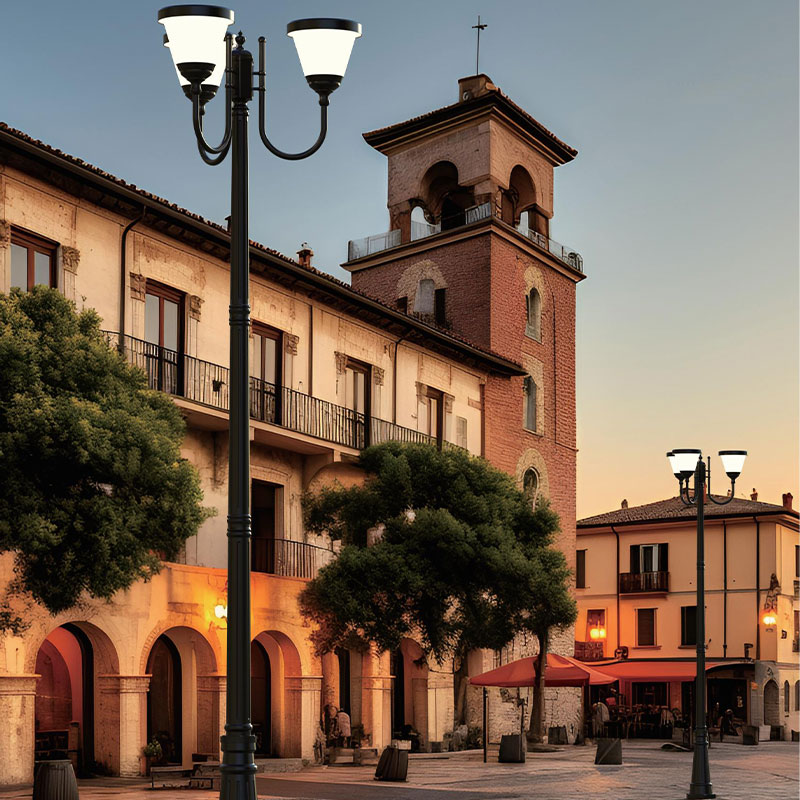
High-specification decorative solar light poles combine the functional performance of a standalone solar system with the architectural finish quality required for principal urban streets, civic plazas, waterfronts, and heritage pedestrian zones. These poles incorporate the solar panel, battery, charge controller, and luminaire within an architecturally considered design -- concealing the battery compartment within the pole shaft and integrating the panel mount into the overall pole profile. The Solar Light Pole range developed for European and Middle Eastern urban environments addresses exactly this requirement, combining decorative pole profiles with duplex surface protection and high-efficiency integrated solar systems suited to the demanding climatic and aesthetic standards of these markets.
Parks, Gardens, and Recreational Spaces
Public parks and recreational green spaces present one of the most naturally suited application scenarios for solar light poles. The combination of open sky exposure -- ensuring maximum solar irradiance at the panel -- with the absence of existing underground electrical infrastructure in planted areas makes solar the technically ideal and economically optimal lighting solution for park pathway, perimeter, and feature lighting.
Park lighting poles are typically of 4 to 6 meters mounting height, with warm-white LED luminaires (colour temperature 2700 K to 3000 K, CRI above 80) that create a comfortable, inviting atmosphere for evening pedestrian use while preserving dark-sky quality above the treeline. Solar poles in park applications eliminate the tree root damage associated with underground cable trenching -- a significant consideration in mature planted parks where root protection zones restrict ground works within several meters of heritage trees.
Botanical gardens, national parks, and protected landscape areas frequently prohibit the installation of underground electrical infrastructure to avoid disruption to buried ecological features. In these environments, solar light poles are often the only permissible illumination solution for visitor pathway lighting, interpretive signage lighting, and facility area lighting -- making them a functional necessity rather than simply an economical preference.
Sports Fields and Outdoor Recreational Facilities
Community sports fields, outdoor basketball courts, tennis facilities, and multi-use games areas (MUGAs) in suburban and rural settings frequently lack grid lighting due to the high cost of trenching across open ground to reach the facility boundary. Solar light poles of 8 to 12 meters height with 80 to 150 W LED luminaires can provide illuminance levels of 50 to 100 lux at ground level -- sufficient for recreational play and community events -- without any grid connection. Motion-sensing dimming control (reducing output to 30% when the facility is unoccupied and boosting to 100% when activity is detected) maximizes battery autonomy while ensuring full illumination is available whenever the facility is in use.
Parking Lots and Commercial Forecourts
Commercial parking areas -- for retail centers, office complexes, logistics facilities, and public transit stations -- represent one of the highest-value applications for solar light poles. Parking lot lighting must meet specific illuminance and uniformity standards for safety and security: EN 12464-2 (outdoor work areas) recommends a maintained average illuminance of 20 to 50 lux across parking surfaces, with uniformity ratios of 0.25 or better (Source: EN 12464-2:2014, CIE).
Solar light poles in parking applications are typically installed on individual concrete foundations within or around the parking grid, at spacing of 15 to 25 meters, with luminaire outputs of 60 to 120 W to achieve the required illuminance levels. The absence of ground-level cable runs eliminates trip hazards and cable damage risks from vehicle wheel-over events -- a meaningful operational advantage in busy parking environments where underground cables running between conventional poles are vulnerable to damage during resurfacing or landscaping works.
For logistics hubs, distribution centers, and industrial facilities with large hardstanding areas that operate overnight -- loading docks, vehicle marshaling areas, container storage yards -- solar light poles provide security and operational lighting without the significant civil engineering cost of new underground cabling across extensive paved areas. Large logistics sites of 5 to 20 hectares can require 1 to 4 kilometers of underground cable per lighting circuit for conventional grid-connected systems, a cost that solar poles entirely eliminate.
Coastal and Waterfront Environments
Coastal promenades, harbors, marinas, beach access paths, and waterfront public spaces present a challenging combination of environmental conditions -- salt-laden air, high UV exposure, sand abrasion, and frequent strong winds -- that places exceptional demands on both the pole structure and the solar system components. At the same time, the open coastal sky exposure maximizes solar irradiance availability, making solar poles energetically well suited to these locations despite the structural challenges.
For coastal solar light pole applications, the pole shaft and solar panel frame must be finished to the highest corrosion protection specification -- a duplex system of hot-dip galvanizing plus polyester or PVDF powder coating, with a minimum salt spray resistance of 1,000 hours per EN ISO 9227 and UV exposure resistance of minimum 50% gloss retention after 2,000 hours per EN ISO 11507. Battery compartments must be sealed to IP65 minimum, with silicone-sealed gaskets on all access doors and cable entry glands rated to IP67.
Mediterranean coastal cities, Middle Eastern corniche developments, and Pacific island communities have all deployed solar light poles extensively for promenade and coastal pathway lighting, where the combination of high solar irradiance, absence of underground infrastructure, and the visual preference for slender poles without overhead cable runs makes solar poles the natural choice for both functional and aesthetic reasons.
Islands and Remote Coastal Communities
Island communities and remote coastal settlements often have limited, unreliable, or expensive grid electricity -- typically from diesel generation -- making solar light poles particularly valuable as a means of providing reliable public lighting without dependency on fuel supply chains. The International Renewable Energy Agency (IRENA, irena.org) reported in 2023 that solar lighting systems in island communities delivered average electricity cost savings of 60 to 80% compared to diesel-generated alternatives, with additional benefits of reduced noise, reduced air pollution, and elimination of fuel delivery logistics.
Agricultural and Rural Community Facilities
Agricultural facilities -- farm buildings, irrigation pump stations, grain storage areas, livestock handling yards, and rural markets -- require reliable nighttime lighting for security, animal welfare, and operational productivity, but are often located far from grid infrastructure. Solar light poles are the standard solution for agricultural security and area lighting in these contexts, providing reliable illumination from sunset to sunrise without recurring electricity costs or grid dependency.
Rural community facilities -- village centers, health clinics, schools, water points, and community gathering spaces in developing regions -- are priority recipients of solar lighting investment by national governments and international development organizations. The United Nations Sustainable Development Goal 7 (Affordable and Clean Energy) includes specific targets for expanding access to reliable energy in rural areas, and solar street lighting is one of the most cost-effective and rapidly deployable technologies for achieving these targets. The World Bank's Lighting Africa program (lightingafrica.org) has supported the deployment of over 13 million solar lighting units across Sub-Saharan Africa since 2007, demonstrating the scale of demand for solar lighting in rural and peri-urban community contexts.
Agricultural Security Lighting
Equipment theft, livestock predation, and unauthorized entry are significant risks for remote agricultural operations, and reliable perimeter and access security lighting is a primary mitigation measure. Solar light poles with motion-activated control -- switching from 20% standby output to 100% full output when motion is detected within the sensor zone -- provide effective deterrent lighting throughout the night while minimizing battery consumption during the many hours when no activity is present. This adaptive control approach can reduce nightly energy consumption by 50 to 60% compared to continuous full-output operation (Source: Lighting Research Center, Rensselaer Polytechnic Institute, lrc.rpi.edu), significantly extending battery autonomy during consecutive cloudy winter days.
Transportation Infrastructure: Bus Stops, Cycle Paths, and Pedestrian Bridges
Transportation infrastructure lighting -- bus shelters, cycle paths, pedestrian underpasses, footbridges, level crossing approaches, and rural bus turning areas -- frequently requires isolated lighting points at locations where underground cable extension from the nearest grid connection is disproportionately expensive relative to the scale of the installation.
A single solar light pole at a rural bus stop costs a fraction of the alternative -- installing a new underground cable run from the nearest street lighting circuit, which may be hundreds of meters distant, and applying for a utility network connection. Local transport authorities in Europe and the Middle East have adopted solar bus stop lighting as a standard specification for rural and peri-urban routes, citing both the lower capital cost and the reduced maintenance burden compared to grid-connected alternatives.
Cycle paths and greenways -- off-road cycling and walking routes following former railway lines, canal towpaths, or rural trails -- are ideal solar pole applications because the routes typically traverse areas with no existing underground infrastructure. Cycle path solar poles of 4 to 6 meters height with 20 to 40 W luminaires provide the 10 to 20 lux pathway illuminance required by EN 13201 Class P and S categories, operating reliably for the full night from modest panel and battery specifications sized for the low luminaire load.
Emergency and Temporary Lighting Applications
Solar light poles are increasingly used for temporary and emergency lighting at construction sites, disaster relief operations, outdoor event venues, and military field installations where permanent electrical infrastructure is absent and rapid deployment of reliable lighting is required. Self-contained solar poles can be transported, positioned, and operational within hours of arrival on site without any electrical infrastructure work -- a capability that grid-connected lighting cannot match in emergency or temporary deployment scenarios.
Industrial Zones and Business Parks
New industrial zones, business parks, and special economic zones (SEZs) in developing economies frequently begin infrastructure development before grid power connections are commissioned, creating a window during which solar light poles provide the only available lighting solution for security patrols, construction operations, and early occupier access. Solar poles installed during this phase remain in service after grid connection, continuing to provide lighting cost-free from solar energy and reducing the overall electricity demand of the development's lighting infrastructure.
For established industrial zones and business parks pursuing sustainability certification -- LEED, BREEAM, ISO 50001, or national green building standards -- solar light poles contribute directly to energy performance scores and carbon footprint reduction targets. Replacing a conventional 150 W grid-connected street light with an equivalent solar pole eliminates approximately 0.35 to 0.55 tonnes of CO2 per year depending on the grid carbon intensity of the local electricity supply (Source: International Energy Agency, iea.org, 2023 Global Electricity Review). For a business park with 100 lighting poles, this represents a cumulative carbon saving of 35 to 55 tonnes of CO2 annually -- a meaningful contribution to corporate sustainability reporting targets.
Heritage Sites, UNESCO Areas, and Dark-Sky Reserves
Heritage sites, archaeological parks, UNESCO World Heritage areas, and designated dark-sky reserves present a unique application scenario where the lighting solution must satisfy strict requirements for minimal visual and environmental impact alongside full functional performance. Underground cable installation is frequently prohibited or restricted in these environments to protect buried archaeological remains, and overhead cables are incompatible with heritage visual standards -- making solar light poles the only technically permissible solution in many cases.
Dark-sky reserve lighting specifications require luminaires with full cut-off optics (zero upward light component), warm-white colour temperatures of 2700 K or lower, and the minimum luminaire output necessary for the safety and security function required. These constraints are directly compatible with solar pole technology -- low-wattage warm-white LED luminaires minimize both power consumption and light pollution simultaneously, and the solar system is inherently sized to the actual luminaire load, naturally discouraging the installation of over-powered luminaires that would compromise dark-sky quality.
In Middle Eastern heritage contexts -- ancient city cores, desert archaeological sites, and traditional souq environments -- decorative solar poles designed in keeping with the architectural character of the setting provide pathway and security lighting without electrical infrastructure that would visually or physically impact the heritage fabric. The Solar Light Pole range for European and Middle Eastern markets includes decorative profile options specifically suited to heritage streetscape contexts, combining traditional aesthetic elements with fully integrated modern solar technology.
Application Scenarios Summary: Matching Solar Pole Specification to Use Case
The following table summarizes the principal outdoor solar light pole application scenarios and the key specification parameters that should be matched to each use case.
| Application Scenario | Typical Pole Height | Luminaire Output | Key Specification Requirement | Control Mode |
|---|---|---|---|---|
| Rural roads and highways | 8 to 12 m | 60 to 120 W | EN 13201 Class M compliance; high wind loading | Dusk-to-dawn or split dimming |
| Urban streets and plazas | 6 to 10 m | 40 to 80 W | Decorative finish; duplex corrosion protection | Dusk-to-dawn with mid-night dim |
| Parks and gardens | 4 to 6 m | 20 to 40 W | Warm white (2700-3000 K); no ground excavation | Dusk-to-dawn |
| Parking lots | 6 to 10 m | 60 to 120 W | Wide-beam optics; EN 12464-2 uniformity | Motion-activated dimming |
| Coastal promenades | 4 to 8 m | 30 to 60 W | Salt spray 1,000 h; IP67 battery; duplex finish | Dusk-to-dawn |
| Agricultural and rural facilities | 6 to 10 m | 40 to 80 W | High battery autonomy (5+ days); robust structure | Motion-activated or dusk-to-dawn |
| Cycle paths and footways | 4 to 6 m | 20 to 40 W | EN 13201 Class P/S; low wattage; compact panel | Presence detection dimming |
| Heritage and dark-sky sites | 3 to 5 m | 10 to 20 W | Full cut-off optics; 2700 K CCT; decorative profile | Dusk-to-dawn low output |
| Industrial zones and business parks | 8 to 12 m | 80 to 150 W | High luminaire output; security lighting spec | Split dimming or motion-activated |
Key Factors That Determine Whether Solar Is the Right Solution
While solar light poles are suitable for a wide range of outdoor scenarios, not every location is equally well suited. The following factors should be evaluated before committing to a solar solution, to confirm that the system will perform reliably and deliver the expected value over its service life.
- Solar irradiance availability: The location must receive sufficient annual Peak Sun Hours (PSH) to support the battery charging requirement for the specified lighting hours. Locations with fewer than 2.5 PSH in winter (parts of northern Europe, northern Canada, northern Russia) require very large panel and battery systems for reliable winter operation, and a conventional grid-connected solution may be more practical and economical in these extreme low-sun environments.
- Shading conditions: Sites with significant shading from trees, buildings, or terrain features during the main solar window (9:00 AM to 3:00 PM solar time) are unsuitable for solar poles unless the shading can be mitigated by pole placement or tree management. Even 30 minutes of daily panel shading can reduce winter energy harvest by 10 to 20% on a series-connected single-panel system.
- Lighting hours and luminaire load: Higher luminaire wattage and longer lighting hours increase the daily energy demand on the battery, requiring larger panels and battery capacity to maintain the specified autonomy. For applications requiring very high output luminaires (above 150 W) at full output all night, solar system size and cost may become a constraint relative to grid-connected alternatives.
- Grid connection distance and cost: The further the site is from the nearest grid connection, the more compelling the economic case for solar. When the cost of grid extension (underground cabling, transformers, utility connection fees) exceeds the cost of solar poles, solar is the financially superior solution regardless of grid availability.
- Environmental and maintenance access: Solar light poles in remote or difficult-access locations benefit from minimal maintenance requirements -- a key advantage. However, sites subject to extreme vandalism risk require robust panel protection (tempered glass, anti-tamper fixings) and secure battery compartments to prevent component theft or damage.
- Sustainability and carbon targets: Where the specifying authority or developer has committed to carbon reduction targets, solar light poles deliver a measurable and verifiable reduction in scope 2 emissions compared to grid-powered alternatives, supporting green building certification and corporate sustainability reporting obligations.