English
 Español
 Français
 عربى
عربى italiano
The core advantages of solar light poles are zero electricity operating costs, no grid infrastructure required, energy independence during outages, significantly lower installation costs in remote locations, zero carbon emissions during operation, and the ability to integrate smart technologies — all within a single self-contained pole structure. These advantages together explain why solar light poles have moved from niche novelty to mainstream infrastructure choice for municipalities, developers, and facility managers across the world.
But the full picture goes considerably deeper than a headline list. Each advantage compounds on the others over the system's operating life, and the emergence of smart-pole capabilities has added a new dimension of value that makes solar poles genuinely transformative infrastructure — not just a greener version of a conventional streetlight. This article examines every major advantage in detail, with real data and specific examples to illustrate the practical impact.
Content
- 1 No Grid Connection Means Massive Installation Cost Savings
- 2 Zero Electricity Bills for the Entire Operational Life
- 3 Energy Independence: Lighting That Works When the Grid Fails
- 4 Dramatically Lower Environmental Impact and Carbon Footprint
- 5 Faster Deployment and Greater Installation Flexibility
- 6 Lower Long-Term Maintenance Requirements
- 7 Smart Technology Integration: Solar Poles as Multi-Function Infrastructure
- 8 Smart City and Smart Grid Integration
- 9 Motion-Activated Dimming: Maximizing Energy Efficiency
- 10 Scalability: From a Single Pole to City-Wide Networks
- 11 Enabling Lighting in Locations Where Grid Power Is Impossible
- 12 Quantified Advantages: Solar Light Poles vs. Grid-Connected LED Streetlights
- 13 Aesthetic and Design Advantages
- 14 How to Maximise the Advantages of Solar Light Poles
No Grid Connection Means Massive Installation Cost Savings
The single largest financial advantage of solar light poles over conventional streetlights is the complete elimination of grid connection infrastructure. Traditional outdoor lighting requires underground electrical cable, conduit, junction boxes, transformer connections, and utility company coordination — all of which generate substantial civil engineering costs before a single fixture is even purchased.
In typical urban environments, trenching and cabling costs range from $500 to $2,000 per linear meter, and can exceed $3,000 per meter in dense urban cores, rocky terrain, or areas with congested subsurface utilities. For a rural highway project lighting 800 meters of road with poles at 30-meter spacing, the grid connection alone can cost between $400,000 and $1,600,000 — before a single pole is purchased, shipped, or installed.
Solar light poles require only a pole foundation and the pole installation itself. This not only eliminates the trenching cost but also removes the need for utility company approvals, electrical inspections of underground works, and the weeks or months of coordination delay that grid connection projects typically involve. Solar pole projects that would take months to coordinate as grid-connected installations can be completed in days.
Even in locations where grid infrastructure already exists nearby, solar poles can still be the economically rational choice when the cost of the final connection run, permitting fees, and utility charges are factored against the system's full lifecycle cost.
Zero Electricity Bills for the Entire Operational Life
Once installed, a solar light pole generates all of its own electricity at no ongoing cost. The photovoltaic panel charges the battery throughout the day, and the stored energy powers the LED luminaire through the night — a cycle that repeats autonomously, every day, for the life of the system, without consuming a single unit of purchased electricity.
The financial impact accumulates significantly over time. A conventional 80W LED streetlight operating 12 hours per night consumes approximately 350 kWh per year. At a commercial electricity tariff of $0.13 per kWh, that is $45.50 per pole per year. For a municipal network of 500 poles, that equates to $22,750 annually in electricity costs — $455,000 over 20 years — that a solar-powered equivalent avoids entirely.
As electricity tariffs continue to rise — average commercial electricity prices in the United States increased by approximately 30% between 2015 and 2024 — the value of energy independence grows proportionally. A solar light pole installed today locks in zero electricity cost for its entire service life, regardless of future energy price movements.
Energy Independence: Lighting That Works When the Grid Fails
Grid-connected streetlights go dark the moment the power supply is interrupted — whether from storms, equipment failure, deliberate outages, or infrastructure attacks. Solar light poles are entirely independent of the electrical grid and continue operating through power outages without any intervention.
This resilience is not merely convenient — it is a critical safety advantage in specific situations. Emergency evacuation routes, hospital perimeters, police station access roads, fire station driveways, and disaster shelter surroundings all benefit directly from lighting that cannot be disrupted by grid failure. Well-designed solar pole systems are sized to provide 3 to 5 days of full-output autonomy without any solar input — maintaining illumination through extended storms or overcast periods that might coincide with grid disruptions.
For coastal and island communities where grid infrastructure is particularly vulnerable to hurricane or typhoon damage, solar light poles represent not just an economic choice but a genuine resilience investment. While grid-dependent street lighting may remain out of service for days or weeks following a major storm event, solar poles — if the physical structure withstands the wind load — resume normal operation as soon as sunlight returns.
Military and security applications similarly value this independence. A perimeter lighting system that cannot be disabled by cutting a single power feed is fundamentally more secure than a grid-connected equivalent.
Dramatically Lower Environmental Impact and Carbon Footprint
Solar light poles produce zero operational carbon emissions. There is no combustion, no consumption of fossil-fuel-generated electricity, and no ongoing environmental cost once the system is installed. This stands in stark contrast to grid-powered streetlights, which draw from an electricity supply that — depending on the regional grid's energy mix — may be substantially powered by coal, natural gas, or oil.
In regions where the grid is predominantly coal-powered, a single grid-connected 80W streetlight operating 12 hours per night can be responsible for the emission of approximately 0.35 to 0.55 tonnes of CO2 per year. A municipal network of 1,000 such lights generates 350–550 tonnes of CO2 annually — equivalent to the annual emissions of 75–120 average passenger vehicles. A solar-powered equivalent eliminates this emissions load entirely.
Beyond carbon, solar poles eliminate the transmission line losses inherent in delivering grid electricity to distributed outdoor lighting. Grid transmission and distribution losses average 5 to 8% of generated electricity in developed nations — losses that solar poles eliminate by generating and consuming power at the same location.
For organizations with sustainability commitments, ESG reporting obligations, or green building certification targets (such as LEED or BREEAM), the verified zero-emission operation of solar light poles contributes directly to measurable environmental performance metrics.
Faster Deployment and Greater Installation Flexibility
Because solar poles require no underground cabling or utility coordination, they can be installed far more quickly and in far more locations than grid-connected alternatives. A competent crew can install a solar light pole — from foundation to operational — in under two hours per pole. A grid-connected equivalent requires weeks of permitting, utility approvals, and civil works before the fixture is ever installed.
This speed advantage has practical consequences across multiple scenarios:
- Emergency and disaster relief: Solar poles can be deployed within 24 hours to provide lighting to evacuation centers, temporary medical facilities, or disaster-struck communities where grid infrastructure has been destroyed.
- Temporary event lighting: Outdoor festivals, sports events, construction site lighting, and seasonal installations can use solar poles without permanent civil works — and the poles can be relocated when the event or project concludes.
- Phased development projects: In new property developments, solar poles can light roads and pathways immediately upon road construction, years before the permanent grid infrastructure is complete.
- Heritage and protected sites: Solar poles can be installed in locations where underground excavation would disturb archaeological sites, established tree root systems, or protected ecological areas — situations where grid cabling is practically impossible.
The location flexibility advantage extends to the physical positioning of poles. Without the constraint of following underground cable routes, solar poles can be positioned purely based on illumination requirements and aesthetics — optimizing light distribution without compromising to accommodate cable paths.
Lower Long-Term Maintenance Requirements
Modern solar light poles, built with quality components, require remarkably little maintenance over their operational life — often less than comparable grid-connected systems when the full scope of maintenance is considered.
LED Luminaire Longevity
Quality LED luminaires used in solar poles carry rated lifespans of 50,000 to 100,000 hours. At 12 hours of operation per night, 50,000 hours represents over 11 years of lamp life — and 100,000 hours extends to more than 22 years. This eliminates the lamp replacement cycle that was a significant ongoing maintenance cost for conventional streetlighting using HID, fluorescent, or high-pressure sodium lamps, which required replacement every 2–5 years.
LiFePO4 Battery Durability
Lithium iron phosphate (LiFePO4) batteries — the standard in quality solar poles today — are rated for 2,000 to 3,000 full charge/discharge cycles at 80% depth of discharge. At one cycle per day, this translates to 5.5–8 years of service life, with many real-world installations achieving 10–12 years before capacity falls below 80% of original rating. Battery replacement is therefore a predictable, infrequent cost rather than an ongoing maintenance burden.
Remote Monitoring Reduces Reactive Maintenance Costs
Smart solar poles transmit real-time status data — battery state of charge, luminaire operating status, panel output, and fault codes — to a central management platform. Maintenance crews receive automatic alerts when a system requires attention, enabling targeted, efficient responses rather than routine inspection sweeps of entire networks. Municipalities deploying monitored solar pole networks report maintenance cost reductions of 30–50% compared to conventional reactive maintenance models for grid-connected lighting.
No Underground Cable Network to Maintain
Grid-connected street lighting systems carry a hidden maintenance liability: the underground cable network itself. Cable faults caused by ground movement, corrosion, dig-in damage from subsequent utility works, or moisture ingress at junction boxes require costly excavation to locate and repair. Solar poles carry no such liability — every component is above ground, accessible, and inspectable.
Smart Technology Integration: Solar Poles as Multi-Function Infrastructure
Perhaps the most transformative advantage of modern solar light poles is their capacity to serve as the physical and power infrastructure for a wide range of smart technologies — effectively turning each pole into a self-powered urban services node. Because the pole already provides electrical power from its solar and battery system, adding technology payloads requires only the hardware and communications link, with no additional power infrastructure.
Surveillance Cameras and Security Systems
Solar poles can mount HD and 4K security cameras with night-vision capability, powered entirely by the pole's own energy system. Deploying cameras on solar poles eliminates the power and data cabling costs that make conventional camera network expansion expensive — a single solar pole camera installation can be completed in hours with no civil works. Footage can be transmitted wirelessly via cellular (4G/5G) networks or point-to-point Wi-Fi links to central monitoring systems in real time.
This capability makes solar poles particularly valuable for extending surveillance coverage to parks, parking areas, remote road junctions, construction sites, and industrial perimeters — precisely the locations where the cost of running power and data cable has historically made camera deployment economically prohibitive.
Environmental and Air Quality Monitoring
Solar poles can incorporate sensors measuring particulate matter (PM2.5 and PM10), nitrogen dioxide (NO2), carbon monoxide (CO), ozone (O3), temperature, humidity, rainfall intensity, wind speed and direction, and UV radiation levels. These sensors consume minimal power — typically under 5W per sensor module — making them easily accommodated within the pole's existing energy budget. A distributed network of solar poles equipped with environmental sensors creates a fine-grained urban air quality monitoring network at a fraction of the cost of installing dedicated monitoring stations.
Traffic Management and Pedestrian Counting
Radar sensors, inductive loop alternatives, infrared counters, and camera-based AI systems mounted on solar poles can count vehicle and pedestrian volumes, measure vehicle speeds, detect traffic congestion, and identify road incidents — feeding real-time data to traffic management centers. This data supports adaptive signal timing, congestion pricing, road maintenance planning, and emergency response routing, all without requiring any dedicated sensor infrastructure beyond the pole itself.
Public Wi-Fi Hotspots
A solar pole equipped with a wireless access point and cellular backhaul becomes a self-powered public Wi-Fi hotspot with a typical coverage radius of 50 to 100 meters per pole. Networks of solar Wi-Fi poles can deliver continuous broadband coverage to parks, plazas, transit stops, outdoor markets, and rural communities — areas where the cost of running fiber or copper to conventional access points makes Wi-Fi coverage uneconomical. This is particularly impactful in developing regions where solar poles can simultaneously provide lighting and internet connectivity to communities that lack both.
Emergency Communication and Public Address Systems
Solar poles can integrate two-way intercom systems, emergency call buttons, public address speakers, and visual alarm indicators. These create accessible emergency communication points along public pathways, in remote park areas, on campuses, and along transit corridors — all self-powered and therefore operational during the grid outages that most commonly coincide with emergency situations. A person experiencing a medical emergency in a remote park at 2am can trigger a call to emergency services from a solar pole station without requiring any grid-connected infrastructure.
Electric Vehicle Charging Integration
High-capacity solar pole systems with shared battery storage can provide Level 1 and Level 2 EV charging at parking areas, nature reserves, and remote sites where grid-connected charging infrastructure is impractical. While an individual solar pole cannot match the output of a grid-connected fast charger, banks of solar poles with aggregated storage can meaningfully serve light EV and e-bike charging demand — extending the reach of sustainable transport infrastructure beyond the grid's reach.
| Smart Capability | Typical Power Draw | Key Benefit | Infrastructure Saved |
|---|---|---|---|
| HD Security Camera | 5 – 15W | 24/7 surveillance, real-time feed | Power cable, conduit, junction boxes |
| Air Quality Sensor | 1 – 5W | Real-time pollution monitoring | Dedicated monitoring station infrastructure |
| Wi-Fi Access Point | 10 – 25W | Public broadband coverage | Fiber/copper network extension |
| Traffic Radar Sensor | 3 – 8W | Real-time vehicle count and speed | Inductive loop installation |
| Emergency Intercom | 2 – 8W (active) | 24/7 emergency access point | Power and comms cable runs |
| Public Address Speaker | 5 – 20W (active) | Alerts, announcements, events | Audio cable infrastructure |
Smart City and Smart Grid Integration
Solar light poles are not isolated devices — they are nodes in an emerging intelligent urban infrastructure. When connected to a central management platform via cellular, mesh Wi-Fi, or LoRaWAN communications, a network of solar poles becomes a distributed smart city backbone with capabilities that extend well beyond illumination.
Central management platforms aggregate data from every pole in a network — battery state of charge, panel output, luminaire status, sensor readings, camera feeds, and fault alerts — presenting this information on a unified dashboard accessible to city operations teams. This enables:
- Predictive maintenance: Automated alerts when battery capacity falls below threshold or a luminaire reports a fault, enabling targeted maintenance dispatch rather than scheduled inspection sweeps — reducing maintenance labor costs by up to 40% in documented deployments.
- Adaptive lighting control: Centrally commanded dimming based on real-time pedestrian or vehicle presence data — reducing energy consumption further by 30–70% compared to fixed full-output operation during low-activity periods.
- Grid interaction: Where solar poles are grid-connected as hybrid systems, excess stored energy can feed back to the local grid during peak demand periods, contributing to grid stability and potentially generating revenue through net metering or demand response programs.
- Integrated urban data platforms: Environmental, traffic, and people-flow data from pole-mounted sensors feeds into city GIS systems, enabling evidence-based urban planning, real-time incident response, and long-term infrastructure investment prioritization.
- Emergency management coordination: During disasters or major incidents, solar pole networks can be commanded to activate emergency lighting patterns, broadcast public address messages, and share camera feeds with emergency services — functioning as a coordinated emergency response infrastructure even when the grid is down.
The smart city integration advantage grows as pole networks scale. A city with 5,000 networked solar poles has not just 5,000 streetlights but 5,000 distributed sensing, communication, and service delivery nodes — an infrastructure investment whose value extends across transportation, public safety, environmental management, and emergency services simultaneously.
Motion-Activated Dimming: Maximizing Energy Efficiency
Solar light poles with integrated motion sensors or centralized adaptive control can dim automatically during periods of inactivity and restore full brightness when pedestrians or vehicles are detected. This adaptive dimming capability provides a significant additional energy saving beyond the baseline advantage of LED efficiency.
A typical adaptive dimming strategy operates the luminaire at 30–50% output during low-activity periods (for example, 11pm to 5am on a lightly trafficked pathway) and ramps to 100% output within seconds when motion is detected. This approach reduces nightly energy consumption by 30–60% compared to fixed full-output operation, which in turn allows a smaller — and lower-cost — battery and solar panel to maintain the required performance.
For solar pole systems, this energy saving has a compounding benefit: a smaller battery and panel requirement reduces the upfront system cost, which further improves the economics of solar pole deployment relative to grid-connected alternatives. The motion-sensing capability also enhances security by providing a visible and immediate response to presence in monitored areas.
Advanced systems integrate time-of-night scheduling, occupancy data from previous nights, and weather-adjusted dimming curves that account for cloud cover effects on available battery charge — producing an intelligent energy management system rather than a simple on/off response.
Scalability: From a Single Pole to City-Wide Networks
Solar light poles scale from single standalone installations to coordinated networks of thousands of poles with equal ease. Because each pole is fully self-contained, adding poles to a network requires no additional grid infrastructure — each new pole is simply placed, commissioned, and connected to the management platform without affecting the performance of existing poles.
This scalability has practical implications across several dimensions:
- Phased investment: Organizations can deploy solar poles incrementally as budget allows, adding coverage progressively without committing to a complete grid infrastructure build upfront.
- Adaptive deployment: Poles can be repositioned if traffic patterns change, new pathways are created, or buildings alter shading conditions — without any infrastructure modification. Grid-connected poles, by contrast, are permanently anchored to their cable connection point.
- Fault isolation: Because each solar pole operates independently, a single pole failure does not affect neighboring poles. In a grid-connected string circuit, a cable fault can take down an entire section of lighting simultaneously.
- Technology upgrades: As better batteries, more efficient panels, or new smart payloads become available, individual poles can be upgraded without any civil works or infrastructure impact — simply swapping components at the pole level.
Enabling Lighting in Locations Where Grid Power Is Impossible
There is a category of locations where solar light poles are not simply preferable to grid-connected alternatives — they are the only viable option. These include:
- Remote rural roads and highways hundreds of kilometers from the nearest grid infrastructure, where extension would be economically absurd regardless of the project's social value.
- Islands and isolated communities where grid supply is unavailable, unreliable, or dependent on expensive diesel generation.
- Protected natural areas — national parks, nature reserves, heritage sites, and conservation zones — where subsurface excavation is prohibited or damaging.
- Mountainous terrain, steep slopes, and difficult access locations where trenching and cable laying is physically hazardous or prohibitively expensive.
- Developing nation communities where national grid infrastructure does not yet reach, and where solar poles provide both lighting and a platform for connectivity and communication services that can transform daily life and economic opportunity.
The World Bank estimates that approximately 760 million people worldwide still lack access to electricity. Solar light poles represent a direct, deployable, and cost-effective response to this gap — providing reliable nighttime illumination that extends productive hours, improves personal safety, and supports economic activity without requiring the years-long timelines associated with national grid extension programs.
Quantified Advantages: Solar Light Poles vs. Grid-Connected LED Streetlights
The following table consolidates the key advantages of solar light poles against grid-connected LED equivalents in a format that supports direct evaluation across the dimensions most relevant to a procurement or planning decision.
| Advantage Area | Solar Light Pole | Grid-Connected LED |
|---|---|---|
| Civil infrastructure cost | Zero (pole foundation only) | $500–$2,000+/meter trench |
| Annual electricity cost (per pole) | $0 | $40–$100 depending on tariff |
| Operational carbon emissions | Zero | 0.35–0.55 t CO2/year/pole (coal grid) |
| Grid outage resilience | Fully independent, 3–5 day autonomy | Fails immediately with grid |
| Installation time (per pole) | Under 2 hours | Weeks (utility coordination required) |
| Location flexibility | Any location with sun access | Must follow cable route |
| Network fault isolation | Each pole independent | Cable fault can affect entire circuit |
| Smart tech integration | Full — self-powered payloads | Full — requires additional power runs |
| Energy efficiency with dimming | 30–70% additional saving via adaptive control | 30–70% with central dimming system |
| Remote and off-grid deployment | Fully viable anywhere with sun | Not possible without grid extension |
Aesthetic and Design Advantages
Solar light poles offer design advantages that are easy to overlook in a purely technical evaluation but carry real practical value in project implementation.
Because they require no above-ground wiring between poles, solar installations present a cleaner visual environment — no cable conduits running along fence lines, no above-ground junction boxes, and no transformer housings interrupting the landscape. In parks, heritage areas, resort grounds, and premium commercial developments, this visual cleanliness has genuine aesthetic and commercial value.
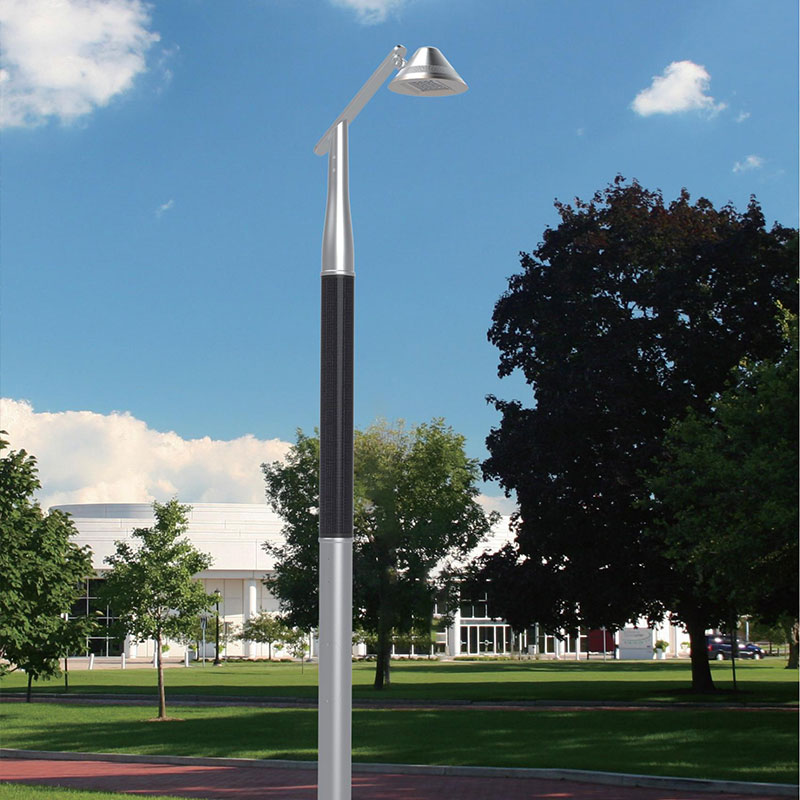
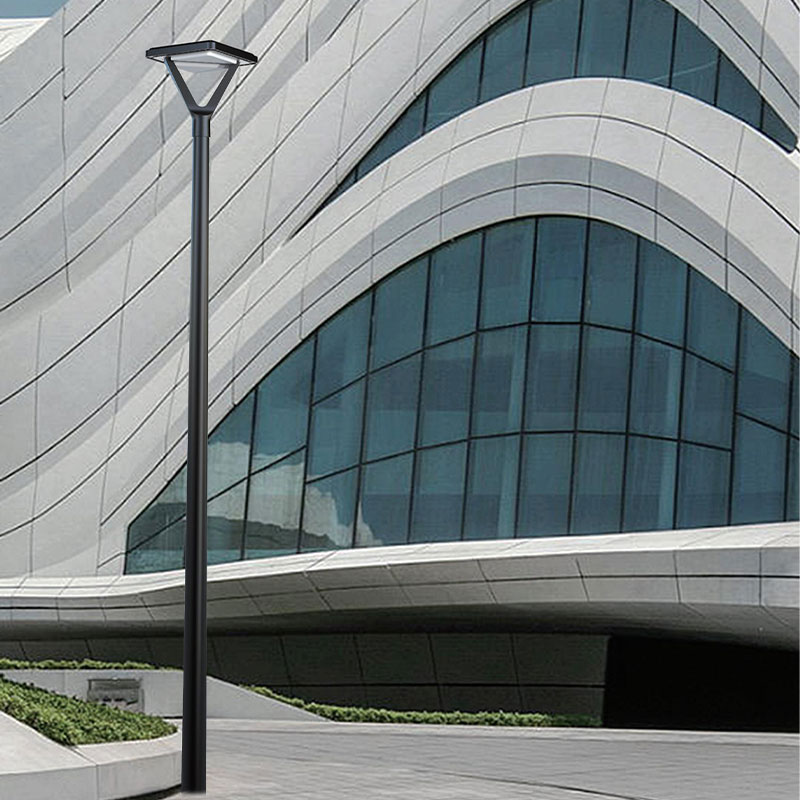
Modern solar pole designs have moved well beyond the utilitarian forms of early-generation products. Integrated solar panels can be built into the pole canopy or arm in ways that appear intentional and architectural rather than retrofitted. Pole finishes — powder-coated steel, brushed aluminum, weathering steel, or custom colors — can be matched to surrounding architecture and urban design schemes.
The absence of underground cable infrastructure also means that landscaping, paving, and planting can be completed independently of the lighting installation — there is no risk of subsequent damage to subsurface cables from irrigation system installation, landscape renovation, or paving repairs. This design independence is appreciated by landscape architects, urban designers, and facility managers who deal with the long-term coordination challenges of traditional outdoor lighting infrastructure.
How to Maximise the Advantages of Solar Light Poles
The full range of advantages described above is only realized when solar poles are specified, sited, and installed correctly. The following practices ensure maximum performance and lifecycle value from any solar pole installation.
- Conduct a thorough solar resource and shading assessment before specifying system size. Use site-specific peak sun hour data for the worst month of the year, and identify any shading sources that will reduce effective panel output. A solar pole under intermittent shade will underperform chronically, negating its cost and environmental advantages.
- Specify LiFePO4 batteries, not lead-acid or generic "lithium." LiFePO4 chemistry provides the cycle life, temperature tolerance, and safety characteristics required for long-life outdoor installation. Insist on documented cycle life specifications — 2,000 cycles minimum at 80% depth of discharge.
- Size for 3–5 days of autonomy, not just single-night operation. Systems sized for only one night without solar input will dim or shut off during any period of consecutive cloudy weather, undermining reliability and user confidence.
- Specify MPPT charge controllers, not PWM. MPPT controllers are 15–30% more efficient than PWM alternatives under real-world conditions — a meaningful performance difference that compounds over the system's operating life.
- Enable remote monitoring from day one. The maintenance cost savings from predictive, alert-driven maintenance versus routine inspection sweeps are substantial. Specifying poles with cellular or mesh network connectivity and enrolling them in a management platform should be standard practice, not an optional upgrade.
- Plan smart payload integration at the specification stage, not as an afterthought. Poles designed from the outset to accommodate cameras, sensors, or Wi-Fi access points have appropriate conduit, cable management, and power budget provisions. Retrofitting smart technology to poles not designed for it produces inferior results at higher cost.
When these practices are followed, solar light poles deliver on every one of their inherent advantages — producing outdoor lighting infrastructure that is financially superior, environmentally responsible, operationally resilient, and genuinely smarter than the grid-connected alternative in a wide range of real-world applications.