English
 Español
 Français
 عربى
عربى italiano
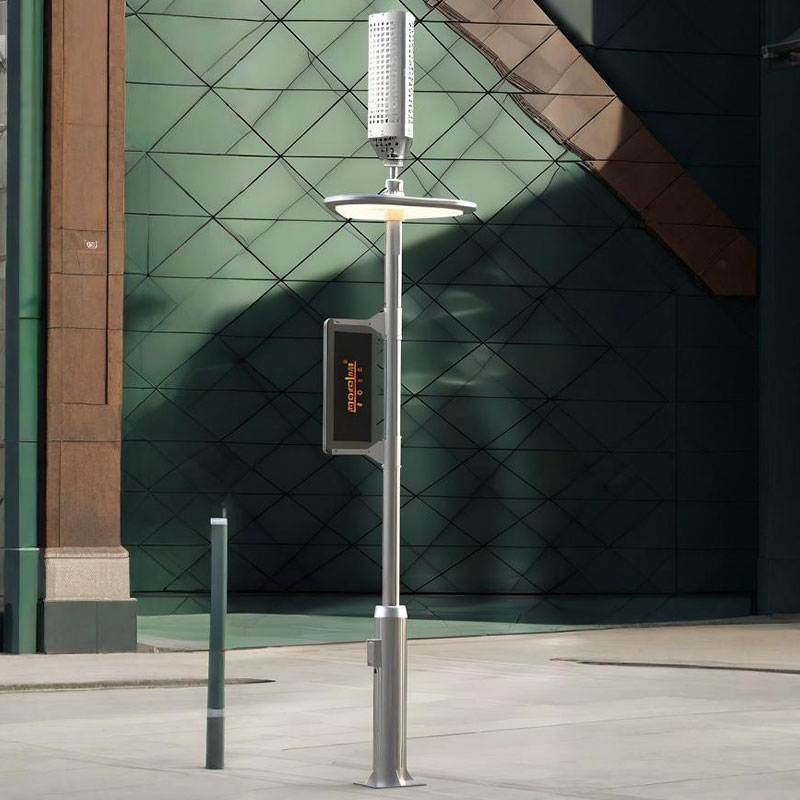
A smart street light pole delivers far more than illumination. By integrating 5G connectivity, video surveillance, environmental sensors, public broadcasting, EV charging, Wi-Fi hotspots, and emergency alert systems into one structure, a smart pole replaces what would otherwise require five to eight separate pieces of urban infrastructure — dramatically reducing installation cost, maintenance complexity, and street-level clutter. For city managers, this consolidation means one power connection, one network link, and one maintenance point per location instead of many.
Content
- 1 Advantage 1: Remote Lighting Management Cuts Energy and Labor Costs
- 2 Advantage 2: Integrated 5G and Wi-Fi Connectivity Becomes Urban Network Infrastructure
- 3 Advantage 3: 24-Hour Video Surveillance and Public Safety Coverage
- 4 Advantage 4: Environmental Monitoring Provides Real-Time Urban Data
- 5 Advantage 5: Public Communication, Emergency Alerts, and Broadcast
- 6 Advantage 6: EV Charging Integration Uses Existing Power Infrastructure
- 7 Smart Pole vs. Traditional Street Pole: A Functional Comparison
Advantage 1: Remote Lighting Management Cuts Energy and Labor Costs
Smart poles allow city operators to control every light individually from a central PC or mobile application — switching lights on, off, or dimming them in response to actual conditions rather than fixed time schedules. Key capabilities include:
- Adaptive dimming: Lights automatically reduce to 30–50% output during low-traffic hours and return to full brightness when motion is detected — reducing energy consumption by 40 to 70% compared to fixed-output street lighting.
- Timed task scheduling: Operators program lighting sequences for different days, seasons, or events without physical site visits.
- Fault detection and reporting: The system automatically identifies which specific pole has malfunctioned and reports it to the management center, enabling targeted maintenance dispatch instead of patrol-based fault finding.
Advantage 2: Integrated 5G and Wi-Fi Connectivity Becomes Urban Network Infrastructure
Smart poles serve as distributed nodes in the city's wireless network. Because street poles are positioned at regular intervals throughout urban areas and already have power connections, they are the natural mounting point for 5G small cells and Wi-Fi AP (access point) hotspot equipment. Benefits include:
- 5G micro-base station integration: Mounting 5G small cells on lamp poles provides dense urban 5G coverage without requiring separate tower installations — critical for achieving the signal density 5G's millimeter-wave frequencies require.
- Public Wi-Fi hotspots: Pedestrians, cyclists, and parked vehicles connect to internet service through pole-mounted Wi-Fi AP equipment — extending connectivity to public spaces, parks, and commercial streets at no additional infrastructure cost.
- Vehicle-to-infrastructure (V2X) communication: Smart poles equipped with communication modules support connected vehicle systems, enabling real-time traffic management and eventually autonomous vehicle navigation infrastructure.
Advantage 3: 24-Hour Video Surveillance and Public Safety Coverage
Built-in high-definition cameras on smart poles — often combining standard HD video with infrared night vision — provide continuous coverage of street-level activity. The elevated mounting position of a lamp pole (typically 6 to 12 meters) provides a wider surveillance field than ground-mounted cameras, reducing the total number of cameras required to cover a given area.
Video feeds are transmitted via the pole's network connection to a city management center for real-time monitoring, traffic flow analysis, and incident response. AI-powered analytics can detect specific events — crowd density thresholds, vehicle incidents, or suspicious behavior — and trigger automatic alerts, shifting from passive recording to active urban safety management.
Advantage 4: Environmental Monitoring Provides Real-Time Urban Data
Smart poles can house a suite of meteorological and environmental sensors that collect city-level data continuously. Common sensors include those measuring:
- Air quality: PM2.5, PM10, CO2, NO2, and ozone concentrations — critical data for managing urban pollution events and issuing public health advisories.
- Weather conditions: Temperature, humidity, wind speed and direction, rainfall intensity, UV index, and ambient light levels — enabling precise, location-specific weather data at street level rather than relying on airport or regional weather stations.
- Noise levels: Continuous noise monitoring identifies areas exceeding safe thresholds, supporting enforcement of noise ordinances and planning decisions for residential development near busy roads.
A network of smart poles distributed across a city creates a granular environmental monitoring grid with far higher spatial resolution than any standalone monitoring station network could achieve cost-effectively.
Advantage 5: Public Communication, Emergency Alerts, and Broadcast
Smart poles with integrated LED display panels and broadcast speakers transform public street infrastructure into a city-wide communication network:
- Emergency broadcasting: In disaster scenarios — extreme weather, accidents, or public safety events — city authorities can broadcast audio alerts through pole-mounted speakers across entire districts simultaneously, reaching pedestrians and outdoor spaces that indoor public address systems cannot cover.
- One-click emergency alarm: Poles equipped with emergency call buttons allow members of the public in distress to instantly connect with a management center, which dispatches assistance — providing a fixed-point emergency response option in areas without reliable mobile coverage.
- Information display: LED screens on smart poles display real-time transit information, local weather, air quality indices, public announcements, and dynamic wayfinding — improving the urban information environment at no additional installation cost over the pole itself.
Advantage 6: EV Charging Integration Uses Existing Power Infrastructure
Street lamp poles are already connected to the electrical grid — making them the most cost-effective mounting point for urban EV charging infrastructure. Smart poles with integrated charging piles leverage the existing power connection to provide:
- On-street charging availability without excavating new cable routes or constructing dedicated charging station structures.
- Mobile app reservation and online payment managed through the pole's network connection — allowing EV drivers to find, book, and pay for a charging slot remotely.
- Remote power management from the city's central platform — monitoring usage rates, managing load balancing, and detecting faults without site visits.
Smart Pole vs. Traditional Street Pole: A Functional Comparison
| Function | Traditional Pole | Smart Pole |
|---|---|---|
| Street lighting | Fixed schedule only | Remote + adaptive dimming |
| Connectivity | None | 5G + Wi-Fi hotspot |
| Surveillance | None (requires separate camera poles) | Built-in HD + IR cameras |
| Environmental monitoring | None | Air quality, weather, noise sensors |
| Public communication | None | LED display + broadcast speakers |
| EV charging | None | Integrated charging pile option |
| Emergency services | None | One-click alarm + remote intercom |