English
 Español
 Français
 عربى
عربى italiano
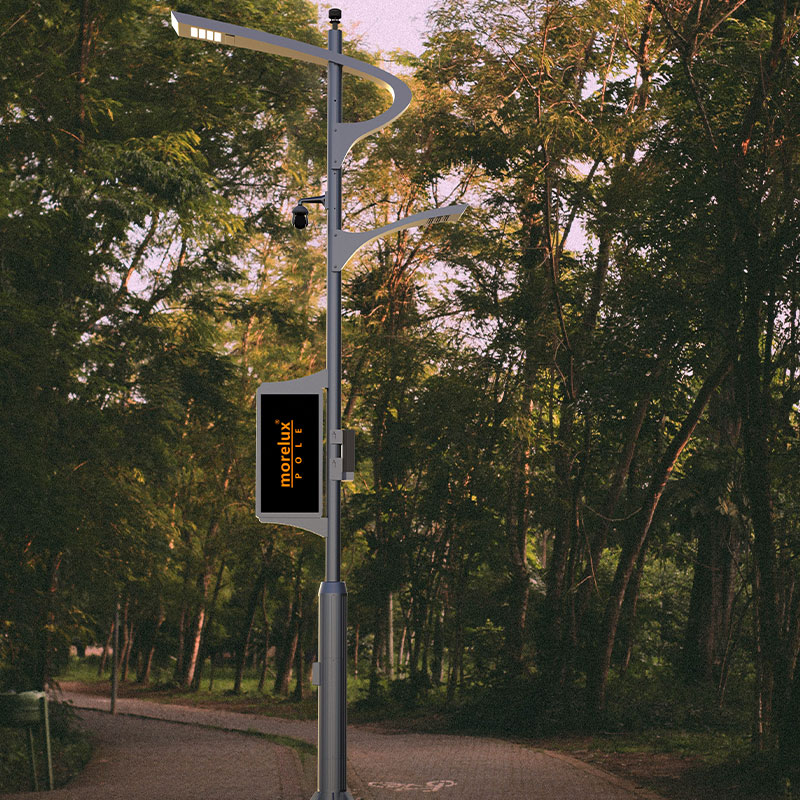
A Smart Light Pole is a multifunctional urban infrastructure unit that goes far beyond simply providing street illumination. Its primary uses include adaptive LED street lighting, 5G and wireless network hosting, environmental monitoring, traffic and pedestrian management, EV charging, public safety surveillance, and real-time city data collection. By consolidating multiple urban services into a single pole structure connected to a central management platform, smart light poles reduce infrastructure duplication, lower operational costs, and form the physical backbone of modern smart city deployments.
Municipalities, commercial districts, industrial parks, airports, universities, and highway authorities across the world are adopting smart light poles as the foundational unit of intelligent urban infrastructure. According to a report by MarketsandMarkets (2023), the global smart street lighting market was valued at USD 5.7 billion in 2022 and is projected to reach USD 14.0 billion by 2027, at a compound annual growth rate of 19.7 percent, driven primarily by the accelerating deployment of smart pole systems in urban renewal and new city development projects.
Content
- 1 Adaptive Street Lighting: The Core Function Reimagined
- 2 5G and Wireless Communication Infrastructure
- 3 Environmental Monitoring and Air Quality Sensing
- 4 Traffic Management and Intelligent Transportation Support
- 5 Electric Vehicle Charging Integration
- 6 Public Safety: Surveillance, Emergency Communication, and SOS Systems
- 7 Smart Pole Applications by Deployment Environment
- 8 Information Display and Public Communication
- 9 Infrastructure Cost Efficiency: The Case for Consolidation
- 10 Smart Pole Integration with City Management Platforms
- 11 Real-World Smart Pole Deployments: Documented Examples
- 12 Selecting a Smart Light Pole: Key Technical Considerations
- 13 Summary: Why Smart Light Poles Are the Foundation of Smart City Infrastructure
Adaptive Street Lighting: The Core Function Reimagined
The most fundamental use of a smart light pole is delivering street illumination, but the way it does so is fundamentally different from a conventional fixed-output streetlight. Smart poles use dimming control, motion detection, and ambient light sensing to adjust output dynamically in real time, delivering light exactly where and when it is needed rather than burning at full power throughout the night regardless of conditions.
Dimming and Scheduling for Energy Savings
Traditional streetlights operate at 100 percent output from dusk to dawn irrespective of traffic volume or pedestrian presence. Smart pole lighting systems typically implement a dimming profile that reduces output to 30 to 50 percent during low-traffic hours (typically midnight to 5 AM) and restores full brightness on demand when motion is detected or based on a time schedule. The U.S. Department of Energy (DOE) documented in its 2022 Solid-State Lighting Report that cities implementing adaptive smart lighting controls achieved energy savings of 50 to 75 percent compared to conventional high-pressure sodium street lighting, even after accounting for the additional power consumed by integrated smart devices on the poles.
Motion-Responsive Lighting for Pedestrian Safety
Smart poles equipped with PIR or radar motion sensors can detect approaching pedestrians or cyclists and pre-illuminate the path ahead by boosting brightness across a sequence of poles in the direction of travel. This "light on demand" approach, piloted in several European cities including Copenhagen and Amsterdam, was shown to reduce nighttime pedestrian accidents while simultaneously cutting energy use compared to constant full-brightness operation (source: European Commission, Sustainable Urban Mobility Plan Implementation Report, 2021).
Fault Detection and Remote Maintenance
Each smart pole's lighting module continuously reports its operational status, power consumption, and any fault conditions to a central management platform. Maintenance teams receive automatic alerts when a lamp fails, a driver malfunctions, or power consumption deviates from expected values. Cities using this approach reduced their street lighting maintenance response time by an average of 60 percent compared to manual inspection regimes (source: Philips Lighting / Signify Smart City Infrastructure Report, 2019). Preventive maintenance scheduling based on actual usage data further extends lamp and driver service life.
5G and Wireless Communication Infrastructure
One of the most strategically significant uses of smart light poles in current urban planning is as mounting structures for 5G small cell antennas, Wi-Fi access points, and LoRaWAN IoT gateways. The densification of mobile networks required by 5G technology demands antenna installations every 100 to 300 meters in urban environments, and existing light pole infrastructure provides a ready-made, grid-powered mounting solution that avoids the need for entirely new urban structures.
5G Small Cell Hosting
5G millimeter-wave frequencies (24 GHz to 100 GHz) have limited propagation range and cannot penetrate buildings effectively, requiring dense small cell deployments at street level. Smart light poles with integrated equipment cabinets, fiber optic connectivity, and weatherproof antenna mounting points are the preferred host structure for urban 5G rollouts by network operators globally. A single smart pole equipped as a 5G node can serve an area of approximately 100 to 200 meters radius with gigabit-class mobile connectivity (source: GSMA Intelligence, 5G Network Architecture Report, 2022).
Public Wi-Fi Access Points
Smart poles in pedestrian areas, parks, commercial districts, and transit hubs frequently host public Wi-Fi access points that provide free or low-cost internet connectivity to residents and visitors. Barcelona's smart city program, one of the most extensively documented deployments globally, installed over 500 smart poles with integrated Wi-Fi that collectively served more than 1 million unique users per month at peak deployment (source: Barcelona City Council Smart City Programme Annual Report, 2020).
IoT Gateway and LoRaWAN Network Node
Beyond cellular and Wi-Fi, smart poles serve as mounting points and power sources for low-power wide-area network (LPWAN) gateways that support IoT sensor networks across the city. A single LoRaWAN gateway mounted on a smart pole can receive data from IoT sensors within a radius of 2 to 5 kilometers in urban environments, covering hundreds of parking sensors, waste bin fill-level sensors, soil moisture monitors, and utility meters simultaneously (source: LoRa Alliance, LoRaWAN Network Coverage Planning Guide, 2021).
Environmental Monitoring and Air Quality Sensing
Smart light poles positioned throughout an urban area form an ideal distributed sensor network for continuous real-time environmental monitoring. Because the poles are already grid-powered and connected, adding environmental sensor modules requires no separate power infrastructure or data transmission equipment.
Air Quality and Pollution Monitoring
Integrated air quality sensors on smart poles measure concentrations of pollutants including PM2.5, PM10, NO2, CO, O3, and SO2 at street level where human exposure is greatest. This granular spatial data enables city authorities to identify pollution hotspots, correlate air quality with traffic patterns, and trigger variable speed limit or traffic diversion measures in real time. London's Ultra Low Emission Zone (ULEZ) enforcement system relies in part on distributed air quality monitoring nodes, many of them pole-mounted, to verify compliance and measure zone effectiveness (source: Transport for London, ULEZ Impact Assessment Report, 2022).
Temperature, Humidity, and Microclimate Mapping
Dense smart pole deployments create a microclimate monitoring grid that can map the urban heat island effect at block-by-block resolution. Singapore's Smart Nation programme uses pole-mounted weather sensor arrays across the city-state to produce real-time urban heat maps updated every 5 minutes, informing cooling demand forecasting and urban planning decisions (source: Government Technology Agency of Singapore, Smart Nation Sensor Platform Technical Brief, 2021).
Noise Level Monitoring
Sound level meters integrated into smart poles provide continuous noise mapping that supports enforcement of urban noise ordinances, identifies construction or traffic noise exceedances, and feeds acoustic data into urban planning models. Cities including Paris and Antwerp have deployed pole-mounted noise sensors as part of comprehensive environmental quality monitoring networks (source: European Environment Agency, Noise in Europe Report, 2020).
Traffic Management and Intelligent Transportation Support
Smart light poles are increasingly integral to intelligent transportation systems (ITS), providing both the sensor infrastructure to observe traffic conditions and the communication infrastructure to transmit data to traffic management centers and connected vehicles.
Traffic Flow Counting and Speed Monitoring
Radar sensors or video analytics cameras mounted on smart poles continuously count vehicle volumes, classify vehicle types, and measure speeds across road segments. This data feeds adaptive traffic signal control systems that adjust signal timings in real time to reduce congestion. The UK Department for Transport found that adaptive traffic signal systems fed by real-time sensor data reduced average journey times by 8 to 12 percent and intersection delays by up to 20 percent compared to fixed-time signal plans (source: UK Department for Transport, Traffic Signal Research Report, 2019).
Vehicle-to-Infrastructure (V2I) Communication
Smart poles equipped with DSRC (Dedicated Short Range Communications) or C-V2X modules can communicate directly with equipped vehicles, broadcasting signal phase and timing (SPAT) data, road hazard warnings, and speed limit information. As autonomous vehicle technology advances, this pole-to-vehicle communication layer becomes a critical safety infrastructure, providing vehicles with information beyond the range of their onboard sensors.
Pedestrian Crossing Safety Systems
Smart poles at signalized crossings can integrate pedestrian detection sensors that automatically extend crossing times when pedestrians are still crossing at signal change, reducing pedestrian accident risk. Cities including Helsinki and Eindhoven have deployed such systems, with reported reductions in pedestrian near-miss incidents of over 30 percent at equipped crossings (source: European Transport Safety Council, Urban Pedestrian Safety Report, 2021).
Parking Guidance and Management
In commercial and mixed-use districts, smart poles hosting ultrasonic or camera-based parking sensors can detect occupancy in nearby parking spaces and feed real-time availability data to parking guidance apps and variable message signs. This reduces the proportion of urban traffic generated by drivers searching for parking, which studies estimate accounts for 30 percent of city center traffic volume in dense commercial areas (source: INRIX Global Traffic Scorecard, 2019).
Electric Vehicle Charging Integration
As EV adoption accelerates globally, the integration of EV charging capability into smart light poles addresses one of the key barriers to EV ownership in dense urban areas: the lack of dedicated home charging infrastructure for residents without private parking.
Curbside EV Charging Points
Smart poles with integrated EV charging modules provide AC charging points (typically 3.7kW to 22kW per outlet) directly at the curbside, utilizing the existing grid connection and civil infrastructure of the pole. The cost of adding an EV charging capability to a smart pole during initial installation is significantly lower than installing standalone dedicated EV charging equipment, since the grid connection, civil works, and communications infrastructure are already in place. The UK government's EV Infrastructure Strategy (2022) specifically identified lamp column and smart pole charging as a key deployment pathway for achieving the target of 300,000 public charging points by 2030 (source: UK Office for Zero Emission Vehicles, EV Infrastructure Strategy, 2022).
Dynamic Load Management
When multiple EV charging points are connected through a smart pole network, the central management system can implement dynamic load balancing that allocates available grid capacity across active charging sessions, preventing local grid overloads while maximizing the number of vehicles that can charge simultaneously during peak periods.
Public Safety: Surveillance, Emergency Communication, and SOS Systems
Smart light poles serve as the physical platform for multiple public safety systems that previously required separate, independently installed infrastructure at significantly higher total cost.
CCTV and Video Surveillance
High-definition cameras mounted on smart poles provide urban surveillance coverage for crime deterrence, incident detection, and post-event investigation. Video analytics software running at the edge or in the cloud can detect specific events such as abandoned objects, crowd density thresholds, vehicle violations, or perimeter intrusions and trigger automated alerts to control centers without requiring continuous human monitoring. Cities that deployed wide-area video surveillance networks using smart pole camera mounts reported reductions in street crime of 13 to 22 percent in monitored zones compared to unmonitored control areas (source: University of Cambridge, Evidence Review of CCTV and Crime Reduction, 2017).
Emergency Call Points and SOS Panels
Smart poles in parks, car parks, university campuses, and isolated pedestrian areas frequently integrate two-way intercom panels or emergency call buttons that connect directly to a security control center or emergency services dispatch. These systems provide a visible and accessible safety resource for members of the public in distress, particularly in locations that lack bystander presence during nighttime hours.
Public Address and Emergency Broadcast
Speaker systems integrated into smart poles allow city authorities to broadcast emergency messages, evacuation instructions, or public information across defined geographic zones. During flood events, industrial accidents, or other civil emergencies, the ability to address specific street-level areas with targeted audio messages is a significant capability that conventional infrastructure cannot provide.
Smart Pole Applications by Deployment Environment
The combination of functions integrated into a smart pole varies significantly depending on the deployment environment. The following table summarizes typical use case combinations by location type:
| Deployment Environment | Primary Uses | Key Sensor / Device Modules |
| Urban arterial roads | Adaptive lighting, traffic management, 5G hosting | Radar sensor, 5G small cell, dimming controller, CCTV |
| City center pedestrian zones | Wi-Fi, environmental monitoring, public safety, EV charging | Wi-Fi AP, air quality sensor, SOS panel, EV outlet |
| Residential streets | Adaptive lighting, noise monitoring, parking management | Motion sensor, noise meter, parking sensor, dimming |
| Highways and expressways | Traffic speed and flow monitoring, V2I communication, incident detection | Radar, DSRC/C-V2X module, variable message sign interface |
| University and corporate campuses | Safety surveillance, access control, environmental comfort monitoring | CCTV, intercom, temperature and humidity sensor |
| Industrial parks and logistics zones | Perimeter security, vehicle tracking, asset monitoring | ANPR camera, LoRaWAN gateway, radar intrusion detection |
| Parks and green spaces | Low-level ambient lighting, microclimate monitoring, public Wi-Fi | Motion sensor, weather station, Wi-Fi AP, SOS panel |
Information Display and Public Communication
Smart light poles in high-footfall locations such as transit hubs, commercial streets, and public squares frequently incorporate digital display screens that serve both information and commercial functions, creating an additional revenue stream that helps offset deployment and operating costs.
Digital Signage and Wayfinding
High-brightness LED display panels integrated into smart pole structures provide dynamic wayfinding information, transit arrival times, local event listings, and emergency notifications. Unlike static signage, digital displays can be updated remotely and in real time, making them significantly more operationally flexible. Smart pole display networks in commercial districts have been shown to increase foot traffic to advertised venues by an average of 17 percent compared to static poster equivalents (source: Ocean Outdoor / JCDecaux Digital Out-of-Home Effectiveness Study, 2020).
Real-Time Transit Information
Smart poles located at or near bus stops and tram stops can display real-time vehicle arrival predictions, service disruption alerts, and journey planning information sourced directly from the transit operator's data feed. This reduces passenger waiting time uncertainty, which research consistently identifies as a major determinant of public transit satisfaction (source: Transit Cooperative Research Program, TCRP Report 165, 2014).
Infrastructure Cost Efficiency: The Case for Consolidation
A key argument for smart pole deployment is the significant reduction in total urban infrastructure cost achieved by consolidating multiple systems onto a single structure rather than installing separate poles, cabinets, conduits, and grid connections for each urban service.
Comparative Cost Analysis
| Infrastructure Item | Standalone Installation Cost (per unit, estimated) | When Integrated into Smart Pole |
| Street light | USD 2,000 to 5,000 | Included in pole base cost |
| 5G small cell node (structure only) | USD 10,000 to 25,000 | USD 1,500 to 3,000 additional module |
| CCTV camera and mounting | USD 3,000 to 8,000 | USD 800 to 2,000 additional module |
| Air quality monitoring station | USD 15,000 to 50,000 | USD 500 to 2,000 sensor module |
| Public Wi-Fi access point | USD 5,000 to 12,000 | USD 300 to 800 additional module |
| EV charging point (curbside) | USD 8,000 to 20,000 | USD 2,000 to 6,000 integrated outlet |
Source: Estimates derived from GSMA Infrastructure Sharing Report (2021), IHS Markit Smart City Infrastructure Analysis (2022), and U.S. DOE EV Charging Infrastructure Cost Study (2021).
The cost savings from consolidation are substantial. A city block that would require six separate standalone installations for lighting, 5G, CCTV, Wi-Fi, air quality monitoring, and EV charging at a combined cost of over USD 100,000 can potentially be served by two to three smart poles at a combined total cost of USD 30,000 to 50,000, representing a saving of 50 to 70 percent before operational cost reductions are considered.
Smart Pole Integration with City Management Platforms
The full value of a smart light pole deployment is realized only when the poles are connected to a unified city operations platform that aggregates data, enables remote management, and provides actionable intelligence across all integrated systems.
Centralized Lighting Management System (CLMS)
Each smart pole communicates with the central platform via wired (fiber or Ethernet) or wireless (4G/5G, NB-IoT, or Zigbee mesh) connectivity. The CLMS provides real-time visibility into the energy consumption, operational status, dimming level, and fault condition of every pole in the network. City managers can adjust lighting schedules, update dimming profiles, or respond to faults from a single dashboard interface without dispatching field personnel.
Data Analytics and Predictive Maintenance
Aggregated data from smart pole sensor arrays feeds analytics engines that identify patterns invisible to manual inspection. Predictive maintenance algorithms can identify poles whose power consumption trends indicate impending driver or lamp failure weeks before the unit actually fails, allowing pre-emptive maintenance scheduling that avoids service interruptions. Predictive approaches reduce unplanned maintenance events by 40 to 60 percent compared to reactive maintenance models (source: McKinsey Global Institute, Smart City Solutions Analysis, 2018).
Open Data and Third-Party Integration
Cities that publish anonymized smart pole sensor data through open APIs enable a secondary ecosystem of applications and services built by third parties. Navigation apps can incorporate real-time road condition and traffic data. Urban researchers can access microclimate datasets. Businesses can use footfall data for location planning. This open data value creation is increasingly recognized as a significant public benefit of smart pole infrastructure beyond its direct operational advantages.
Real-World Smart Pole Deployments: Documented Examples
The following deployments illustrate how smart light pole uses translate into measurable outcomes in practice:
- Los Angeles, USA: The city replaced over 209,000 streetlights with LED smart lighting systems between 2009 and 2018, achieving annual energy savings of USD 9 million and reducing street lighting energy consumption by 63 percent (source: City of Los Angeles Bureau of Street Lighting Annual Report, 2019).
- Barcelona, Spain: The Superblock program integrated smart poles with environmental sensors, adaptive lighting, and public Wi-Fi across multiple neighborhoods, reducing local traffic by 21 percent and increasing pedestrian space by 60 percent in pilot areas (source: Barcelona Urban Ecology Agency, Superblock Evaluation Report, 2021).
- Dubai, UAE: Smart pole deployments across major boulevards integrate 5G nodes, CCTV, air quality sensors, and digital signage as part of the Dubai Smart City initiative, contributing to the city's ranking as the second smartest city globally in the IMD Smart City Index 2022 (source: IMD World Competitiveness Center, Smart City Index 2022).
- Singapore: The Smart Nation Sensor Platform uses lamp post-mounted sensors for real-time urban monitoring across the entire island, with over 110,000 smart lamp posts planned as part of the national infrastructure upgrade (source: Government Technology Agency of Singapore, Smart Nation Sensor Platform Overview, 2022).
- Amsterdam, Netherlands: The city's smart pole network includes noise and air quality monitoring that feeds directly into the municipal environmental quality dashboard, informing policy decisions and public health communications (source: Amsterdam Smart City Programme Report, 2021).
Selecting a Smart Light Pole: Key Technical Considerations
For municipalities, developers, and infrastructure planners evaluating smart pole procurement, the following specifications and design features most significantly affect long-term performance and total cost of ownership:
- Structural load capacity: The pole must be engineered to support the combined weight and wind loading of all intended mounted devices. Each additional module (antenna, camera, display) adds both static weight and wind resistance that must be accounted for in the structural calculation per local wind load standards (such as EN 40 in Europe or AASHTO LTS in the USA).
- Internal cable management and equipment cabinet: A well-designed smart pole incorporates sealed internal conduit runs and a weatherproof equipment cabinet with sufficient space and DIN rail capacity for current and future electronics. Inadequate internal space is a common limitation in first-generation smart pole designs that forces external equipment mounting.
- Power supply capacity: The pole's electrical supply must accommodate the combined load of all integrated devices at peak consumption. A pole hosting 5G equipment, CCTV cameras, EV charging, and environmental sensors alongside the street light can require 5 to 15kW of supply capacity, far beyond the 150W to 400W typical of a conventional streetlight connection.
- Connectivity options: The pole should support multiple backhaul connectivity options including fiber, 4G/5G, and mesh radio to ensure network resilience and future-proof the installation against technology changes.
- Corrosion and environmental protection: Poles in coastal, industrial, or high-humidity environments require hot-dip galvanizing and powder coating with corrosion protection ratings of C4 or C5 per ISO 12944, ensuring structural integrity across a 25 to 50-year design service life.
- Aesthetic integration: Particularly in heritage districts, commercial streets, and tourist areas, the visual appearance of the smart pole must be carefully designed to complement the urban environment. Modular designs that conceal technology within the pole body or in discrete side-mounted enclosures achieve the best balance of functional capacity and aesthetic quality.
The Smart Light Pole range available at moreluxpole.com is engineered to address all of these considerations, offering structurally rated pole bodies with generous internal equipment space, multiple mounting point configurations for functional modules, corrosion protection suitable for coastal and harsh environments, and design aesthetics aligned with European and Middle Eastern urban contexts.
Summary: Why Smart Light Poles Are the Foundation of Smart City Infrastructure
The uses of a smart light pole extend across virtually every dimension of urban management: energy efficiency, communications, safety, environmental quality, mobility, and public services. No other single piece of urban infrastructure offers comparable functional density relative to its footprint and cost. The pole that once served only to hold a lamp above a street now functions simultaneously as a communications tower, environmental monitoring station, traffic sensor node, public safety asset, EV charging point, and city data platform terminal.
For city planners, infrastructure developers, and procurement authorities, the strategic question is no longer whether to adopt smart pole technology, but how to design and sequence the deployment to maximize long-term value. The key decisions involve selecting poles with sufficient structural, electrical, and spatial capacity to accommodate future technology additions, choosing open-standard communications and software platforms that avoid vendor lock-in, and prioritizing locations where the density of use cases generates the most measurable return on infrastructure investment.
Explore the full Smart Light Pole range at moreluxpole.com for detailed specifications on pole dimensions, structural ratings, equipment cabinet configurations, and available functional modules for your smart city or infrastructure project.