English
 Español
 Français
 عربى
عربى italiano
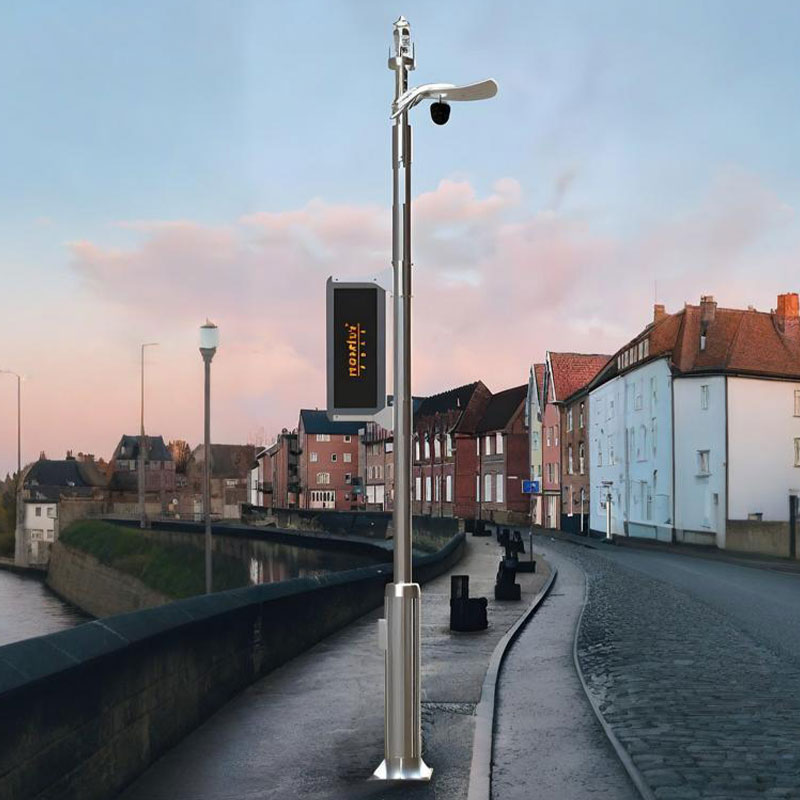
Smart light poles work by integrating a multi-layer platform architecture — device perception, network communication, data aggregation, and system application — onto a single pole structure that uses the street light's existing power supply and network infrastructure as its operational backbone. Beyond illumination, a smart pole acts as a distributed urban data node: it collects environmental and traffic data through onboard sensors, transmits that data over 5G, Wi-Fi, or fiber connections to a cloud management platform, and executes control commands received from that platform in real time. A single smart pole can simultaneously manage LED street lighting, stream HD surveillance video, broadcast public announcements, monitor air quality and weather, provide Wi-Fi hotspot coverage, host 5G antenna equipment, and supply electric vehicle charging — all managed remotely from a PC or mobile device. This convergence of functions onto existing pole infrastructure is what distinguishes smart poles from both traditional street lights and standalone smart city installations.
Content
- 1 The Four-Layer Architecture That Makes Smart Poles Work
- 2 Smart Street Light Control: Remote Management in Practice
- 3 Integrated Functions Hosted on a Single Smart Pole
- 4 Environmental Monitoring: Distributed Sensing Across the City
- 5 Vehicle-Road Collaboration and Traffic Intelligence
- 6 Public Safety Features: Emergency Response and Surveillance
The Four-Layer Architecture That Makes Smart Poles Work
Understanding how smart poles function requires understanding the four-layer platform architecture that structures the flow of data and control commands between the physical pole and the city management system.
Layer 1: Device Perception Layer
This is the physical layer — the sensors, cameras, and hardware modules mounted on or integrated into the pole structure that perceive and measure the real world. The perception layer collects raw data continuously. Typical devices at this layer include:
- HD surveillance cameras (fixed and PTZ) for traffic monitoring, pedestrian detection, and incident recording
- Meteorological sensors measuring air temperature, humidity, wind speed, wind direction, rainfall, UV intensity, noise levels, and ambient light intensity
- Air quality sensors for PM2.5, PM10, CO, NO₂, and O₃ concentration monitoring
- LED luminaire drivers with current and voltage feedback reporting actual light output and power consumption per fixture
- One-click emergency alarm terminals that allow members of the public to directly contact the management center
- EV charging pile management units that report charging session status, energy consumption, and payment transactions
Layer 2: Network Communication Layer
The communication layer connects the pole's devices to the data platform. Smart poles leverage the existing power cabling routes of the street lighting network for their connectivity backbone, avoiding the need to lay separate communication infrastructure. Communication technologies used at this layer include:
- 5G/4G cellular — for high-bandwidth uplinks of HD video and real-time sensor data, and for hosting micro-base-station or small-cell antenna equipment on the pole to extend cellular coverage in urban areas
- Wi-Fi 6 / Wi-Fi AP hotspot — for public wireless internet access coverage in the pole's immediate vicinity, typically a radius of 50–100 meters per pole
- Power line communication (PLC) — data transmitted over the existing power cables to concentrator nodes without requiring separate data cabling
- Optical fiber — for high-bandwidth backbone connections at major intersections or high-density monitoring locations
Layer 3: Data Aggregation Layer
Data from thousands of individual smart poles is collected, aggregated, and processed at this layer — typically a cloud or edge computing platform operated by the city management authority. The aggregation layer normalizes data from different device types, applies preprocessing algorithms (video analytics, anomaly detection, trend analysis), and stores structured data for reporting and historical analysis. Edge computing nodes placed at district or sub-district level perform time-sensitive processing — such as traffic incident detection from camera feeds — locally to reduce latency, while less time-critical analytics are processed in central cloud infrastructure.
Layer 4: System Application Layer
The application layer is the interface through which city managers, operators, and the public interact with the smart pole network. Applications at this layer include the street light management platform (remote control, dimming schedules, fault alerts), video surveillance management, environmental monitoring dashboards, public information display content management systems, and emergency response coordination platforms. These applications are typically accessible through web-based PC interfaces and dedicated mobile apps, allowing authorized operators to manage the entire pole network from anywhere with internet access.
Smart Street Light Control: Remote Management in Practice
The most operationally mature function of smart light poles is the remote management of the LED street lights themselves — a function that delivers immediate, quantifiable benefits in energy savings and maintenance cost reduction.
- Individual fixture monitoring — every luminaire reports its operating status, actual power consumption, lamp hours, and any fault condition (driver failure, LED degradation, communication loss) to the management platform in real time. Failed lamps are automatically detected and precisely located, reducing the response time to dark-spot failures from days (patrol-dependent detection) to minutes (automated alert).
- Adaptive dimming via timed schedules — operators set dimming profiles through the PC or mobile interface: full brightness during peak evening hours, stepped reduction to 30–50% output during late-night low-traffic periods, and programmed pre-dawn increase before morning rush. These schedules typically reduce street lighting energy consumption by an additional 20–30% beyond the base LED efficiency gain over HPS.
- Event-triggered override — emergency vehicles, crowd events, or adverse weather trigger automatic brightness override through integration with traffic management and emergency services platforms, ensuring full illumination when safety conditions require it regardless of the scheduled dimming profile.
Integrated Functions Hosted on a Single Smart Pole
The convergence of multiple urban services onto a single pole structure is the key economic and operational rationale for smart poles — it avoids the cost and visual impact of installing separate dedicated infrastructure for each service.
| Integrated Function | Hardware on Pole | City Management Benefit |
|---|---|---|
| LED street lighting | Smart LED luminaire with networked driver | Remote dimming; fault detection; 40–70% energy saving |
| 5G small cell / Wi-Fi AP | Micro base station antenna; Wi-Fi 6 access point | Urban 5G densification; public Wi-Fi coverage |
| Video surveillance | HD/IR camera (fixed or PTZ) | 24/7 road and pedestrian monitoring; incident recording |
| Environmental monitoring | Multi-parameter meteorological and air quality sensor array | Distributed city-wide environmental data collection |
| Public information display | LED display screen on pole body | Real-time weather, traffic, emergency, and civic information |
| Public broadcast and intercom | Weatherproof speaker and microphone module | Emergency announcements; two-way remote communication |
| EV charging | AC or DC charging pile integrated into pole base | EV infrastructure using existing power supply; online payment |
| One-click emergency alarm | Emergency call terminal with indicator light | Immediate public distress reporting; faster emergency response |
Environmental Monitoring: Distributed Sensing Across the City
One of the most valuable data collection functions of smart poles is their role as a dense network of distributed environmental sensors. Because poles are installed at regular intervals across the entire urban road network — typically every 25–50 meters on urban streets — a city-wide smart pole deployment creates an environmental monitoring grid of unprecedented spatial resolution.
Built-in meteorological sensor arrays on each pole continuously measure air temperature, relative humidity, wind speed and direction, rainfall intensity, UV radiation index, ambient light levels, and noise decibel levels. Air quality sensor modules add real-time measurement of particulate matter (PM2.5 and PM10), carbon monoxide (CO), nitrogen dioxide (NO₂), and ozone (O₃). This data is streamed continuously to the city's environmental management platform, enabling:
- Real-time air quality maps overlaid on city GIS platforms, identifying pollution hotspots at block-by-block resolution
- Automated alerts to traffic management when air quality or noise levels exceed regulatory thresholds in specific zones
- Hyperlocal weather data for urban heat island analysis, flood risk management, and climate adaptation planning
- Public display of real-time environmental data on the pole's information screen, enabling residents to make informed decisions about outdoor activity
Vehicle-Road Collaboration and Traffic Intelligence
Smart poles equipped with roadside communication units (RSUs) participate in vehicle-road collaboration (V2X — vehicle to everything) systems that are foundational to autonomous vehicle deployment and intelligent traffic management. The pole acts as a fixed infrastructure node in the V2X network, performing functions that on-vehicle sensors alone cannot accomplish:
- Non-line-of-sight hazard detection — a smart pole camera at an intersection can detect a pedestrian approaching from behind a parked truck and broadcast a warning to approaching autonomous or connected vehicles before the vehicles' own sensors can detect the hazard — effectively extending the vehicle's sensing range beyond physical line-of-sight limits.
- Real-time traffic signal phase broadcast — poles can broadcast current traffic signal status (phase, time remaining, upcoming change) directly to connected vehicles, enabling smoother approach speeds that reduce fuel consumption and stop-start congestion.
- High-precision positioning augmentation — RSU-equipped smart poles provide differential GNSS correction signals that improve vehicle positioning accuracy from the 1–5 meter range of standard GPS to 10–20 centimeter accuracy required for autonomous lane-keeping in urban environments.
Public Safety Features: Emergency Response and Surveillance
Smart poles significantly enhance public safety capabilities compared to both traditional street lights and conventional standalone security cameras, primarily because they combine detection, communication, and response in a single continuously powered infrastructure node.
- One-click emergency alarm — a clearly marked emergency terminal on the pole allows any person in distress to immediately connect to the city's management center with a single button press. The system automatically transmits the pole's GPS location to the operator and can activate the pole camera to stream live video of the reported incident site, enabling dispatchers to assess the situation and direct emergency response before first responders arrive.
- Infrared night vision surveillance — built-in infrared cameras maintain full surveillance capability in complete darkness, extending the effective security coverage of each pole to 24 hours per day without requiring additional lighting beyond the street light itself.
- AI-powered video analytics — edge computing units installed at or near the pole run real-time video analysis algorithms that detect specific events — crowd formation, abandoned objects, illegal parking, perimeter breaches, or traffic accidents — and generate instant alerts to the management center without requiring operators to watch every camera feed continuously.
- Remote intercom and broadcast — the pole's built-in speaker and microphone allow operators at the management center to address specific locations by voice in real time — directing traffic at an incident scene, issuing warnings to individuals engaging in prohibited activity, or broadcasting emergency evacuation instructions across a zone of poles simultaneously.